



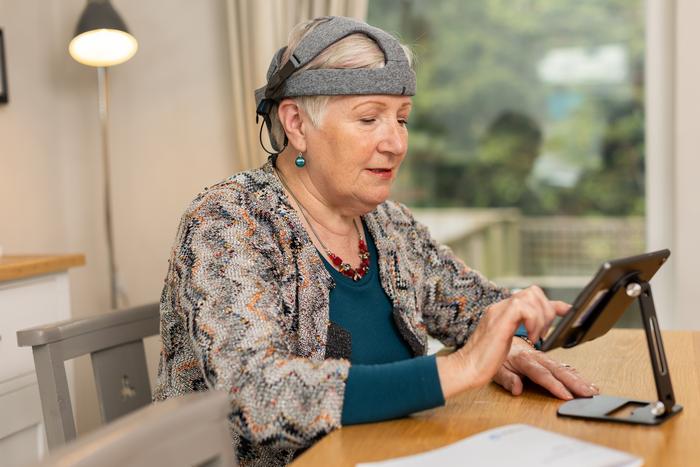
A simple but revolutionary test to improve early detection for dementia could soon be helping patients and their families after the project secured funding to enable its further progress.
The Fastball EEG dementia assessment is a non-invasive test which measures patients’ brain waves whilst they watch a series of flashing images displayed on a screen.
Developed in-house at the University of Bath and University of Bristol, the technology requires users to wear an electroencephalogram (EEG) headset, which is linked to a computer for analysis.
Now, the project has secured £1.5million funding from the National Institute for Health and Care Research (NIHR)’s Invention for Innovation (i4i) fund, which will enable researchers Dr George Stothart and Dr Liz Coulthard to scale-up testing and development.
Through the new five-year NIHR project, the team will test Fastball on more than 1,000 patients in a working dementia clinic at Southmead Hospital in Bristol.
This represents the biggest study of any kind to use EEG to screen for Alzheimer’s disease with a goal to enrol a diverse patient population.

Previous research from Dr Stothart, Dr Coulthard and colleagues has shown Fastball to be highly effective at picking up small, subtle changes in brain waves which occur when a person remembers an image.
They have demonstrated that this response changes as a person develops dementia, offering hope as a breakthrough for early diagnosis.
Dementia is typically diagnosed too late, at a point at which the disease has damaged the brain beyond repair. This can be up to 20 years after dementia first started to develop.
Current diagnosis often relies on a series of subjective questions to test a person’s memory, which is limited and can be impacted by a person’s education, language skills or nervousness.
Fastball, by contrast, is completely passive, where the person doing the test does not need to understand the task or be aware of their memory response. Crucially, it is also portable, meaning that diagnoses in the future could be carried out anywhere, including in a patient’s home.
By testing more people earlier and more regularly, the team believes it could help lower the age of diagnosis by up to five years in the short-term and by more in the future.
Recent findings from Alzheimer’s Research UK suggested that many people would want to know if they will develop Alzheimer’s in the future, even if they don’t yet have symptoms.
The team will also work with Belfast-based commercial partners Cumulus Neuroscience Ltd to develop the technology into a product that can be rolled out wider across the NHS and beyond. It will use the existing Cumulus dry electrode 16-lead EEG headset that is UKCA marked and has FDA 510-K clearance.
“Nearly all of us will know someone, or be caring for someone, with dementia. The costs to families, and to the NHS is enormous and is set to rise as our population ages,” said Dr Stothart, project co-lead and a cognitive neuroscientist at the University of Bath.
“Yet, dementia is currently diagnosed too late – typically up to 20 years after the disease has first begun.
“Quicker, more accurate ways to diagnose dementia are greatly needed so that patients can get treatments earlier and families can plan better for the future, which is why we are so excited for the potential of Fastball EEG and the development of our work through this significant new funding and the collaborations it will enable.”
Dr Coulthard, associate professor in dementia neurology at the University of Bristol and neurologist at North Bristol NHS Trust, added: “Patients can wait a long time for diagnosis and some of our current tests can be inaccurate and sometimes stressful for them.
“A quick, easy-to-administer memory test, like Fastball, could transform a patient’s journey to diagnosis.
“As we adopt new treatments into clinical practice, we will need to scale-up our ability to diagnose people at an early stage of Alzheimer’s and avoid language barriers. Fastball offers the opportunity to improve Alzheimer’s diagnosis equitably.”
Through the new NIHR funding, Fastball EEG is one of six projects announced as part of an £11million investment to develop enhanced digital approaches for early detection and diagnosis for dementia.
Professor Lucy Chappell, NIHR CEO, added: “New technologies have the potential to radically transform healthcare for the future. Improving methods for treating and living with dementia is work of vital public interest.
“Such significant investment in these important projects shows that the UK is at the cutting edge of research into one of the most pressing health and care issues of our time.”
Fastball EEG also continues to be supported by South West-based dementia charity BRACE, whose support helped to get the project off the ground.
Director of BRACE Dementia Research, Chris Williams, said: “We are thrilled and excited to see the Fastball test being investigated for wider use in the NHS.
“Since 2017, BRACE has awarded significant funding to the Alzheimer’s test, and we applaud George and Liz’s fantastic work.”


