Posterior Fossa Syndrome Rehabilitation at PhysioFunction

Posterior Fossa Syndrome (PFS) is a common complication of posterior fossa tumour resection, most commonly medulloblastoma, the most common brain tumour in childhood.
PFS, which is also known as cerebellar mutism (Kahn et al., 2021), has a reported incidence between eight per cent and 39 per cent (Wibroe et al., 2017) after posterior fossa surgery and affects the structures of the brain located in the posterior fossa:
- Cerebellum – a critical area of the brain affecting balance and posture, responsible for modulating motor activity in response to changes in sensory and proprioceptive information (Cleveland Clinic, 2022a).
- Pons – located in the brainstem above the medulla, the pons is responsible for controlling your body’s alertness when you wake and managing pain signals sent from the body to the brain. It is also a major relay point between the body and brain for many autonomic processes (Cleveland Clinic, 2022b).
- Medulla – located in the brainstem the medulla is responsible for many automatic processes, including breathing, circulation and cardiac functions. It also influences the control of sleep-wake cycles and other automatic functions in the body that we do not consciously think about, such as sneezing, swallowing and coughing (Cleveland Clinic, 2022c).
 Symptoms of PFS commonly include difficulties with:

- Speech and communication
- Motor control, movement and balance
- Emotional control
- Cognition and understanding
(Children’s Cancer and Leukaemia Group, 2016)
Many of the symptoms of PFS improve with time but recovery is commonly incomplete, and patients are often left with some degree of limitation (Wibroe et al., 2017).
At Physiofunction we work closely with the The Danny Green Fund, a charity established by the parents of Danny Green who suffered PFS after resection of a medulloblastoma in November 2011 and sadly lost his battle with cancer in on 25th July 2012, to provide funding and support for other children living with PFS.
During Neurological Physiotherapy sessions at Physiofunction, children with PFS learn to control their movements more effectively, helping them to balance, walk, run and jump.
We utilise a range of approaches including balance and strengthening exercises and the incorporation of rehabilitation technology. Systems such as the Litegait, AlterG and Galileo Med-35 have been highly effective in allowing children with PFS to train their balance and mobility in a safe and controlled environment.
The Litegait uses a harness to provide partial bodyweight support and stability, allowing the practice of static and dynamic balance with reduced bodyweight and an eliminated risk of falls. It can often be seen being used over a treadmill with obstacles placed on the belt for the individual to negotiate, replicating challenges faced when walking in uneven or unstable environments, requiring higher levels of movement control and balance. The Litegait also has a ‘crawling harness’ allowing bodyweight supported movement in kneeling or ‘four-point’ position, either for younger children or as an alternative challenge for older children, helping to build strength not only in the legs but also that arms, and provide additional challenges for coordination and balance.
In the AlterG, as their movement and coordination improves, it becomes possible to practise higher level activities including running in a ‘fall-safe’ environment. This can help 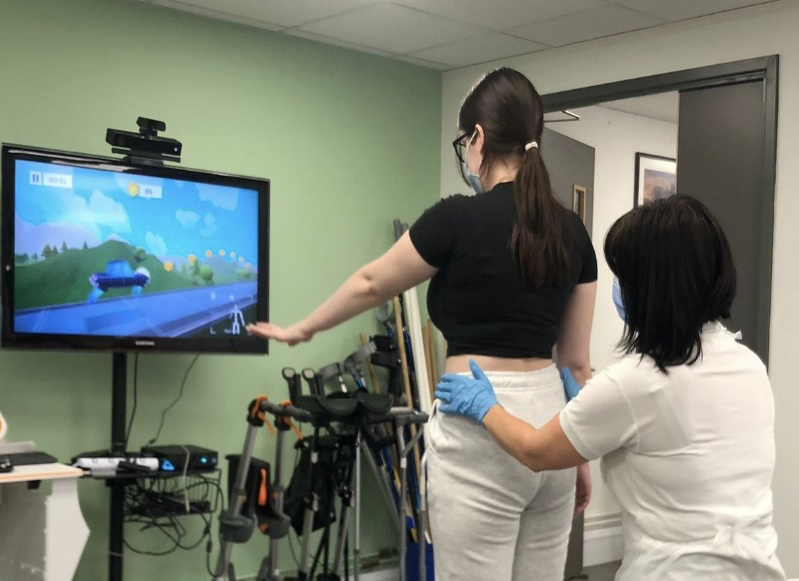
to support higher intensity exercise which is often not possible for children with balance impairments due to the risks associated with falls.
The Galileo Med-35, a side-alternating vibration platform, is used to provide an abundance of proprioceptive information to the brain, producing a high level of stimulus to the structures of the posterior fossa to promote neuroplasticity and improve function. The Galileo Med-35 can be used statically in isolation, or combined with more challenging exercises, such as bodyweight resistance exercises (squats, lunges), balance exercises (narrow stance, single leg, eyes closed), higher level coordination activities (throwing and catching) and cognitive tasks.
For more information of how Physiofunction can help with PFS, please visit www.physiofunction.co.uk, or contact us by email at [email protected] or phone on 01327 842 321.
References:
Children’s Cancer and Leukaemia Group. (2016). Posterior Fossa Syndrome. Available from: [https://www.cclg.org.uk/write/MediaUploads/Publications/PDFs/Posterior_Fossa_Syndrome_Factsheet.pdf] accessed 20th April 2023.
Cleveland Clinic. (2022a). Cerebellum. Available from [https://my.clevelandclinic.org/health/body/23418-cerebellum] accessed 20th April 2023.
Cleveland Clinic. (2022b). Pons. Available from [https://my.clevelandclinic.org/health/body/23003-pons] accessed 20th April 2023.
Cleveland Clinic. (2022c). Medulla Oblongata. Available from [https://my.clevelandclinic.org/health/body/23418-cerebellum] accessed 20th April 2023.
Khan, R. B., Patay, Z., Klimo Jr, P., Huang, J., Kumar, R., Boop, F. A., … & Robinson, G. W. (2021). Clinical features, neurologic recovery, and risk factors of postoperative posterior fossa syndrome and delayed recovery: a prospective study. Neuro-oncology, 23(9), 1586-1596.
Wibroe, M., Cappelen, J., Castor, C., Clausen, N., Grillner, P., Gudrunardottir, T., … & Juhler, M. (2017). Cerebellar mutism syndrome in children with brain tumours of the posterior fossa. BMC cancer, 17(1), 1-7.