‘I’m still me’: Tilly’s recovery after a stroke at 19
When Tilly had a sudden stroke, ordinary young-adult life suddenly felt out of reach. Her story shows how specialist, technology-enabled community neurorehabilitation can turn clinical progress into something more personal: work, friendships, freedom and a way back to herself.
By Resilience Neuro Specialists, Warwickshire
“Having a stroke at 19 isn’t the most interesting thing about me. I’m still me.”
– Tilly
For Tilly, recovery means work, money, a social life and freedom. It is driving into town to see her friends, with Nicki Minaj playing in the car. These are ordinary ambitions for any young person, but after a stroke they became powerful rehabilitation goals.
“I would love to drive again,” Tilly says. “Listening to my music. Nicki Minaj. Driving is so important. I had two jobs. I want to drive into town and to see my friends.”
A life changed without warning
In August 2025, at just 19, Tilly had a stroke out of the blue. Before it happened, she was healthy and active, worked two part-time jobs in a pub and in retail, drove a manual car and had a busy social life.
After being found collapsed by friends, she was taken by ambulance to University Hospital Coventry and Warwickshire. Scans identified three blood clots in her brain.
Two were removed immediately, but the stroke caused a significant brain injury.
In the days that followed, Tilly lost all verbal communication.
She had no feeling down her right side and needed a purée diet. After two and a half weeks of physiotherapy, speech and language therapy and occupational therapy at UHCW, she transferred to the specialist stroke ward at the Central England Rehabilitation Unit (CERU).
Tilly spent around six weeks at CERU. She required hoisting for ten days and her rehabilitation was complicated by postural orthostatic tachycardia syndrome (POTS), which limited how much therapy she could tolerate.
Once her blood pressure stabilised, her progress became more consistent. Speech returned gradually, and for a time she used a pen and whiteboard to communicate.
“Tilly had daily therapy and the staff were incredibly motivational,” says her mum, Amelia, a retired social worker. “The experience there was very positive.”
Medically stable, but not yet back to usual
Tilly returned home at the end of September. She was medically stable, but that did not mean she had her former life back.
She had reduced weight-bearing through her right leg, an asymmetrical gait, foot drop, limited use of her right arm and hand, and much less confidence in everyday activities.
All these things stood between Tilly and the things that defined independence for her: working, driving, seeing friends and making her own choices.
Without further specialist input, there was also a risk that compensatory movement patterns would become established and limit her functional recovery.
At home with her parents, Amelia and Paul, Tilly was honest about the contrast with life before her stroke. “Boring,” she says.
“I’m happy because I can spend more time with my family. But I miss driving and working. It’s getting to me.”
Her goals gave the next stage of rehabilitation its direction. The task was not only to improve muscle strength and walking quality at the Resilience Therapy Centre – it was to help Tilly rebuild the physical ability and confidence needed for adult life.
A place to work hard and feel like herself
Tilly began a personalised programme at the Resilience Therapy Centre, close to her family home.
Therapy focused on restoring function through her right side, improving walking and balance, increasing use of her arm and hand, and rebuilding confidence and independence.
The environment mattered.
For a 19-year-old who had already spent weeks in hospital, the centre offered a setting that felt active and familiar rather than clinical. “This doesn’t feel like a hospital,” Tilly explains. “It feels like somewhere you go to get fit and healthy, like a normal gym.”
She works closely with Michelle, Resilience’s clinical director and neurophysiotherapist, and Luke, rehabilitation coach. Their relationship combines clinical challenge with trust and humour.
“Luke works me hard,” Tilly says, laughing. “Come on Tilly! Keep going! And I think, ‘Oh please!’ But I trust them. I feel comfortable with the team. I can be myself.”
Making movement visible
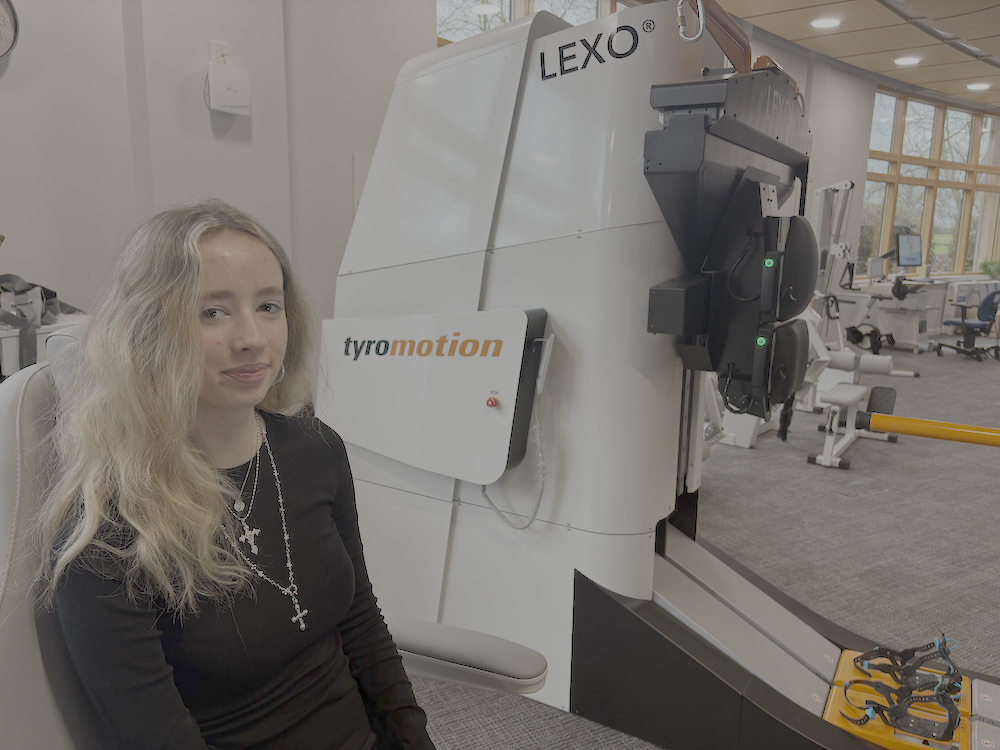
Technology has supported Tilly’s recovery, with each device selected around her individual needs and goals.
The technology complements hands-on therapy, helping Tilly understand her movement while allowing the team to measure progress and adapt her programme.
The Walker View uses a treadmill and 3D movement analysis to provide immediate feedback about how Tilly stands, transfers her weight and walks.
This helps her practise placing more weight through her right leg and develop a more symmetrical walking pattern.
The Omego supports lower-limb rehabilitation through activities including cycling, stepping and leg strengthening. Tilly uses it to work on strength, coordination and endurance, with interactive feedback helping to keep repeated practice engaging.
For her hand and fingers, Tilly uses the Amadeo robotic rehabilitation system. It provides intensive, repetitive practice and adapts as movement improves.
Her recorded active contribution has increased from 0 per cent to around 30 per cent, alongside improvements in arm movement and grip strength.
“The neurotechnology pinpoints exactly what’s happening with her limbs,” Amelia says. “She can see where something is out of place, which is incredibly helpful.
Measuring progress that matters
Since starting at Resilience, Tilly has made measurable improvements in gait symmetry, endurance, right-sided strength and active upper limb engagement.
On the Amadeo, her active contribution increased from 0 per cent to around 30 per cent. She has also increased active movement in her arm, improved grip strength and can walk further distances independently.
The clinical measures are reflected in everyday movement. Tilly is now walking without a stick for longer distances and with a straighter gait. She can stand on her right leg and complete sit-to-stand using her right side.
Just as importantly, she understands her exercises and is more confident in what her body can do.
“She’s made so much progress,” Amelia says. “She’s now walking without a stick, for longer distances, and much straighter. She knows what exercises she needs to do and feels more confident in herself.”
Tilly’s programme is coordinated with her existing community stroke support. Goals and progress are reviewed regularly, so specialist independent provision adds to the NHS pathway rather than sitting apart from it.
This joined-up approach has allowed Tilly to continue building on her earlier rehabilitation while receiving more targeted work on the functional barriers that matter most to her.
Beyond impairment: recovery as participation
For referrers, Tilly’s recovery shows why the period after discharge deserves close attention.
Someone may be medically stable and living at home, yet still face significant barriers to work, mobility, confidence and community life.
Timely, goal-led community neurorehabilitation can bridge the gap between completing an early pathway and reclaiming a meaningful life. Clinical gains matter because they open up daily tasks and help a young adult work, travel and take part in life.
Tilly is now preparing for a return to work, with conversations under way about the support she may need. Driving remains a major goal, as does a holiday in Fuerteventura. She has also continued to see friends.
After leaving hospital, she went to a nightclub for her best friend Jess’s birthday, using a walking stick and foot-up supports.
“That’s just Tilly,” Amelia says. “She’s dealt with this incredibly well. We use humour. We keep moving forward.”
Tilly’s recovery is ongoing, but the direction is clear. She is walking further, using her right side more actively and moving closer to work, driving and independent adult life.
The stroke changed what she could do, but not who she is. As she puts it: “I’m still me.”
About Resilience Neuro Specialists
Resilience Neuro Specialists provides personalised neurorehabilitation through an interdisciplinary team of physiotherapists, occupational therapists, speech and language therapists, neuropsychologists and other specialist clinicians.
Therapy is delivered in the community or at the Resilience Therapy Centre near Coventry, combining expert hands-on care with advanced neurorehabilitation technology to support meaningful, measurable progress.
Referrals and enquiries: [email protected] | 024 7601 0362 | resilienceneurorehab.co.uk