



Can meaningful changes still occur 10 Years after spinal cord injury?
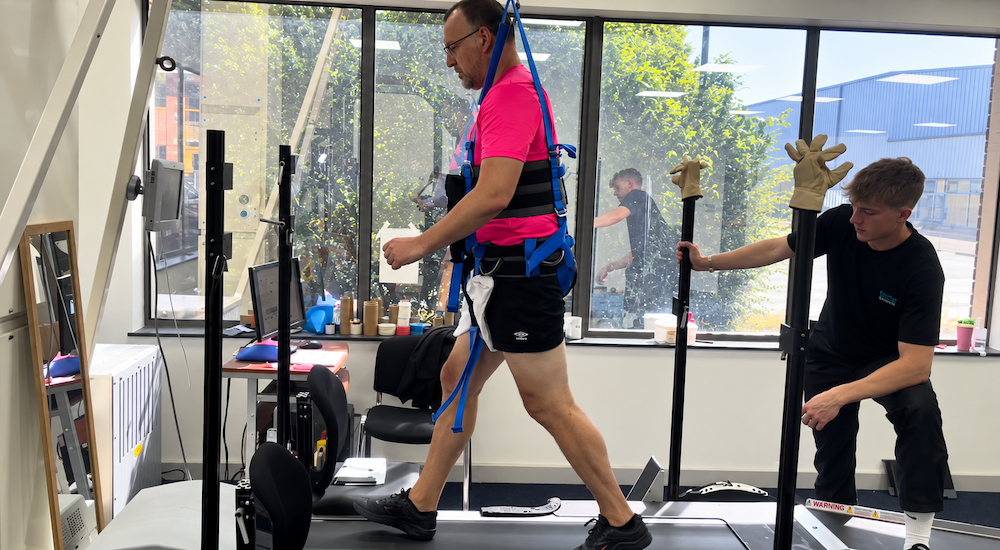
Is meaningful improvement still possible 10 years after an incomplete cervical spinal cord injury? Steven Dowd set out to find the answer….
Ten years after breaking my neck in a cycling accident, I set out to explore one simple question: is meaningful improvement still possible a decade after an incomplete cervical spinal cord injury?
In June 2016, I sustained an incomplete C3/C4 spinal cord injury that left me paralysed. Through surgery, intensive rehabilitation and a lot of determination, I’ve recovered far beyond what many people expected. Today I can stand, walk, row and even run. But I’m still quadriplegic and I still struggle with my hands every single day. Like many people living with spinal cord injury, I’d always heard that most neurological recovery happens in the first couple of years. After that, progress becomes much less likely. But what if that isn’t the whole story?
This summer I spent eight weeks combining the newly approved ARC Ex spinal stimulation therapy protocol from ONWARD Medical with the Neurokinex Activity Based Rehabilitation (ABR) to explore that question. I documented the journey exactly as it happened, filming my sessions, noting how I felt and charting my progress each week. Throughout, I tried to remain objective and honest: what follows is a summary of my experience, observations and reflections.
WEEK ONE – Getting started
The first question I’m asked is what happens during an ARC Ex spinal stim session.
Three electrodes are placed on the back of my neck, bridging the level of my injury. The stimulation gradually increases until it reaches the level that is right for me. The best way I can describe the sensation is like wearing a travel pillow with an angry woodpecker tapping away at the back of your neck. Not painful, but right on the border between comfort and discomfort. Fortunately, after a few minutes my brain tuned it out and I could focus on the exercises.
With the stimulation running, I worked through upper-limb exercises with my Neurokinex trainers. It’s surprisingly hard work and immediately afterwards I moved into an hour of Activity Based Rehabilitation (ABR). I had these back-to-back sessions three days a week for the entire programme.
WEEK TWO – Unexpected changes
Early on, I tried not to convince myself that every little thing meant something but after six sessions, I began noticing things I wasn’t expecting. One of the first had nothing to do with my hands: my bowel motility improved. People don’t often talk about this side of spinal cord injury, which impairs the autonomic nervous system responsible for your bowel and bladder function. In my case, my bowel programme went from what was often multiple days without going, to daily, resulting in feeling less bloated.
Another surprise came during a grip exercise. When I looked into a mirror instead of directly at my hand, my grip became noticeably stronger. I wasn’t expecting it and I still can’t explain it.
During one session we worked on a shoulder and forearm stretch while the stimulation was running. Almost immediately my fingers felt more dexterous. And some of the biggest surprises happened outside the sessions. Earlier in the week I couldn’t complete a Superman exercise independently on both sides. For those who don’t know, this is where you start in four-point (on your hands and knees) and raise your opposite arm and leg simultaneously, hold for a second or two and then repeat on the other side. (Harder than it sounds, let me tell you!) Later that week, I could do this exercise and repeat it at home with no assistance.
During my 8-week programme, I used my walk back to the train station as an unofficial assessment. I had no therapist or equipment – it was just me walking. By the end of week two my gait felt smoother with more hip rotation, greater arm swing and less foot drop. I kept asking myself: Is this real? Is it repeatable? Will it still be there tomorrow?
WEEK THREE – Learning recovery isn’t linear
Week three was tough and I went home exhausted after almost every visit. Some of the things that caught my attention the previous week continued, but not all. My hands felt tighter and slower to open. My forearms were noticeably tighter and my right arm showed more clonus (involuntary muscle contractions and relaxations).
I became much more aware of how good my body has become at compensating. Over 10 years it has quietly learned hundreds of little ways to work around problems. When my hands are isolated, it can be confronting. Not being able to open them properly isn’t just about failing an exercise, it’s about struggling to type and do up shirt buttons. It results in me dropping and breaking things. Daily frustrations that matter to me.
The week ended with a highlight as I got back on a rowing machine with the stimulation on. For one-minute bursts I was pulling 500m splits down to around 1:57. For those few minutes I felt completely in control. Rehab doesn’t follow a straight line but knowing that intellectually doesn’t stop you feeling it emotionally!
WEEK FOUR – Looking for patterns
At the halfway point, I had enough observations to stop looking at individual sessions and start looking at the programme as a whole. My mindset shifted and I found myself noticing things away from the rehab setting such as comfort on the train home, making a cup of tea or typing an email.
I noticed increased sensitivity in my left hand to subtle temperature changes. My right hand seemed to be opening more easily and quickly. I felt more strength in the muscles that extend my fingers. Encouragingly, some changes lasted for hours or even days after the stimulation was turned off. These were exactly the sorts of observations I hoped this project would allow me to notice.
WEEK FIVE – Precision work
By week five, the programme shifted from broad to precise. Could I move one finger without another joining in? Could I keep a finger straight while moving my thumb? We were no longer only looking for movement: we were trying to improve the quality of it.
The most obvious improvement came from catching beanbags. In the earlier weeks, I could trap them. This week, I was opening my hand, tracking them as they came towards me and plucking them out of the air! It was an exciting development and revelation to be honest.
WEEK SIX – Measuring the wrong thing
Six weeks in, I was suddenly aware I might have been measuring the WRONG thing.
My therapist James had me working on opening my right hand hidden behind a mirror. From where I was sitting, all I could see was the reflection of my left hand. My brain was surprisingly quick to accept that it was actually my right. It looked great opening and closing away.
Meanwhile, James had been busy watching my actual right hand which was doing far better than I’d realised – until I watched it back later.
For 10 years I’ve been spotting what’s missing and what doesn’t work. What I haven’t noticed is what’s quietly changing underneath it, as shown by an exercise like this.
Another thing that seemed to just fall into place was doing an exercise called a Bird Dog. You’re on all fours and must lift your opposite arm and leg while keeping your core on the whole time. Looks simple but really isn’t! Earlier in this programme I could barely organise myself, even with help, because everything wanted to compensate for everything else.
In Week Six, though, my trainer just stepped back and watched.
I got myself down on the mat and into position, organised myself and got on with it. It was a revelation to just be able to do this without thinking about every element…
When I started this project, I thought it was about seeing whether I could make my body do MORE. That’s no longer what I’m measuring. What matters more is noting those moments where I stop thinking about the spinal cord injury – even if it’s only for a few seconds.
Every time my body quietly gets on with something without me consciously noticing, it feels a little more like the body I remember.
WEEK SEVEN – In-body memories
Something happened this week that took me aback. I was doing a movement that involved folding forwards over a bar. My head was fine, but my body kept backing out. Later I realised the movement was remarkably similar to the moment I broke my neck and was an unpleasant reminder of how in-body memories stay with you. Repetition helped change that perception and I must thank my trainer, James, for his patience and persistence as I pushed through this difficult stage.
In better new, this week also saw my fingers stay spread and extended under load through my right arm without clonus. It was the first time this had happened: a landmark moment for me.
WEEK EIGHT – The results
In the final week of the ARC Ex Therapy programme, the trainers repeat the assessments carried out at the start to reveal what’s gained and what’s changed. I could tell that certain things were much improved. However, my feelings, emotions and perceptions are not as accurate – or plausible – as measurements and data.
The results from my assessments backed my own belief that, yes, meaningful improvement is still possible 10 years after a spinal cord injury.
The standout result was grip strength. At baseline, my right hand measured 17.6 kilos. At the end it was 30.6 kilos – nearly double. You can’t argue with that.
Using an array of clinical measures including GRASSP-2, among other improvements noted were:
- Overall hand strength on both sides
- Full finger extension on my right hand, with resistance
- Better shoulder movement and strength
- Improved dexterity
- Completing a timed hand test that I couldn’t even finish that first week
Meaningful, not miracle
I’m delighted but need to keep all this in perspective. Combining ARC Ex spinal stim therapy and Activity Based Rehabilitation has brought meaningful gains, but it’s not a miracle cure. Not everything has changed dramatically and my hands are still disabled. But I can now do up shirt buttons that I avoided for years. I can detect heat from a barbecue early enough to pull my hand away. And my bowel function has improved significantly – making it one of the most meaningful changes of all.
When I started this, I wondered whether 10 years after my injury might simply be too late to achieve gains. What I’ve shown is that my body is still capable of significant and measurable change. And that makes me hopeful.
The real test will be to see how much function stays with me. How much further I can build on this progress. I will keep with my rehab, gym work and exercises at home to see how much more I can achieve.
Having answered one question, I must now ask another. Will I get to keep these gains or will they slowly disappear?
I’ll come back in three months’ time and let you know.
Image credit: Steven Dowd

 Tetraplegic veteran completes 79-mile challenge for spinal injury charity


