Giant ice brain unveiled as charity warns of gaps in stroke awareness
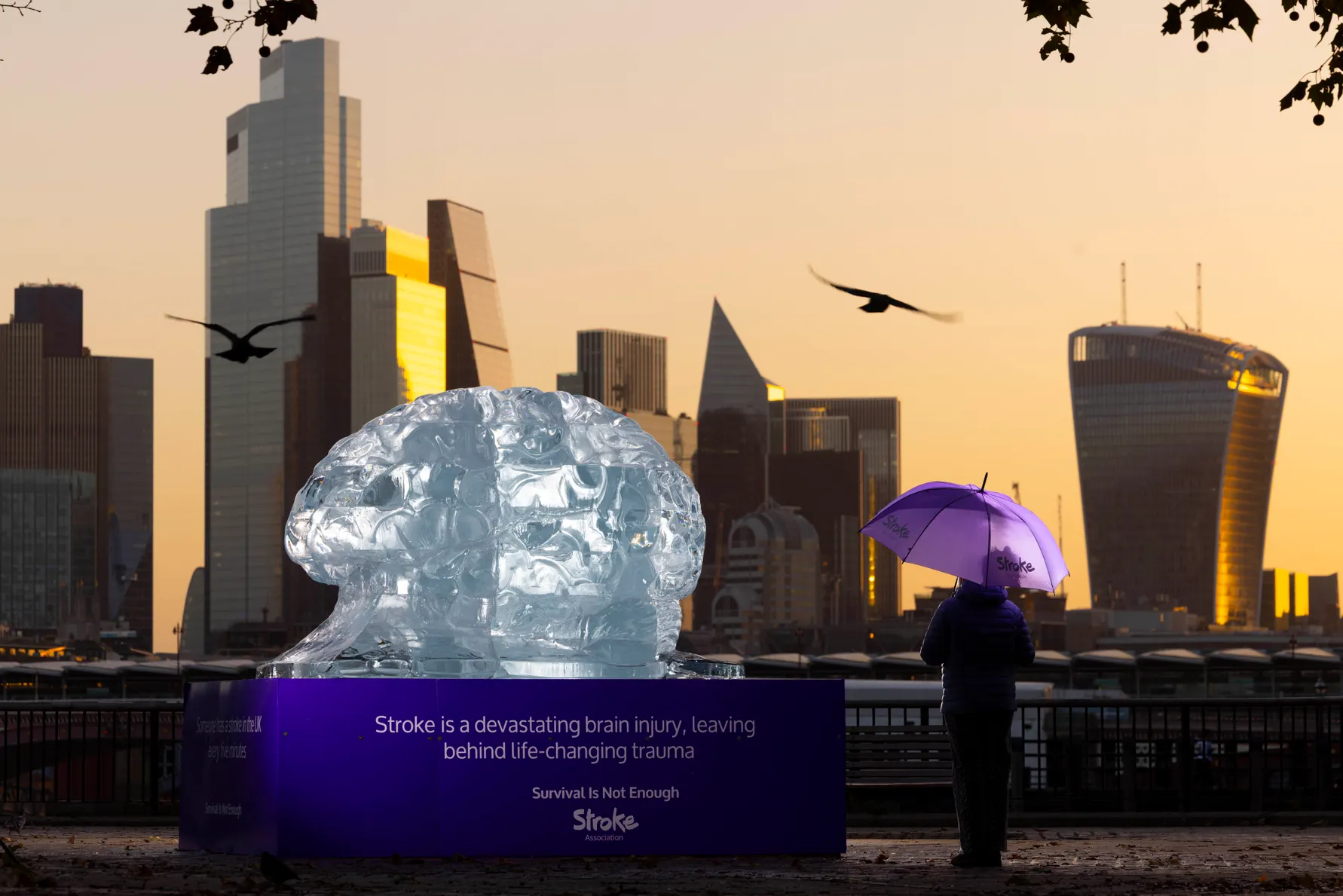
A giant ice brain has been unveiled on London’s Southbank as new research reveals widespread misconceptions about stroke and its lasting effects.
The 2.5-metre-tall sculpture, which took 150 hours over five days to create, marks World Stroke Day and the launch of the Stroke Association’s ‘Survival Is Not Enough’ campaign.
The installation represents the fragility of the brain and draws attention to the physical and emotional challenges faced by stroke survivors.

It was unveiled by actor and producer Josh Whitehouse, whose father, John, survived a severe stroke almost 20 years ago and has since lived with aphasia, a condition affecting speech, writing and language comprehension.
Whitehouse said: “My dad had a severe stroke almost 20 years ago, and it changed everything for our family. He survived, but he’s lived with aphasia ever since, and watching someone you love have to fight for their words every single day really stays with you. Seeing the sculpture today I couldn’t stop thinking about how fragile the things we take for granted really are.”
Whitehouse was joined by radio presenter Adele Roberts and her partner Kate Holderness, whose mother survived a stroke earlier this year.
Five stroke survivors, Tayshelice, Jordan, Jermaine, Rutuja and Jim, also attended, representing different generations affected by the condition.
Their brain scans helped inspire the sculpture’s design. Tayshelice experienced a stroke at the age of eight, while Jim is now in his 70s.
Research released alongside the campaign found that many people underestimate their risk of stroke and its long-term consequences.
Although one in four strokes affects people of working age, 34 per cent of adults aged 18 to 34 and 24 per cent of those aged 35 to 44 believe they are too young to have one.
Almost a third of respondents, 32 per cent, did not know that stroke is a brain injury.
Another 19 per cent were unaware that it can cause lasting difficulties with walking, talking, seeing or swallowing, while 22 per cent believed recovery takes only a few months or less.
In the UK, someone experiences a stroke every five minutes, and approximately 1.4 million people are living with a brain injury caused by stroke.
More than 85,000 people survive a stroke each year, but many face lengthy rehabilitation and difficulties rebuilding their lives.
He said the campaign reflected the difficulties survivors and their families continue to face long after the initial medical emergency.
The Stroke Association says many survivors are left without the essential long-term rehabilitation and support they need.
Juliet Bouverie, chief executive of the Stroke Association, said: “A stroke is a devastating brain injury, leaving behind life-changing trauma.
“In an instant, a stroke can steal away the things that many of us take for granted, such as walking, talking, eating and living independently; the things that make you, you.
“This new research shows that people still don’t understand a stroke happens in the brain and wrongly believe a stroke only affects older people.”
The sculpture will be on display at Southbank’s Observation Point on 26 and 27 October, where visitors can learn about the experiences of the survivors featured in the campaign.
The campaign also supports a two-part documentary series commissioned by Channel 4 in partnership with the Stroke Association.
‘Trauma: My Broken Brain’ follows three young adults, Dan, Saskia and Dec, as they face the consequences of life-threatening strokes.
The documentary is scheduled to be available to stream on Channel 4 from 10pm on Monday 26 October.