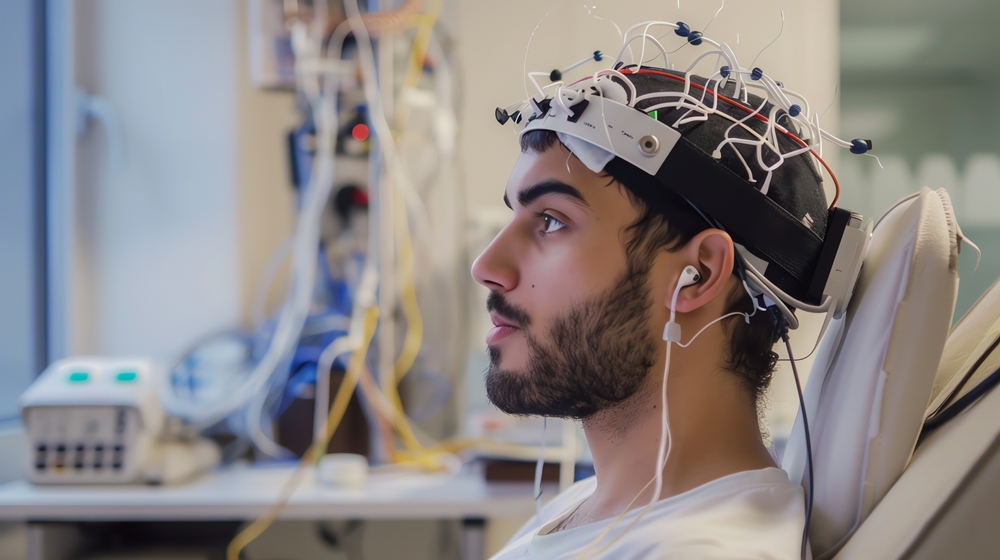
A specific brain rhythm may help explain how deep brain stimulation works in Parkinson’s and could lead to more precise treatment, research suggests.
Scientists found the benefits of deep brain stimulation, or DBS, appear to depend on stimulating a specific brain network that communicates mainly through a relatively fast beta rhythm of 20 to 35 Hz.
The findings come from scientists and clinicians at the University Hospitals of Cologne and Düsseldorf, Harvard Medical School and Charité Berlin.

The research is the first to bring together two approaches that have largely been studied separately: electrophysiology, which measures electrical activity in the nervous system, and brain imaging.
“For the first time, we were able to characterise the DBS response network in Parkinson’s disease in terms of space and time, simultaneously,” said Andreas Horn from the University of Cologne, who led the study and specialises in computational neurology.
“We show that Parkinson’s disease can best be treated if we stimulate a very precisely defined network. This network operates synchronised within a specific frequency band, and offers an explanation for how well patients respond to deep brain stimulation.”
Deep brain stimulation of the subthalamic nucleus is an established treatment for easing movement symptoms in people with Parkinson’s disease.
The treatment uses implanted electrodes to deliver small electrical pulses to areas deep within the brain.
Previous brain imaging studies have identified areas where stimulation appears to work most effectively, while electrophysiological research has measured the frequencies of the electrical signals involved.
Until now, researchers had not captured both the location and timing of these signals at the same time.
To investigate, the team studied a large multicentre group of 50 patients and 100 brain hemispheres.
Researchers simultaneously recorded brain activity through implanted DBS electrodes and with magnetoencephalography, or MEG.
Using the recordings, they mapped functional connections between regions deep within the brain and areas closer to its surface.
The analysis identified a network linking the subthalamic nucleus with frontal areas of the brain that communicated largely at a comparatively fast frequency of 20 to 35 Hz.
The strength of this connection was linked to how much individual patients’ motor symptoms improved after electrode implantation.
“These results suggest that a certain rhythm of the brain acts as a communication channel between the subthalamic nucleus and the cerebral cortex and may mediate the therapeutic effects of deep brain stimulation,” said first author Bahne Bahners, who works at Düsseldorf University Hospital.
“By stimulating regions that are connected to the identified network, we will probably be able to adjust DBS settings more precisely in the future, especially in patients who have not yet benefited optimally from deep brain stimulation.”
The findings could provide a basis for tailoring deep brain stimulation more closely to an individual patient’s brain network, particularly when existing DBS settings do not provide the desired level of symptom relief.
Researchers now plan to investigate more directly how deep brain stimulation causes changes within brain networks.
Studies examining these causal effects are currently under way.