Beyond Accessibility: The challenge of finding accessible spaces
Author: Esme Mendel-Roe, Psychology Intern, Supervised by Dr Penny Trayner, Paediatric Clinical Neuropsychologist.
A critical distinction exists between a building being described as “accessible” and an individual being able to use it functionally and independently.
Too often, accessibility is treated as a simple checklist: a step-free entrance, an accessible toilet, a lift.
While these provisions are foundational, their presence alone does not constitute a genuinely accessible space. The more important questions arise once an individual is inside.
Can they move comfortably and independently? Can they reach and use their necessary equipment? Most importantly, can they fully take part in the activities taking place?
For neurorehabilitation services, this distinction is particularly important. A therapeutic environment must accommodate a wide range of individuals’ physical, cognitive, sensory, and communication needs.
When it fails to do so, the environment itself can unknowingly become a barrier to rehabilitation, independence, and participation.
More broadly, inaccessible spaces can place boundaries on what people are able to do and achieve.
If accessibility is only provided in the places where disabled people are expected to observe rather than participate, perform, or lead, the design of the environment can quietly restrict the possibilities available to them.
This challenge came into sharp focus during BPM Rehab’s recent search for a new studio, ultimately leading to their move to Archway 3 in Manchester.
Finding a space for electronic music-based neurorehabilitation meant looking beyond the conventionally accepted “accessible” property listings.
While buildings may appear suitable on paper, they may still pose significant practical challenges once the activities, equipment and people using them are considered.
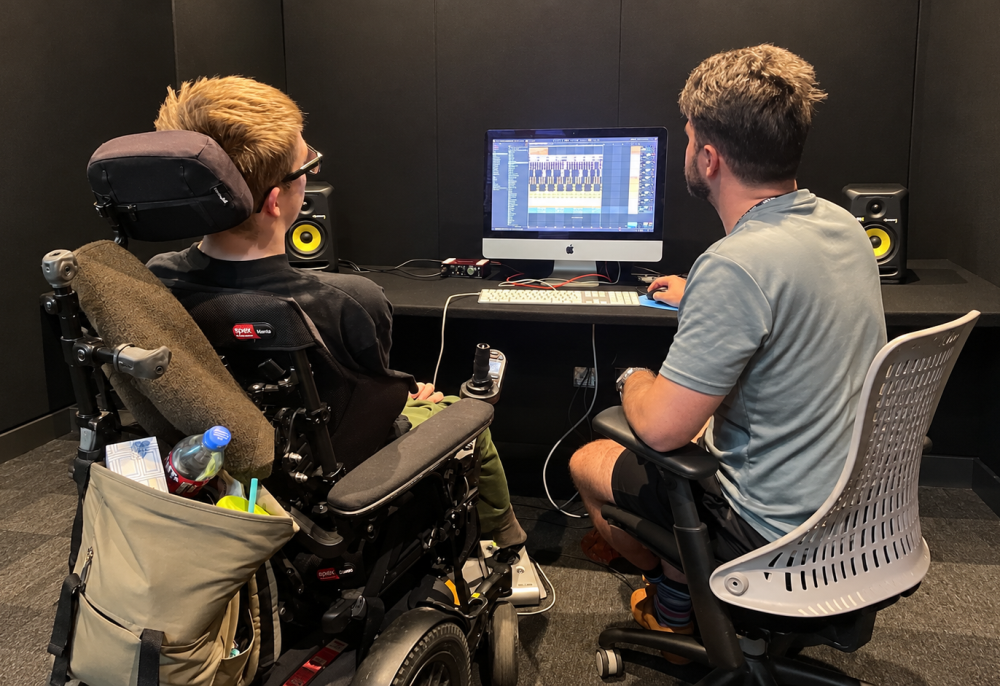
For BPM Rehab, it was not enough for somebody to be able to simply enter the building. Participants needed to be able to navigate the studio, reach equipment, position themselves at workstations and function as independently as possible.
At BPM Rehab, DJing provides a practical context for developing cognitive and motor skills, building confidence and supporting broader independence, while creating opportunities for performance and wider participation.
The environment therefore needs to support, rather than restrict these opportunities.
Designing around participation
This was a central element of BPM Rehab’s search for a new studio.
DJ Alex Sweeney, who has progressed from BPM Rehab student to Accessibility Officer, played a leading role in the process.
Combining his professional role with lived experience of acquired brain injury (ABI), Alex brought an expert-by-experience perspective to the search, helping ensure that potential spaces were considered through the needs of the people who would actually use them.
This meant looking beyond property specifications and asking questions about how participants could navigate the studio, the functionality of workspaces and controls, and whether the spaces could be adapted to the individual physical, cognitive, sensory, and communication needs of the participants.
Not every inaccessible feature or barrier can be anticipated, nor will the same environment work identically for every person.
Instead, accessibility should be considered as an open and responsive process, listening to those using the space, what they are trying to achieve, and making adaptations to allow participation to flourish.
Archway 3 in Manchester offered a strong starting point, with lift access, wide doors and appropriate circulation space. But more importantly, there was a willingness to engage and consider practical changes required.
Where Alex identified potential barriers, these were discussed and addressed to allow the internal studio to be developed around its participants, instead of expecting participants to adapt to the limitations of the space.
This is a crucial distinction, as the accessibility of an environment is ultimately measured by what people can do within it.
Where accessibility creates opportunity
BPM Rehab’s participants have repeatedly demonstrated what can become possible when the environments support their participation.
Members of the programme have frequently progressed from learning and developing skills within rehabilitation, to publicly performing at events such as AccessFest, the UKABIF Summit and Headway Salford’s celebration events.
In these settings, they are not considered as recipients of rehabilitation, or as disabled people accommodated within an audience: they are DJs, performers, and active contributors to the event itself.
These opportunities can often matter much more than the performance itself.
A key sign of success within neurorehabilitation is the enabling of independence, confidence and meaningful participation in life beyond clinical services.
For many, music can provide a pathway to social connection, creativity, performance and even professional development. Yet, these possibilities would never have even been realised if the environment had prevented these skills from being developed.
This is why it is crucial to consider and understand accessibility beyond simply removing restrictions towards enabling opportunity.
An inaccessible DJ booth can do more than make performing inconvenient. An inaccessible workspace can do more than make someone reliant on assistance.
Each time someone’s individual needs are overlooked, the opportunities available are narrowed.
Conversely, an environment designed with participation in mind can allow an individual’s skills, interests, and ambition to develop into opportunities that may otherwise never have been available.
The lesson from BPM Rehab’s search for a new studio is therefore not that there is a single blueprint for an accessible building.
Individuals’ needs differ, activities change, and barriers cannot always be predicted.
What can change is the way spaces approach accessibility: involving lived experience, remaining open to adaptation, and considering what people need to do, rather than simply whether they can enter.
 Helping wheelchair users find the right transport solution