



News ›
News
The latest news from across neurorehabilitation.
 Parkinson's28 Jan
A breakthrough discovery has been made in the fight against Parkinson’s disease, with researchers discovering a protein which could slow down or stop its progression.
The protein BMP5/7 has been discovered to be significant in the advancement of the condition, which affects over 10 million people worldwide. The development of treatment in this area could yield the long-awaited breakthrough in the ability to halt the progression of Parkinson’s, with work now advancing further in this field to bring it to clinical application.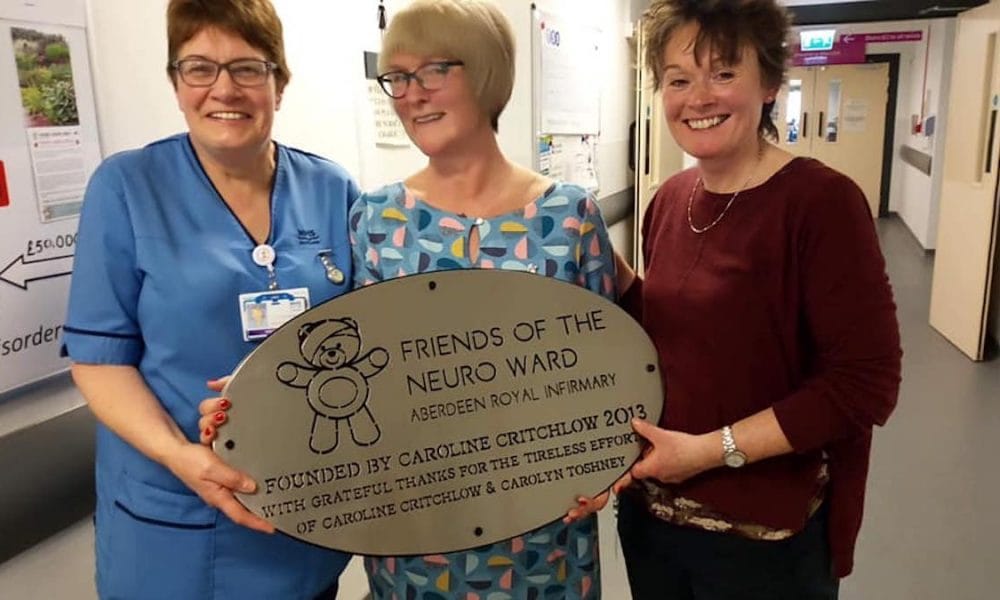 Care & services28 Jan
The neuro ward at Aberdeen Royal Infirmary has a new lease of life thanks to the wife of one former patient, who was inspired to act by how underfunded it was. Now, Caroline Critchlow is turning her fundraising attention to another neuro centre, with plans to create a therapy garden
Although it was back in 2013 that her husband underwent major brain surgery, Caroline Critchlow remembers it like it was yesterday. Not just for the understandable trauma, anxiety and distress caused by your husband undergoing a 22-hour operation, the longest ever performed at Aberdeen Royal Infirmary - but equally for the state of the hospital neuro ward, which will forever be ingrained in her memory. “It was in a terrible state. The day room was in dreadful condition, which is the place relatives like me waited, and where patients took a break away from their beds. When you went to the loo, the toilet seat was cracked; the lino was held together with tape; the coffee table was broken; the wallpaper was peeling off,” recalls Caroline. Brain injury27 Jan
A link has been established between gut disease and brain injury in premature babies.
In a landmark study, the way by which necrotizing enterocolitis (NEC) - a potentially lethal inflammatory condition that destroys a premature infant's intestinal lining - is linked to the brain has been discovered for the first time. Working with mice, researchers at Johns Hopkins Medicine and the University of Lausanne in Switzerland have identified an immune system cell which travels from the gut to the brain and attacks cells rather than protect them as it normally does. Statistics show that as many as 12 per cent of babies weighing under 3.5lbs at birth are affected by NEC, a rapidly progressing gastrointestinal condition in which bacteria invade the wall of the colon and cause inflammation that can ultimately destroy healthy tissue. If a hole is created in the intestinal wall, bacteria can enter the bloodstream and cause life-threatening sepsis. Long COVID27 Jan
The toll Long COVID can have is still being researched, its symptoms have much in common with a number of neurological conditions. Here, specialists from Neuro Physio Wales share their thoughts on why early intervention could be crucial.
Early intervention with symptoms of Long COVID can be vital in mitigating long-term effects, specialist neurophysiotherapists have said. While the effects of Long COVID are still being realised, with the condition only recently being recognised as a lasting impact of COVID-19, accepted symptoms include fatigue, brain fog, joint or muscle pain, dizziness, depression or anxiety and pins and needles. Community neuro rehab27 Jan
A medical centre has become the first in the world to adopt technology to alert them to a disabled person’s visit before they arrive, ensuring they are fully prepared for their arrival and can offer the best possible standards of customer service.
Charter Medical Centre in Hove has become the first of its kind to use the WelcoMe app, which makes use of pioneering technology to enable people with disabilities, including brain injuries and neurological conditions, to tell businesses and venues when they intend to visit their premises. Brain injury26 Jan
The world’s first rapid handheld blood test for mild traumatic brain injury (TBI) has been given clearance by US regulators, it has been revealed.
The device, developed by Abbott, will help detect injuries including concussions, and will help clinicians determine if further assessments, including a CT scan, are necessary. A blood sample will be taken from the patient, with plasma drawn and applied to the test’s cartridge, with results being delivered a short time later. Millions of people worldwide sustain mild brain injuries each year, with Abbott estimating five million in the US alone are affected, and to which its new test could be relevant. Case management26 Jan
An event which examines the latest research, thinking and best practice in chronic pain is bringing an international audience together with leading speakers from around the world.
The second International Chronic Pain Virtual Summit is being held on Thursday and Friday next week, and offers a programme of presentations from expert speakers alongside networking opportunities for delegates. The free event has over 1,500 clinicians, case managers, insurance and legal professionals and others with special interest in chronic pain set to attend, to hear from some of the leading names in chronic pain globally. Multiple sclerosis25 Jan
The effect of medication Tysabri on cognitive fatigue in people with multiple sclerosis (MS) is to be analysed in a new research study.
The study will look at how the medication, also known as natalizumab, impacts cognitive fatigue in individuals with relapsing and remitting MS. Most people living with MS report symptoms of cognitive fatigue, which can adversely affect their ability to perform activities in their everyday lives. Statistics show that over 40 per cent consider such fatigue their most troubling symptom. Patient stories25 Jan
A woman left with a traumatic brain injury after a hit-and-run is now using her experiences to support and inspire others.
Emily Bradfield was left seriously injured after a car careered into her as she was walking to a London station one July evening in 2018. While thankfully she won her fight for survival, Emily faced a long road to recovery having suffered a brain injury, broken right arm, and heme-paresis on her whole left side. There also were fears about whether she would walk again. Brain injury22 Jan
The force exerted on the brain during traumatic injury is linked to damage years after the initial event, research has revealed.
Findings of the new study have been hailed as having the potential to predict the severity of brain injuries and help influence new approaches going forward, particularly in the field of sport. TBI has a number of immediate impacts, including physical effects like unconsciousness and bleeding, alongside the ‘hidden’ symptoms of memory loss, mood and personality changes, which may take much longer to develop.


