



Therapy
Therapies that support recovery after neurological injury and illness.
 Stroke4 Feb
Targeted training of the better arm improved movement and daily function in chronic stroke survivors, a phase II randomised trial has found. After a stroke, damage in the brain can slow and unbalance both arms. The less-impaired arm often looks normal but loses speed and coordination needed for everyday tasks. A total of [...]
 Stroke30 Jan
Electromagnetic therapy combined with physical therapy significantly reduced disability in stroke survivors, preliminary research has found. The therapy, called electromagnetic network-targeted field therapy (ENTF), stimulates specific connections in the brain with electromagnetic pulses. An analysis of two small clinical trials suggests that the treatment is safe and may be effective in reducing overall disability after [...]
 Neuropsychology28 Jan
A major new study has found that transcranial magnetic stimulation (TMS), which applies magnetic energy to the brain, can be a cost-effective treatment option for the NHS in treating moderate and severe forms of depression that have not responded to other treatments. The economic analysis, which is published in BMJ Mental Health, compared TMS to [...]
 Brain injury8 Dec
Prompt treatment after a head injury, even if symptoms seem minor, could halve the risk of Alzheimer's, new research suggests. Beginning physical and cognitive therapy within a week cut later Alzheimer's risk by more than 40 per cent, the study found. Co-author Austin Kennemer said the finding could change how patients and hospitals respond. [...]
 Parkinson's27 Nov
Scientists identify how protein droplets trigger the harmful clumping that drives Parkinson's disease, potentially opening new treatment paths. The discovery reveals how ubiquilin-2 protein catalyses the aggregation of alpha-synuclein, the misfolded protein that forms toxic deposits in the brains of people with Parkinson's. These deposits, called Lewy bodies, accumulate in neurons in the substantia nigra [...]
 Stroke17 Nov
Stroke patients at a Wakefield hospital are being encouraged to dance at weekly ward discos to aid recovery and socialise. Pinderfields Hospital introduced Disco in the Bay to support physical rehabilitation and encourage patients to socialise. Occupational therapist Louise Hewitt said music had a therapeutic power and could play a valuable role in stroke recovery. [...]
 Brain injury11 Nov
There was much excitement and anticipation at the inaugural ‘drum-off’ at Richardson Care in Northampton. Service users in two of the specialist neuro-rehab services for adults with acquired brain injury took part: The team from The Richardson Mews competed against the guys from 144 Boughton Green Road in a series of fun drumming games. Each [...]
 Brain injury5 Nov
HCA UK’s The Wellington Hospital celebrated its Neurological Rehabilitation Centre’s success at the Neurological and Complex Care Awards last week, recognising the highly complex care their teams deliver every day. Their programme for patients with Prolonged Disorders of Consciousness (PDOC) was honoured with the 'Innovation in Neuro Rehab' award for Paolo Tomaselli’s work integrating Neurologic [...]
 Parkinson's27 Oct
A woman with Parkinson’s disease played the clarinet during brain surgery, allowing doctors to observe immediate improvements in her movement. Denise Bacon, 65, from Crowborough in East Sussex, underwent Deep Brain Stimulation (DBS) at King’s College Hospital while awake. Her playing helped surgeons assess the success of the procedure in real time. DBS involves implanting [...]
 Stroke22 Oct
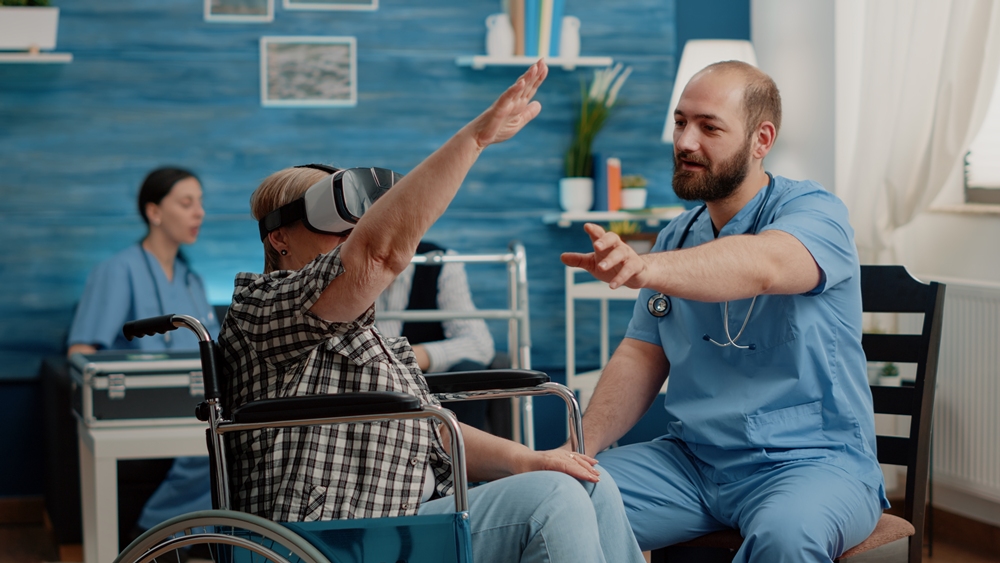
A new virtual reality training task developed by researchers in Finland shows promise for helping stroke survivors with visuospatial neglect, a condition that affects awareness of one side of space. The VR-based rehabilitation tool combines audiovisual cues with physiotherapy exercises to support recovery. Visuospatial neglect (VSN) affects about 30 per cent of stroke survivors and [...]


