Reviewed by Warren Collins, partner and solicitor-advocate, Penningtons Manches Cooper LLP
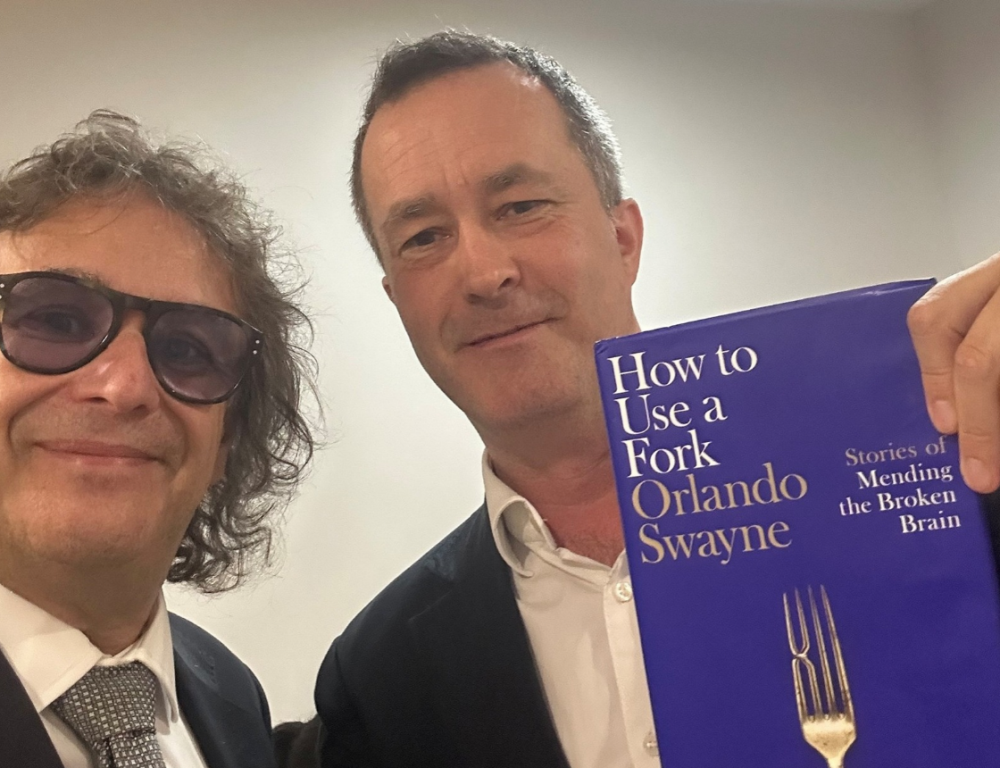
The title is deliberately unglamorous, and that is the point.
Very few of us give any thought at all to the sequence of decisions and movements involved in lifting a fork to the mouth, and none of us can remember learning it.
For a patient who has sustained a severe brain injury, that unremarkable act may represent months of effort, the co-operation of an entire multidisciplinary team, and a moment of genuine significance for a family who had been told at the outset to expect very little.
Dr Orlando Swayne has chosen his title well, because his book is concerned throughout with the proposition that the ordinary things are the ones worth fighting for.
Dr Swayne is a consultant neurologist who leads the neurorehabilitation unit at the National Hospital for Neurology and Neurosurgery in Queen Square and is an honorary associate professor at the UCL Institute of Neurology.
He also practises at the Wellington Hospital in London, where I have had the considerable benefit of seeing his work at close quarters in the course of a catastrophic injury claim, a matter to which I will return.
This is his first book, and it arrives with endorsements suggesting that he belongs in the company of Oliver Sacks and Henry Marsh. That comparison is a heavy burden for a debut author, and it is one he largely carries.
The central argument will be familiar in outline to readers of this publication, although it is developed here with unusual clarity and force.
Dr Swayne was taught as a medical student what his generation was taught as a matter of orthodoxy, namely that a damaged brain does not mend.
As a junior doctor he began to encounter patients whose progress could not be reconciled with that teaching, and he went on to spend a career investigating why.
The account he gives of cortical reorganisation, of the forging of new networks and the remapping of damaged circuits, is written for a general readership but never patronises the reader, and the clinicians and case managers who read it will find the underlying science handled with precision rather than enthusiasm alone.
What gives the book its weight is the gap he then identifies.
If the brain retains a far greater capacity for adaptation than the old dogma allowed, the question that follows is whether the systems we have built around brain injured patients are capable of exploiting it.
His answer, stated with a restraint that makes it more persuasive rather than less, is that clinical practice has not kept pace with the neuroscience, and that a substantial number of patients are therefore denied recoveries that biology would otherwise permit.
Rehabilitation on the scale that neuroplasticity demands is intensive, prolonged and expensive, and the resources allocated to it bear little relationship to what the evidence suggests is achievable.
That is an argument about commissioning and funding as much as it is an argument about medicine.
The clinical narratives are the reason the book will be read outside the professions. Dr Swayne introduces us to many patients with stories that come to life off the pages.
There is Christian, a stroke patient who lost his left side; Priya a 16 year old girl with NMDA encephalitis who was misdiagnosed and referred to a mental health unit; and Claire who responds so well to music therapy.
Dr Swayne resists every temptation towards the theatrical, and the stories are the better for it. He writes as a clinician recording what he observed, with a dryness that occasionally becomes very funny, and he is consistently more interested in his patients as people than in their conditions as curiosities.
His acknowledgement of the trust his patients placed in him during the worst periods of their lives is not a formality.
For those of us who conduct catastrophic injury litigation, the book has a particular resonance. My own interest in it is not academic.
One of my clients, who sustained a catastrophic brain injury, is receiving neurorehabilitation at the Wellington Hospital under Dr Swayne’s care, funding for which was secured under the Rehabilitation Code with the support of Lisa Goudy of Ben Holden and Associates.
The Code exists precisely because the window in which intensive rehabilitation delivers its greatest return does not wait for the resolution of liability, and Dr Swayne’s book supplies, in accessible form, the scientific justification for the urgency that the Code assumes.
Practitioners who have found themselves arguing with a compensator about the value of an early interim payment for rehabilitation will recognise the terrain immediately.
There are limits to what a book of this kind can do, and it would be unfair to criticise it for failing to do things it never set out to do.
Professional readers may wish for more on outcome measurement, on the transition from inpatient units to community rehabilitation, and on the long tail of neurobehavioural difficulty that case managers spend their working lives addressing.
There is a further point worth registering, which is that hope requires careful handling in a medico-legal setting.
Families read books such as this one, and they read them for the passages about recovery rather than the passages about uncertainty.
Dr Swayne is scrupulous about the boundaries of what rehabilitation can achieve, but those of us who advise injured people and their relatives will want to be ready for the conversations that follow.
Those reservations aside, this is an important and humane book, and it deserves the readership it is receiving. For clinicians it is a reminder of why the work matters.
For case managers it is a well-argued statement of the case they make daily. For lawyers it is a clear account of the science that underpins every rehabilitation application we make.
I recommend it without hesitation.
Picador – 2026 (Hardback: £20)