News ›
News
The latest news from across neurorehabilitation.
 Dementia20 Jul
A team of scientists are exploring if pauses, pitch and voice intensity could predict the development of Alzheimer’s Disease.
It is thought that people with the disease tend to speak slower and pause more often as they try to find the right words. The Alzheimer’s Society in the UK estimates that 850,000 people were living with dementia in 2019. It represents 1 in every 14 people aged 65 or over. It is thought this could rise to 1.5 million by 2040. The study The scientists used three machine-learning algorithms to assess voice data from 24 participants diagnosed with Alzheimer’s disease. They compared this to 99 participants without the disease. All those who took part were over the age of 65. Dementia19 Jul
A campaign group that promotes the use of music in care for dementia patients has formed a new partnership with one of the UK’s leading music organisations to promote its power.
Music for Dementia works with over 200 different organisations to show how integral songs and melodies can be for those with the disease and they have now added UK Music to its list. Dubbed the ‘Power of Music’, the partnership is looking to get more groups to recognise the impact this can have when it comes to improving overall health and wellbeing. Grace Meadows, campaign director at Music for Dementia, explained to NR Times a bit more about the collaboration. “It is a national campaign,” she said. “What we do is we advocate and call for music to be made an integral part of dementia care. News13 Jul
One care home organisation is giving its residents more purpose during their stay thanks to a unique scheme.
 Dementia12 Jul
Conservative MP Andrew Bowie is calling for the UK to use the lessons it has learned from COVID-19 and use them for research into dementia.
In May he spoke about the topic to his peers in Parliament as part of a general discussion to mark Dementia Awareness Week. Here the representative for West Aberdeenshire and Kincardine drew upon his own experiences with the disease, with both his grandmothers having battled with it. Bowie said both women went from ‘animated and fun’ people to a shadow of their former selves as dementia stripped them of their personalities. He is now calling on the government to increase funding for dementia research and help lead the way for finding a cure for the disease. Brain injury7 Jul
If injury or illness means living life your way isn’t easy, live-in care can provide support. Agincare is experienced in supporting people with acquired brain injuries, acquired spinal cord injuries and more diverse neurological needs.
As a family owned and run business and one of England’s largest care groups, we’re proud to have been delivering skilled and professional care with a smile for 35 years. If you’re looking for round-the-clock support without compromising on your choice, lifestyle, or independence, live-in care is designed for you. To discover the difference that live-in care can make, we’d like you to meet Callum. Callum’s story Callum is no less an adrenaline junkie today than he was as a teenager. Unfortunately, at age 16, while having fun with friends, Callum fell 30 feet. He sustained trauma to his head, memory loss and an acquired spinal cord injury. Callum spent the next two years in hospital. With his mobility declining and behavior becoming challenging, Callum’s social worker decided to research live-in care. Stroke6 Jul
As a former Royal Marine Commando, Troy Johnson has faced many challenges in his life, but his biggest came while he was out on a cycle in May last year.
After a "bad day at work" under lockdown conditions, he went out on his bike to relieve stress. All seemed normal until Troy, 53, noticed a strange feeling in his right arm as he reached down to grab his water bottle. Getting off his bike to retrieve the dropped bottle, his movement seemed off and he struggled to keep his balance. Brain injury6 Jul
The Children’s Trust has launched a programme to help education professionals gain a better understanding of how an acquired brain injury (ABI) can affect young people.
The initiative will be used to show teachers and carers the daily challenges each child with ABI faces. Every professional in the education sector can access the programme, which features a number of 30 minute online interactive sessions delivered from a teacher's point of view.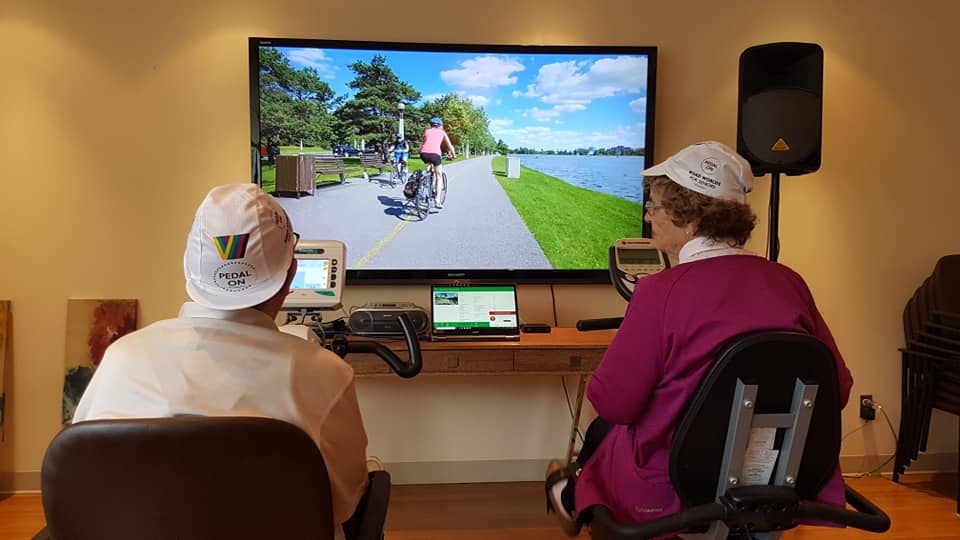 Dementia6 Jul
Cycling apparently boomed during last year's lockdowns as frustrated families sought to make the most of their exercise window; and the quieter roads as commuting ground to a halt.
Another cycling revolution, meanwhile, is underway in care homes, as new tech enables residents to unleash their pedal power and experience the open road - albeit on a screen. Motiview, designed by Norwegian firm Motitech, offers users the opportunity to cycle down the streets from their memories, revisit towns they once knew or explore destinations around the world via its video simulation system, all from the comfort of their own chair, using specially adapted exercise bikes Spinal injury6 Jul
Erin Pollitt suffered a serious spinal injury in her second year of professional dance training.
While practicing a difficult move during rehearsals at the Northern School for Contemporary Dance in Leeds, she fell to the floor and suddenly felt a sharp pain at the base of her spine. She was booked in to see the school’s physio the next day, feeling the full impact of the fall after being unable to walk properly or move as she normally could. Dementia6 Jul
In dementia cases, the instinct to look after and nurture something or someone can be among the last things to leave a person. People with the neurodegenerative condition may hold dolls while in care, for example, as their brain recognises them as objects requiring their care and attention.
While pets can also help to satisfy this need, taking care of them may be too much responsibility for many with the disease. A new solution is emerging, however, in the form of robotic animals.