From framework to practice: Raising the standard of rehabilitation personal training
By Rowan Morgan-Ruffley, RMR Rehabilitation Ltd
In our previous article, we explored why RMR Rehabilitation developed a Medical-Legal Personal Trainer Framework and why greater clarity, governance and accountability are needed when Personal Trainers work within complex rehabilitation pathways.
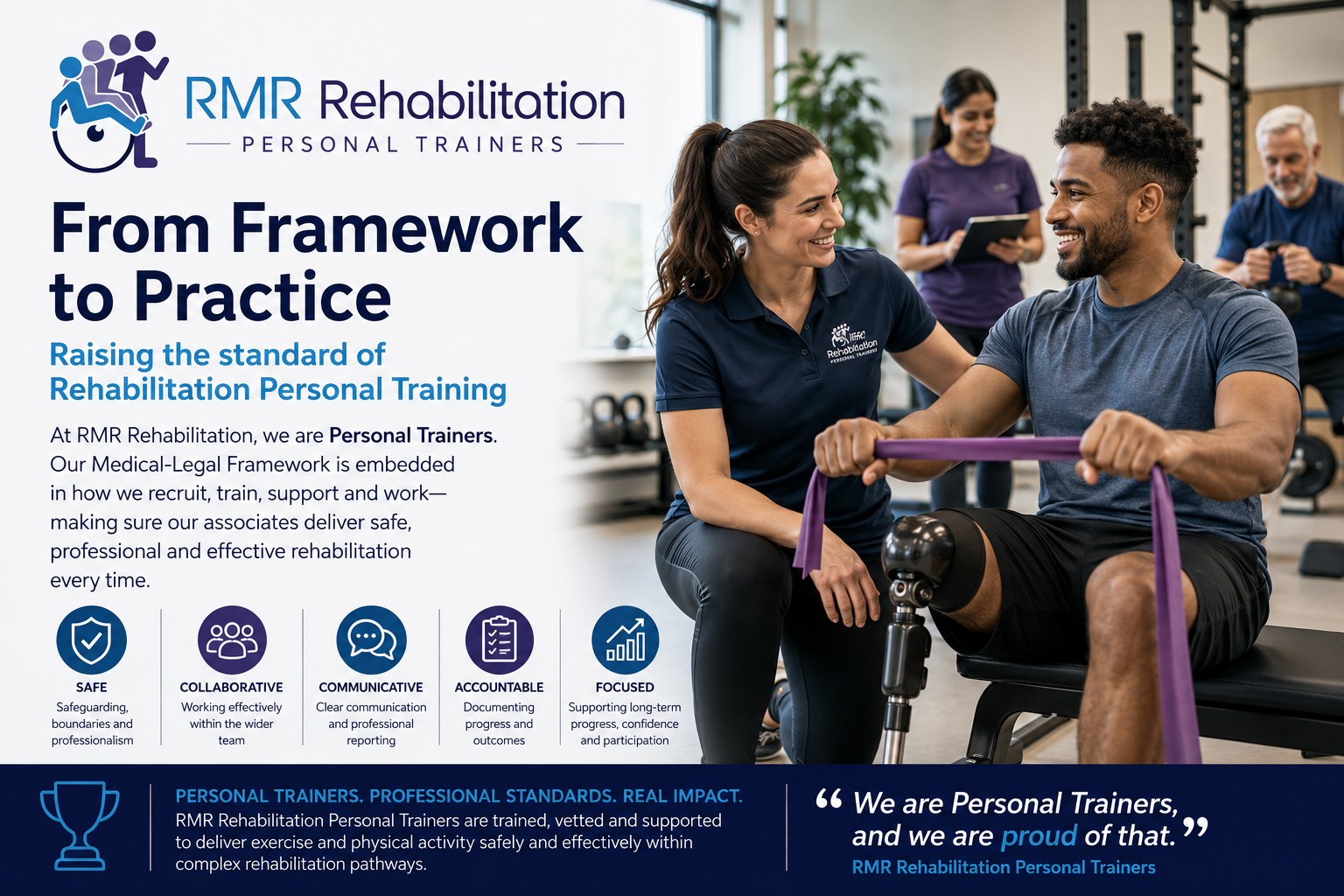
At the heart of RMR Rehabilitation, we are Personal Trainers.
We believe appropriately qualified and experienced Personal Trainers can make an important contribution to rehabilitation through exercise, physical activity, progression, motivation and confidence.
Learn more about RMR Rehabilitation
But working with people with complex injuries and conditions, particularly within the medico-legal sector, brings responsibilities that extend beyond delivering a good exercise session.
Creating our framework was the first step.
The next challenge was making sure it became part of how our Personal Trainers actually work.
More than a qualification
A Personal Training qualification provides an important professional foundation, but working within complex rehabilitation requires additional understanding.
Our associates need to understand safeguarding, professional boundaries, multidisciplinary working, communication, documentation and when something needs to be escalated.
This has changed the question we ask when bringing Personal Trainers into RMR.
It isn’t simply:
“Is this person a qualified Personal Trainer?”
It is also:
“Are they appropriately prepared to be a Personal Trainer within a rehabilitation pathway?”
Building the framework into our associates
The Medical-Legal Personal Trainer Framework is now part of how we prepare RMR associates for this work.
It includes safeguarding, understanding the medico-legal environment and multidisciplinary working, professional communication and report writing, and safe practice.
Alongside this sit our requirements around qualifications, insurance, DBS status and professional scope.
The purpose is not to turn Personal Trainers into clinicians.
It is about developing excellent Rehabilitation Personal Trainers who understand their expertise, their responsibilities and their professional boundaries.
Knowing our role
One of the most important principles within RMR is clarity around what we are there to provide.
Our expertise is Personal Training, exercise and physical activity.
Our Personal Trainers can help people build strength, fitness and confidence, progress their physical activity and work towards meaningful goals over the longer term.
We also recognise the importance of knowing when something falls outside our professional scope.
Working within rehabilitation requires confidence, but it also requires the professional judgement to stop, ask questions and seek guidance when appropriate.
Clear boundaries don’t diminish the role of the Personal Trainer.
They strengthen it.
Communication is part of professional practice
Working within medico-legal rehabilitation also means Personal Trainers need to communicate effectively beyond the training session.
Our associates may be communicating with case managers and members of a wider multidisciplinary team.
A trainer working regularly with somebody may observe changes in exercise tolerance, fatigue, mobility, confidence, motivation or participation.
Those observations can be valuable when communicated appropriately.
This is why professional communication and report writing form an important part of our framework.
We want our Personal Trainers to report objectively, provide useful information and understand the difference between sharing what they have observed and making conclusions outside their professional scope.
Creating consistency across our network
As our associate network grows, maintaining consistent standards becomes increasingly important.
Every client is different. Every Personal Trainer will bring their own experience, personality and coaching style.
We want to retain that individuality.
What should remain consistent are the professional standards surrounding the service — safeguarding, boundaries, communication, documentation, compliance and knowing when to escalate or seek support.
Individualised rehabilitation should not mean inconsistent professional standards.
For us, that is one of the most important reasons for having the framework.
Keeping Personal Training at the heart of RMR
As Personal Trainers become more involved in rehabilitation, we don’t believe credibility comes from trying to make Personal Training increasingly clinical.
Personal Trainers already bring valuable expertise.
We understand exercise and physical activity. We know how to progress and adapt training. We understand motivation, behaviour change and confidence. And we can help people find ways to make physical activity a sustainable part of their lives.
Our framework is about bringing those skills into complex rehabilitation safely, consistently and professionally.
And implementing it means those principles have to influence how we recruit associates, how we prepare them, how we communicate, how we report and how we support them once they begin working with clients.
At RMR Rehabilitation, we are Personal Trainers — and we are proud of that.
Our Medical-Legal Personal Trainer Framework isn’t about trying to make us something we’re not.
It’s about setting a higher standard for what a Rehabilitation Personal Trainer can be.