‘By the time we emerged from lockdown, I had learned to walk again’
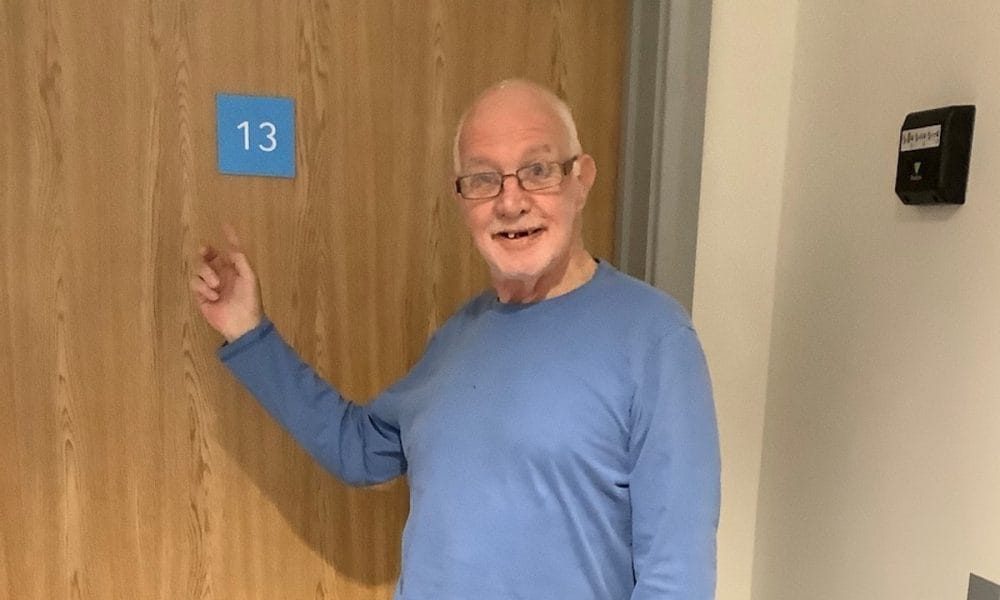
In April last year, due to a rare neurological disorder, Barry Whaite could only move his head independently. But by the time the country emerged from the first lockdown in August, he had regained the ability to walk. Here, he shares his story.
“I had initially been suffering from a chest infection and was taking antibiotics and steroids, as prescribed by my GP. I was not improving and eventually I fell a couple of times, then on 17 February last year, I was unable to stand up.
An ambulance came and took me to the Royal Preston Hospital, where after an MRI, a CT scan and a lumbar puncture, I was diagnosed with Guillain–Barré Syndrome (GBS).
I was given an immune therapy drug to stop the illness progressing to my lungs. I was now totally helpless, needing a hoist to move me.
I was transferred to the MRU. where I underwent rehabilitation. Unfortunately, due to Coronavirus, I was put into self-isolation and was transferred to a nursing home in Preston. The staff there were not able to deal with my illness, so my wife and daughter made arrangements for me to be brought home.

The consultant from the hospital, Dr Shakespeare, came to visit me to explain that the new Sue Ryder Neurological Care Centre Lancashire was due to open, and that it would be in my best interests to take up residence there.
I agreed, although reluctantly, to go for three weeks, as I was not progressing at home. I was unable to move, and was advised that the Community Rehabilitation Team would not be able to come to the house.
When I was admitted on 29 April, the only part of my body that I could move independently was my head.
I was depressed initially and this was compounded by the fact that I could not have any visitors. My daughter came every week and left cordial and goodies for me, to keep my spirits up.
I made great progress at the centre. I was hoisted for the first few weeks, and with their care and patience of the Sue Ryder team, I was taught to roll over on the bed, put my legs over the side and sit up without falling over.
The senior physiotherapist supported me into a standing position for a few seconds, then caught me on the way down. This made me believe that I would eventually stand again and spurred me on.
They introduced me to the banana board, which I hated with a passion! Eventually I managed, with assistance, to move from the bed to the wheelchair and to the toilet.
The next episode was to the gym with my ever-trusty banana board. There the physios worked on my legs and feet, then I needed to rest in order that my muscles could recover.
In the gym, I was also shown how to stand using the plinth, which the team raised slowly, forcing me to stand up.
That day gave me hope. I learned ‘sit to stand’ and then I was introduced to a walking frame.
On my second goal-setting meeting, I celebrated my birthday and as a treat, the staff had decorated my room, made me a birthday cake and organised a new self-propelled wheelchair.
At last, I had some freedom.
My family visited on the day, and I was allowed to speak to them in person through the door, albeit two metres apart. This was the first time I had seen them, other than on FaceTime.
I slowly progressed with the help and encouragement of the rehabilitation team. They went on to show me how to deal with my personal care so I could become more independent.
I then became involved in more activities with the staff and other residents, including bingo, quizzes, Jenga and jigsaw puzzles.
Later, I had a home visit to see what equipment I would need to support me when I was discharged, such as a shower seat, internal hand rails, perching chairs and an enhanced toilet seat. All these items were provided, together with a four wheeled walker. The only difficulty I had was gaining access to, and leaving, my home through the main door due to the steps.
On my return to the Sue Ryder Neurological Care Centre Lancashire, I was offered a further three weeks’ stay, in order that I could master a few steps, as my walking ability (with the aid of the walker) had improved dramatically.
I was discharged on August 5 to a Guard of Honour, and a round of applause and the staff singing ‘Take Me Home Country Roads’!
The occupational therapist and physiotherapist brought me home and helped me settle in.
I have nothing but praise for Sue Ryder Neurological Care Centre Lancashire. Without them, and had I remained at home, I am sure that I would still be bed ridden now.”