



“I had to recover from life-saving neuro surgery during lockdown”
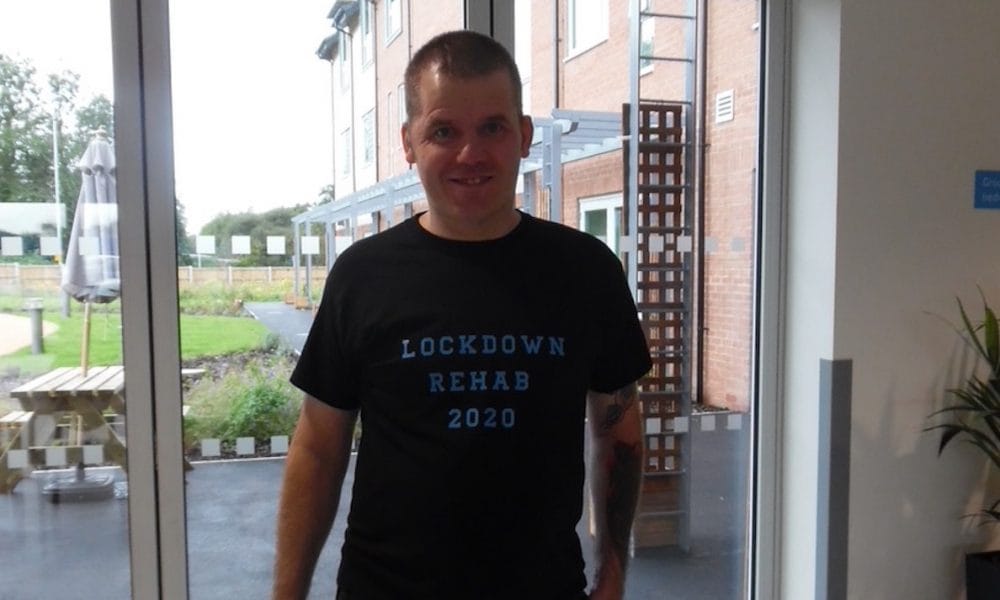
Having had a subarachnoid haemorrhage the day after full lockdown was imposed on the UK in March, Lee Atkinson faced the trauma of a lengthy recovery without seeing his family. Here, he shares his story of how he coped.
For millions of people across the country, the onset of the COVID-19 pandemic marked the start of a hugely challenging period. But for Lee Atkinson, that challenge was one of survival, after he experienced a subarachnoid haemorrhage the day after the UK went into lockdown on March 23.
Having felt unwell for about three weeks, Lee, a car garage manager, was seeking medical attention for his developing situation.
“He had been coming home from work feeling really tired and he’d had a few headaches,” recalls his wife, Petra.
“He went to the GP and they thought it was down to high blood pressure. He was even seen at the hospital for a scan and then he went back to work.
“But then I came home one morning after a night shift and found him collapsed in the bathroom.”

Lee, 47, was rushed to the Royal Preston Hospital, and underwent life-saving surgery after it was established he had experienced a haemorrhage. In the aftermath of his operation, Lee realised he had become partially paralysed and was struggling to communicate.
As the pandemic escalated, Lee was transferred out of hospital and into the Sue Ryder Neurological Care Centre Lancashire. The purpose-built centre had only recently opened its doors after an 18-month construction project to bring it to life, and fast-tracked its ability to welcome patients to help relieve pressure on the hospital and other local partners.
“I went into Sue Ryder on a stretcher on April 30, and at that point I was paralysed on my left hand side and my speech wasn’t great. I couldn’t use my left arm,” remembers Lee, a father of two.
“But over a period of time, they helped me get back on my feet, but they were very cautious with me.
“I had a set timetable over the week so everything was planned for me. It was really good for me to have that structure because I was in a bad place to start with. I was quite depressed but they really helped me through that.
“I was wanting to push to walk and they were being cautious because I had a period where I still had a hole in my skull from the operation. They leave it like that for about three months and you have to wear a helmet.
“I still have that helmet – all the Sue Ryder staff signed it for me. We really appreciate what they did. I was really lucky to be moved there.”
Due to the stringent restrictions on visiting imposed as a result of COVID-19, Petra was only allowed to visit her husband once in hospital, and with the pandemic escalating quickly, the opportunity for in-person visits was not possible at Sue Ryder, to protect the centre and its residents from the deadly virus.
However, keen to offer families the opportunity to be together however possible, visiting ‘of sorts’ was enabled by the team.
“After a week or so they let me and the kids go and visit him through the window, just to be able to do that meant a lot to us because we had not seen him for so long,” says Petra.
“Then, after a little while, Lee got better with his phone and was able to Facetime us. The staff were always happy to help with anything like that.
“It was obviously all new for the staff too, because usually the families would be really involved in someone’s care, but because of COVID, we weren’t able to be there.”
But while Lee was parted from his family, he was making strong progress in his recovery, buoyed by the thought of going home and working with the centre’s occupational therapy team to make that happen.
“We really didn’t know if he was going to walk again but the physio team were fantastic and some of the assistants who helped with the cognitive treatment were great,” recalls Petra.
“The staff really catered to his needs. They were so understanding about what he liked to eat and let him eat when he wanted to. They even got him involved in some games. They were just fantastic.”
On August 28, five long months after Lee’s life-saving surgery, he was able to return home, with the assistance of the Sue Ryder occupational therapy team. He is now supported by the local community team for ongoing rehabilitation.
“They arranged for Lee to have an overnight stay before he was discharged so we could make sure everything was in place that we needed,” recalls Petra.
“I went and picked him up and it gave me a chance to talk to them about things I was worried about. It really has changed our lives. It has changed everything. We were just a normal family before this.”
Lee’s recovery continues, but he is grateful for the support of the team at Sue Ryder Neurological Care Centre Lancashire during such a traumatic time for him, and particularly without the ability to see his family.
“I found it really helpful at Sue Ryder because while I was going through a really stressful time in my life, they were really great helping me to get through it,” adds Lee.
“I was just lucky that they were able to open when they did.”


