


People who have limited movement following a brain injury are at risk of developing pain and future health problems due to prolonged sitting and lack of exercise, which can lead to atrophy of the muscles.
Rehab certainly can help with this – but one company hopes to help these exercises become much more enjoyable.
Munich-based Icaros says its devices are adjustable, easy to use and can be customised to patient’s needs.
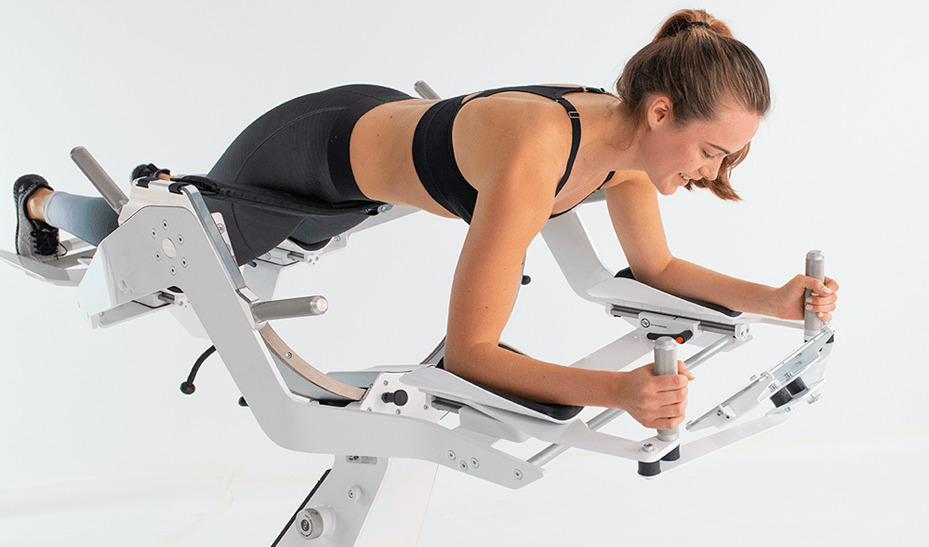
The ICAROS Health unit is designed for professional use in therapy and rehab, offering core training for patients who have physical limitations. The device is designed to help improve muscle activity and coordination between muscles, while a slight increase in heartrate boosts circulation.
“We gamify fitness training, mostly using virtual reality (VR),” says co-founder Johannes Scholl.
Gamifying is the application of game-playing features in non-gaming contexts. Icaros does this by creating its own hardware and software solutions in-house to provide exercise experiences linked to flying, that enables users to work out their muscles and their core, as well as shoulders and lower back. It also allows users to work on their coordination, balance and reflexes.
“It’s mostly used by people who’ve had a brain trauma or stroke,” Scholl says.
The most important feature of the device, Scholl says, is that it’s built like a gyroscope’ that allows users to move freely. Users are in a plank position, and get an anti-gravity feeling when they’re on the device.
Scholl says the device helps people re-engage muscle groups they sometimes haven’t used for years. The device’s impact on people who use it regularly can be checked by testing muscle activity and standardised tests used in neuro rehab.
“A patient recently did a test – where they sit on a chair, stand up and walk forward for three metres, and turns around and sits down again – before and after a half an hour flying session, and they improved by two seconds, which is a dramatic improvement,” Scholl says.
“One stroke patient who was visiting us a few weeks ago had a stroke seven years ago, and is still in recovery, our colleagues measured his muscle activity and it’s incredible.”
Scholl attributes the company’s success partly to its interdisciplinary approach; the company is supported by a science board.
“Me and my co-founder Michael Schmidt turn things into reality, and we work with patients. We watch the doctors work with patients, and take notes with them – then it’s on us to develop the hardware and software. We listen, watch and observe.”
Scholl says the work is always rewarding, and sometimes challenging.
“The most important thing is to listen and observe – every patient is unique, and what works on one won’t necessarily work on another.”
This is especially important since the company is constantly adapting and updating. Icarus Health, for example, includes lots of feedback the company received from trainers, for example, for extra, adjustable chest support.
“We always though, when we started with the fitness device, that the flying position is something everyone is capable of doing, but if a stroke patient is paralysed in their right arm, they won’t have the strength to hold the plank position so they need support.
“It’s fun, and rewarding, to solve problems like this,” Scholl says.
Ultimately, it’s a great break from traditional rehab exercises for patients, Scholl says, which are usually quite repetitive by nature.
“There are so many exercises in rehab patients have to do – in our case, having a patient fly over the Swiss Alps has a great emotional and motivational aspect to it,” he says.
Icaros Health is shipped globally and used all over the world in fitness centres and rehab facilities, but Scholl says the company’s goal is to expand further and have more systems installed in facilities around the world to help neuro rehab patients.
“Patients seem to love what we’re doing,” he says. “We’re constantly trying to improve”.


