‘I was utterly distraught, because I knew I might never again be with the woman I love.’
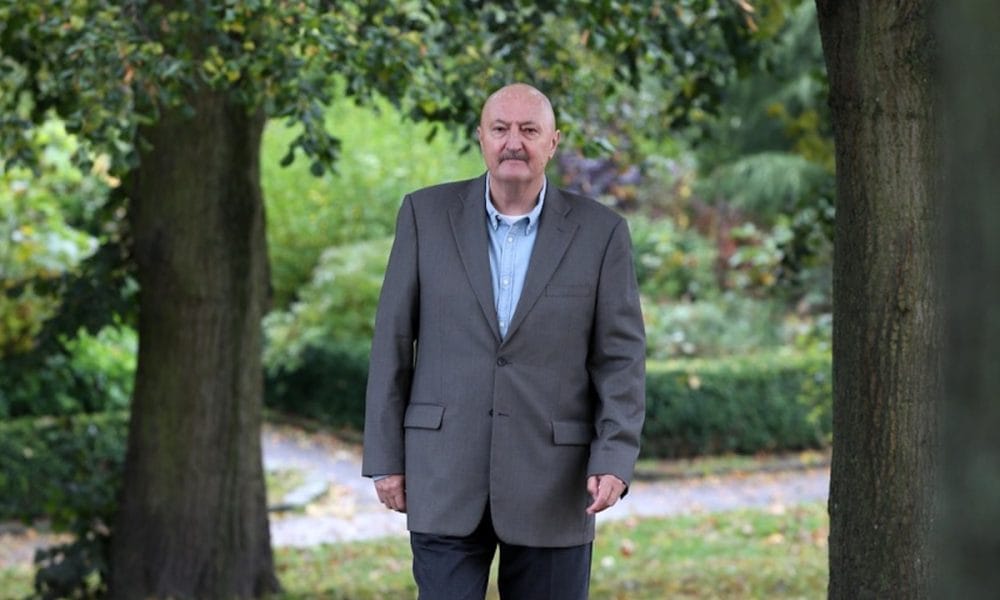
Lockdown has prevented Kevin Jones from being with his partner, who has Parkinson’s and dementia with Lewy bodies, in her care home. Here, he shares his story.
“When this horrible, horrible condition started, our lives changed basically overnight.”
They are the heartbreaking words of Kevin Jones, whose partner Jean has dementia with Lewy bodies.
Jean now lives in a care home that has been locked down during the pandemic, with Kevin only able to see her through a bedroom window.
‘I’d give anything to be able to sit by her side, hold her hand and give her a kiss,’ he says.

Kevin, who lives in Wrexham, north Wales, says, ‘This is not just my story, this is Jean and I – she was my rock.’
Kevin visited Jean every day prior to the pandemic.
Jean, now 80, grew up in Newport and was an office manager for various companies. She met Kevin in 1990, while she – by then divorced – was holidaying with her daughter Julie.
‘We met purely by chance and it was love at first sight,’ says 71-year old Kevin, a former police officer.
Jean was excellent at crosswords and sudoku, and she loved opera. Having both retired in 2000, she and Kevin enjoyed winter sun holidays and cruises.
‘She was always loyal, supportive and 100% genuine,’ says Kevin. ‘My only regret is that I had not met Jean 50 years ago instead of only 30.’
In December 2016, Jean fell as she was leaving the couple’s flat. They pushed ahead with a planned holiday, but it was soon clear that something wasn’t right.
‘Jean became very anxious at the airport and wouldn’t let go of my hand,’ says Kevin. ‘At the hotel, she wouldn’t come down for breakfast and didn’t want to be around crowds or interact with people. She also lost all interest in our usual walks.’
Jean had numerous medical appointments over the following months. Despite support from Kevin and others, she began to have spasms and had to spend time in hospital. She was diagnosed with Parkinson’s, and a consultant confirmed that she also had dementia with Lewy bodies.
People who have dementia with Lewy bodies can have problems with attention and alertness that vary over time, and difficulties judging distances.
They may see or hear things that aren’t there, have persistent false beliefs or experience disturbed sleep. Difficulties with movement, which increase the risk of falling, affect many people with the condition.
As with other types of dementia, symptoms increase and get worse over time. As it progresses, day-to-day challenges become more similar to other types of dementia.
‘Jean would say, “What are those birds doing on the ceiling? Why are there cats and dogs walking on the walls?”’ recalls Kevin. ‘She also started shouting and screaming at night, which was very distressing.’
With Kevin struggling to cope, Jean moved to a nursing home for around six months, where her health improved. But after returning home she soon deteriorated and moved back into a care home, this time on a permanent basis, in June 2018.
‘We were very lucky that we found a home which could support Jean with dementia, epilepsy and Parkinson’s,’ says Kevin. ‘It was excellent – I went every single day and was made part of the family.’
One Sunday in mid-March, Kevin was with Jean when the home’s manager said the building was going into lockdown.
‘Jean didn’t really understand what was happening,’ says Kevin. ‘I said to her, “I don’t know when I’ll be able to come back here and be physically with you, my love. I love you lots and I’ll see you as soon as humanly possible.”
‘I was utterly distraught, because I knew I might never again be with the woman I love.’
The home encouraged socially distanced outside visits, but because of Jean’s frailty and health, Kevin wanted her to stay in her warmer room. He sees Jean through her ground floor window every Sunday.
‘The staff wheel her chair to the window. We can’t have a conversation, but at least I can see her. Some residents are on the first floor and their loved ones haven’t been able to see them since March.
‘It’s heartbreaking and I’m devastated when I come home to an empty flat. I just sit on a chair and cry. I’m in utter shreds. Then as the week progresses, I get stronger.’
Kevin was shocked when Jean developed COVID-19 in July, though thankfully she recovered.
‘At the time I was very upset,’ he says. ‘I’ve since taken stock and understand the difficulties they have in these care homes. If you have a flood, some water might get in.’
Kevin gets weekly Companion Calls over the phone from Alzheimer’s Society volunteer Rachel.
‘Rachel was my only light at the end of the tunnel when I was self-isolating,’ says Kevin. ‘It was all I had from March to August – some weeks she was the only person I spoke to.
‘She has been a listening ear, and very supportive. I can say how I feel, how I miss Jean. She never judges me or criticises, she just listens.
‘I would like to sincerely express my gratitude to her and Alzheimer’s Society. If I wasn’t able to talk to somebody, I think I’d have serious mental issues. I’m truly thankful for those calls.’
Kevin welcomed the recent announcement of a pilot scheme for family carers to be treated as key workers.
‘Whatever model they use, if something was offered to me, I’d jump at it,’ he says.
Recent months have been agonising for Kevin, but he’s keen to share his and Jean’s story.
‘For anyone out there with nowhere to turn, like I was in March, they may think, “I’m not alone.”’
And, as difficult as he finds them, Kevin continues his weekly visits to see Jean, no matter what.
‘On occasion, up until very recently, she could look at me with recognition in her eyes,’ he says. ‘I know, when we have that moment, the bond between us is stronger now than it has ever been.
‘Those moments are so precious to me, I just can’t explain. That keeps me going.’
* Interview shared with permission from Dementia together, the magazine of Alzheimer’s Society – www.alzheimers.org.uk/magazine