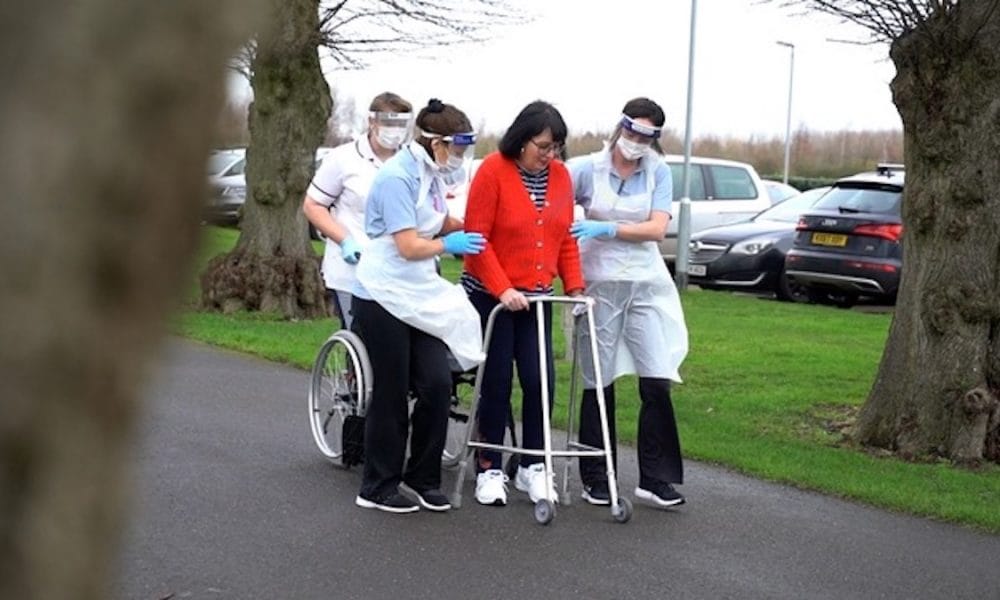
A mother-of-three who was left only able to move a couple of her fingers after being struck by a rare neurological condition has been discharged from a specialist rehab centre in time for Mother’s Day – even managing to walk independently through the front door of her home.
Hayley Trotman had been in an induced coma for eight days after being diagnosed with Guillain-Barré syndrome (GBS). She spent three months in intensive care, where she had stopped breathing twice and had to be mechanically ventilated with a tracheostomy.
The 44-year-old was left unable to move her body, save for a couple of fingers, and was in excruciating pain through GBS, a life-threatening condition that attacks the nerves which Hayley is believed to have contracted through a common cold.
To support her recovery, Hayley was admitted to Askham Rehab, a specialist neuro rehab community, near Doddington, from an acute trust last November.
Due to the severity of her condition, she needed specialist treatment from all of the disciplines at Askham – clinical psychology, physiotherapy, occupational therapy, and speech and language therapy.
Following assessments, the multidisciplinary team set SMART (Specific, Measurable, Attainable, Relevant, and Time-Bound) goals for Hayley, who was then subsequently prescribed to a treatment programme specific to her needs.
“When Hayley first came to Askham, there were a lot of issues around her pain,” recalls Sara Neaves, clinical lead and outpatient service manager at Askham Rehab.
“Just pulling back her bedsheets caused extreme pain, and this required a lot of input from our medical and clinical psychology teams to help stabilise.
“I remember Hayley saying to me, ‘I’m so scared I will never be able to walk again’. I promised her she would, but we knew it was going to be a long road to recovery.”
Once her pain had stabilised, Hayley was able to make use of Askham Rehab’s new robotics and sensor-assisted technology, with the centre being one of a very small number of providers in the UK to offer a specialist robotic-led rehabilitation service.
Using Tyromotion’s OMEGO Plus, a multifunctional chair enabling specific training of functional therapy goals, Hayley was able to challenge her lower limbs in strength, movement, accuracy, and coordination.
To help with upper limb movement, Hayley made use of the MYRO table, a sensor-based surface with interactive applications, the AMADEO, a robotics and sensor-based device for hand therapy, and the PABLO, a sensor-based rehab device for unilateral and bilateral training.
Empowered with the state-of-the-art equipment, along with sessions in the hydrotherapy pool and sensory rooms and gardens, therapists were able to improve Hayley’s condition drastically in just a matter of weeks, to the point where she was able to walk again with assistance.
Continuing with the activities the multidisciplinary team put together for her as a weekly timetable, Hayley was soon able to live independently in a self-contained, fully adapted on-site apartment.
Using the space to build back her confidence through independently cooking, walking and making use of the abundant gardens and grounds, Hayley was given a departure date of March 11 – being able to fulfil her ultimate goal of arriving home to her children and husband in time for Mother’s Day.
Reflecting on Hayley’s journey, Sara says: “From someone who could only move their fingers when they first arrived, Hayley has progressed incredibly well.
“Askham’s ethos is all about empowering and caring for the individual, making their journey very much patient centred. The environment here is friendly and open – we could tap into Hayley’s hobby of being out in the garden which helped lift her mood and fully engaged her in the rehab process.”
Hayley reflects: “I was terrified when I came out of ICU but upon my arrival to Askham, I was reassured that everything was going to be OK and that I would return home to my family.
“My most memorable milestone was when I first used the rollator to walk. I thought I was going to hit the deck, but the team at Askham encouraged me to do it and I ended up walking down the corridor – it was fantastic.
“They even videoed the moment and sent it to my husband and children.
“During my stay, I started a journal so I could reflect on my journey and note my progress. Each day, I wrote down advice from the team and used it as motivation.
“Their words helped me move forward and have stayed with me to this day. I’ve been supported in every step of my journey and will be forever grateful for everything the team at Askham did for me.
“I’ve got so many things on my bucket list now. One of the first things I want to do is jump out of a plane to raise funds for GBS.”