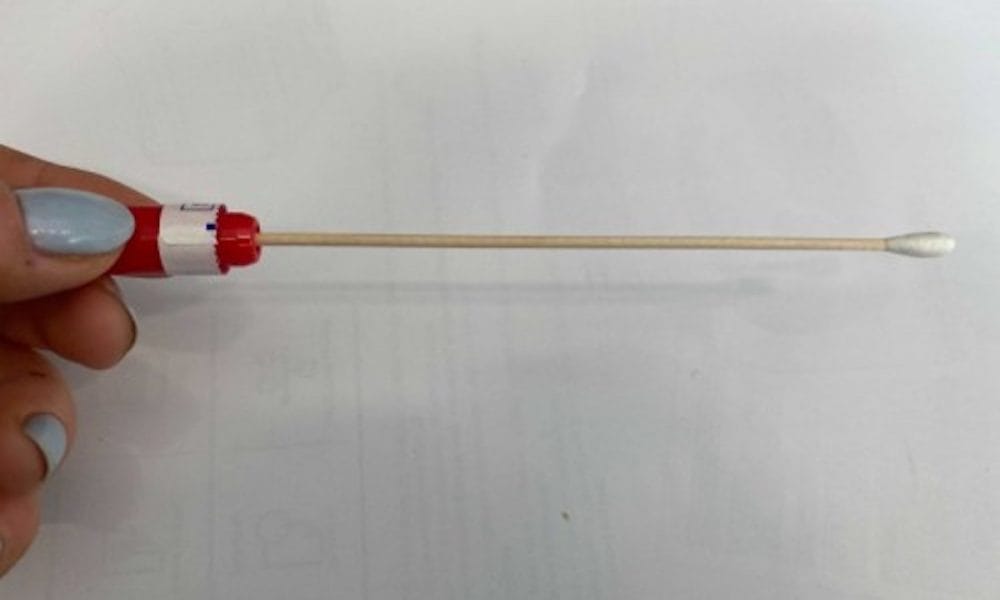
Diagnosis of Parkinson’s disease could be made through a skin swab procedure, after research confirmed it it possible to identify the condition from compounds found on the surface of the skin.
Scientists at The University of Manchester have developed a world-first technique which works by analysing compounds found in sebum – the oily substance that coats and protects the skin – and identifying changes in people with Parkinson’s disease.
“We believe that our results are an extremely encouraging step towards tests that could be used to help diagnose and monitor Parkinson’s,” says Professor Perdita Barran, from the University of Manchester, who led the study.
“Not only is the test quick, simple and painless but it should also be extremely cost-effective because it uses existing technology that is already widely available.
“We are now looking to take our findings forwards to refine the test to improve accuracy even further and to take steps towards making this a test that can be used in the NHS and to develop more precise diagnostics and better treatment for this debilitating condition.”
The research has been funded by charities Parkinson’s UK and the Michael J. Fox Foundation as well as The University of Manchester Innovation Factory.
It comes after a recent survey of more than 2,000 people with Parkinson’s, carried out by Parkinson’s UK, more than a quarter (26 per cent) reported they were misdiagnosed with a different condition before receiving the correct Parkinson’s diagnosis.
The team, led by Professor Barran and the clinical lead, Professor Monty Silverdale at Salford Royal Foundation Trust, recruited 500 people with and without Parkinson’s.
People with Parkinson’s may produce more sebum than normal – a condition known as seborrhoea. Sebum is rich in lipid-like molecules and is one of the lesser studied biological fluids in the diagnosis of the condition.
Samples of sebum were taken from their upper backs for analysis.
Using different mass spectrometry methods, 10 chemical compounds in sebum were identified which are elevated or reduced in people with Parkinson’s. This allows scientists to distinguish people with Parkinson’s with 85 per cent accuracy.
High resolution mass spectrometry was used to profile the complex chemical signature in sebum of people with Parkinson’s and show subtle but fundamental changes as the condition progresses.
Detailed analysis showed changes in people with Parkinson’s in lipid processing and mitochondria. Problems with mitochondria are one of the hallmarks of Parkinson’s.
This means this world first testing strategy is not only useful in diagnosing Parkinson’s but also in monitoring the development of the condition.
The skin swab could provide an incredibly important new tool in clinical trials helping researchers measure whether new, experimental treatments are able to slow, stop or reverse the progression of Parkinson’s.
The study unveiled novel diagnostic sebum-based biomarkers for Parkinson’s, provides insight into understanding of how the condition develops, and links lipid dysregulation to altered mitochondrial function.
The research team hopes the study could lead to a definitive test to diagnose Parkinson’s accurately, speedily and cost effectively. The team is now seeking funding to further develop the test and explore the potential for using the test to ‘stratify’ patients.
Working with the University of Manchester Innovation Factory, the team has patents filed for their diagnostic techniques and are planning to create a spin-out company to commercialise the new tests.
They are also working to use this approach to develop tests for COVID-19 as shown in research last week in EClinical Medicine as well as other conditions and are actively seeking investors interested in supporting the drive to bring this technology to market.
Professor David Dexter, associate director of research at Parkinson’s UK, adds: “We are proud to have part-funded this groundbreaking research which marks a significant step towards developing a quick and accurate test that can not only revolutionise the way we diagnose Parkinson’s, but also allow us to monitor how this debilitating condition progresses.
“Every hour, two more people in the UK are diagnosed with Parkinson’s and a significant portion of these people may well have been misdiagnosed with, and treated for, another condition before receiving their correct diagnosis.
“This has been compounded in the COVID-19 pandemic where people have been left waiting and have faced months of anxiety to confirm their diagnosis by a health professional.
“However, with this innovative test, we could see people being diagnosed quickly and accurately enabling them to access vital treatment and support to manage their Parkinson’s symptoms sooner.”