Explained by Sean O’Sullivan, Neuro Rehabilitation Trainer at www.neurokinex.org
What is it?
Neuromuscular electrical stimulation is frequently used post spinal cord injury (SCI) as it has been shown to increase muscular strength and mass, enhance bone density and assist in improving cardiovascular function. However, this form of stimulation only results in contractions of superficial muscle fibres.
Wide Pulse Stimulation (WPS) is a form of electrical stimulation used at Neurokinex which not only activates muscles superficially to promote the benefits of traditional stimulation, but also promotes increased central activation. This is of particular importance since central activation is the ability to contract available muscle mass which is disrupted after SCI. Research has shown that even in motor complete individuals (those with no motor function below their level of injury), electromyography activity persists after WPS, enhancing the environment within the spinal circuitry to activate motor units. In other words, the participant’s neural system has been primed and is at a heightened state, increasing the potential for SCI rehabilitation.
Work alongside it
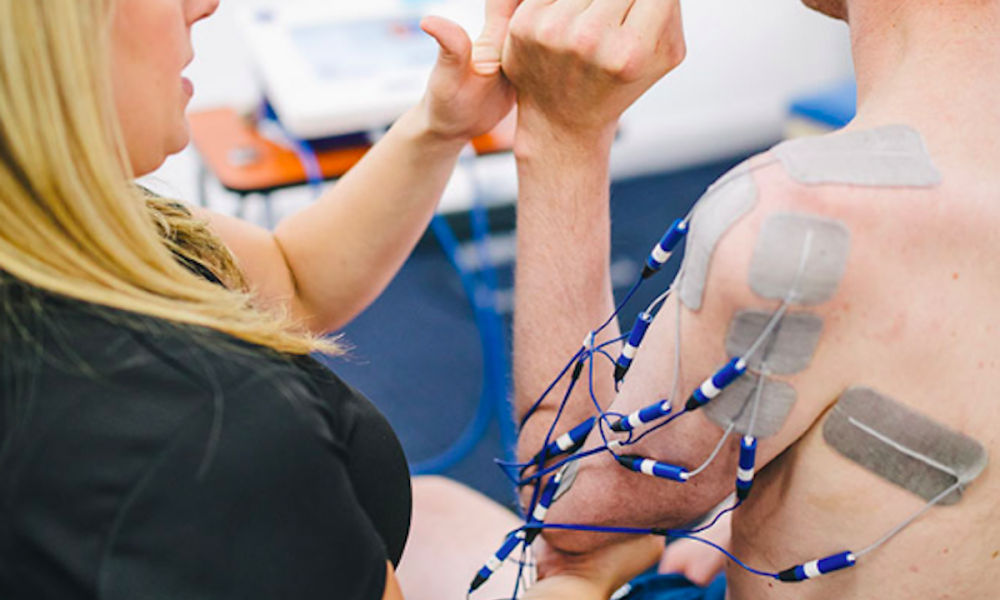
So how does a WPS session at Neurokinex work? Before any stimulation is applied, participants discuss with their trainer what functional goals are important to their daily life. Depending on the level of their injury and function, this can range from reaching to grasp an object, to standing from a seated position. This is then combined with scores achieved on the Neuro Recovery Scale to form a stimulation plan. Electrodes are then placed on the skin over the corresponding muscles which are associated with a particular functional movement and the participant consciously works alongside the WPS.
In order to maximise the potential of WPS, it’s imperative that consistent, high repetitions are completed – the body is wonderfully adaptive and neural connections can be strengthened through repeated activity, otherwise known as neuroplasticity.
The main benefits of WPS are:
- Increased muscle mass
- Improved voluntary motor control
- Improved function
- Improved sensation
- Improved autonomic regulation
- Provision of the optimal environment for neuroplasticity to take place
With the neuromuscular system primed, the rest of the session is dedicated to further enhancing function through activity-based rehabilitation.
Neal’s story
Neal, 55, has been using WPS alongside activity-based rehabilitation at Neurokinex Gatwick since November 2017 after a cycling accident resulted in a SCI (T3 ASIA B). The primary focus of our WPS therapy with Neal is to target his core and legs to achieve minor gains that, in turn, have made a tremendous impact on his daily life. Regaining slight movement in his quadricep muscle has enabled Neal to transfer into his car more quickly and safely. In addition, the improvements in Neal’s core stability means he can now reach down from his chair to pick up items from the floor – a huge help in his daily job of running a local health shop with his wife.
Here at Neurokinex, we use WPS with a diverse range of clients as it’s the perfect complement to our activity-based rehabilitation programme. The highly trained team can create bespoke WPS programmes catered to the specific needs of individuals, resulting in gains that bring lasting lifestyle improvements.