



Typically when someone mentions Parkinson’s Disease the first thing people think of is muscle stiffness, tremors and slowness.
This leads a lot of people to believe that those with the condition cannot partake in any sort of sport, particularly those that are of a high intensity like football.
However this has not stopped the creation of one football club in Hertfordshire that is getting those who live with Parkinson’s out on the pitch.
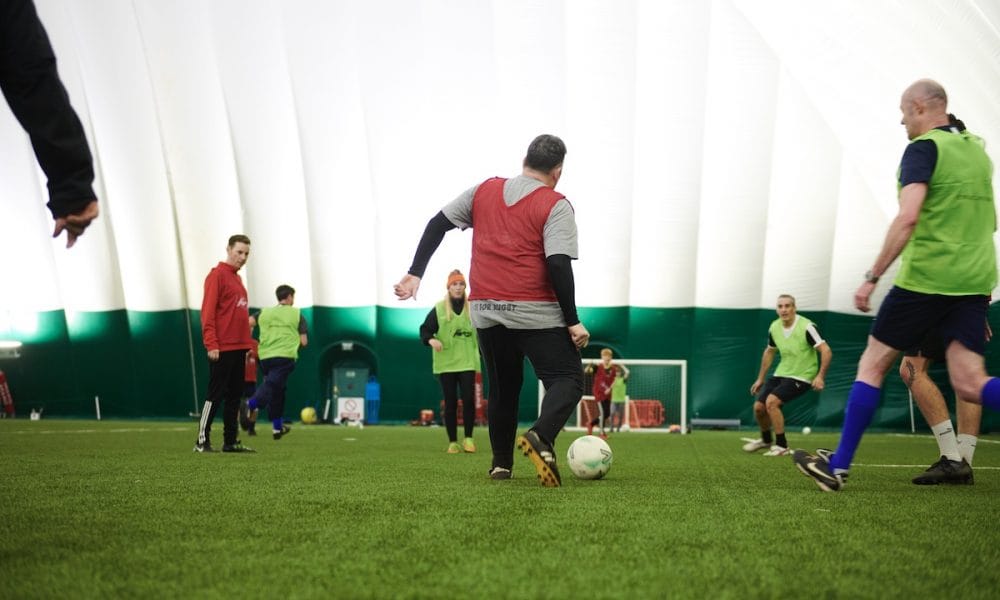
Fighting Fit Football has been showing how exercise can alleviate symptoms by bringing people together for fun and engaging sessions each week.
 Set up by Nick Light, who himself lives with Young Onset Parkinson’s, it features a number of regulars who are at different stages of the disease, with the club lucky enough to be able to use Watford FC’s training facilities.
Sessions are catered to each patient’s needs with no rough tackling allowed, but Nick says this has not detracted from people’s enjoyment.
“What never fails to impress me is the quality of some of the play that we do,” Nick said. “Most of the football we do is five and seven-a-side and we play at a decent speed considering we are all dealing with our own issues with our health.
“We play at a very decent level and I think people that have been before are quite impressed with what they see.”
The team consists of around 12 regular players with a number of others joining in each week, all supported by volunteers.
Nick’s own battle with Parkinson’s is what led him to the creation of Fighting Fit Football after being diagnosed just age 45.
He recalls the shock he felt when he found he had the condition.
“I went to see my GP about a pain in my leg and arm and some stiffness,” Nick said. “Surprisingly he referred me to a neurologist so I went in there not really knowing what was going to happen and he said there and then that I had Parkinson’s.
“It was completely unexpected to say the least, it came out of the blue.”
“I didn’t really know much about the condition because you think of it as being something for the elderly, but I’ve subsequently found out that there is a large minority of people that do have the condition, many much younger than myself.”
“If you met me you probably wouldn’t know I had Parkinson’s if you saw me at the right time.”
Nick admitted he had never played football to a high standard but that did not stop him seeing the potential of an initiative like this.
This is partly due to what happened to him after his diagnosis, feeling the benefits first-hand of what exercise can do to those with the disease.
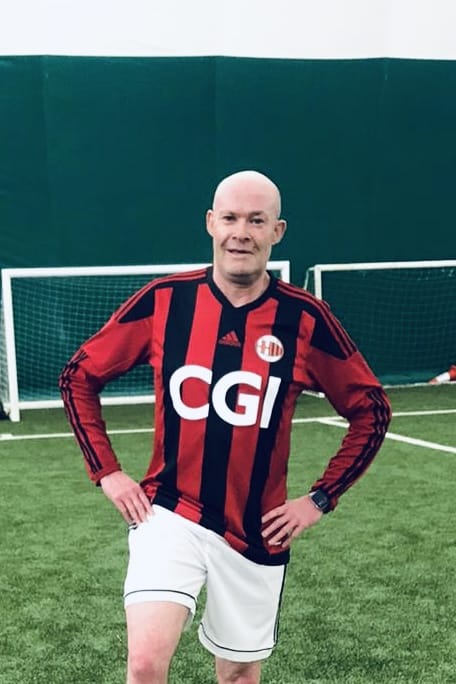
Nick Light – Fighting Fit Football
“One thing the doctor said to me was if you can exercise then do it,” Nick said. “I was semi-fit at the time and I thought I’m going to go for it.
“My first reaction was to do that and I’ve now learnt that it is really important for people who have Parkinson’s.
“As a result of being fit I didn’t need to go on any medication. I made that personal decision but for the first four years I didn’t need any.”
For most doctors exercise is now top of their prescription list for Parkinson’s patients, particularly for those diagnosed with the Young Onset version of the disease.
After what he has been through Nick agrees with this, saying it is ‘as important as anything else.’
However for some getting in the gym does not cut it, which is why alternatives like Fighting Fit Football are so crucial.
Being on the doorstep of the professionals at Watford FC certainly helps with this, as does training sessions with England walking football over 60s manager Stuart Langworthy.
But the close knit group that Nick, who also has a full-time career in IT, has helped form has created a real sense of community for the players.
These types of support networks are vital to make sure no one faces the condition alone.
“People say to me that it’s almost like when they play they forget their own limitations, they forget that they have anything wrong with them at that point in time.
“I find the exercise is only half the story because actually the community, which is something I didn’t really appreciate until more recently, is just as powerful.
“I enjoy the coming together and doing it together as a team. Those who come are mainly men of a certain age who may not seek out support groups.
“This becomes an unofficial supportive community where we can chat to each other, we all feel like we’re in this together and we’ve all got a common goal which is to enjoy it.”
Although the physical impact of the disease is there for all to see, the mental side can be equally as damaging with things like anxiety and depression common among these patients.
This is very relevant for those with Young Onset Parkinson’s as they can often feel the most alone.
The events of the last year have robbed many of the group’s attendees of this connection, but Nick is determined to carry on the success of the club.
Off and on lockdowns in the UK has made it a particular struggle and even caused the cancellation of the Cure Parkinson’s Cup which Fighting Fit Football was set to compete in.
However they are set to try again this year and are preparing to enter a team to this year’s version in July, with Nick also having plans to expand the team’s reach and host other clubs for games from around the country.
Furthermore Nick wants to expand the team and get more people involved so they too can feel the benefits of this community.
For now though the club are focusing on their regulars back play so they can feel the effects of this positive footballing community.


