
Sponsored feature
Why is Cartilage Important?
Bones that come in contact with other bones are covered by cartilage at their contact points. Cartilage does not have blood vessels – it is supplied with nutrients through movement of the joint. That’s why regular exercise is so important!
Cartilage ensures that the joint surfaces move against each other in the most efficient way and with little friction. It absorbs shock, cushioning the joint, and distributes the forces acting on the joint.
If cartilage is damaged and its gliding properties are affected, it can no longer serve its purpose and the joints range of movement can become limited.
Typical Progression of Osteoarthritis
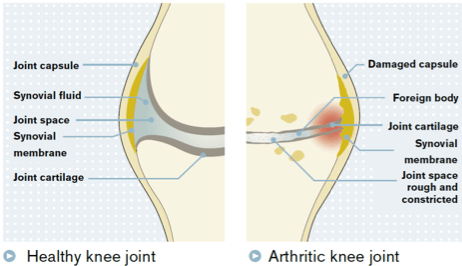
When osteoarthritis of the knee develops due to joint malalignment, an accident, advancing age, obesity or excessive strain, the damaged cartilage is no longer able to properly fulfil its function.
This results in pain and reduced mobility. The affected patient instinctively assumes a relieving posture to reduce strain on the knee.
However, this often leads to new problems in other places, such as the hip, and reduces the supply of nutrients to the cartilage, for which movement is required – sparking a vicious circle.
The cartilage develops cracks and begins to break down. At the same time, the bone thickens at the site of the damage.
When the cartilage layer is completely worn away, the affected bones come into direct contact and rub against each other causing joint pain and inflammation.
The thickest joint cartilage is located behind the kneecap (patella). This is an area of high stress. Osteoarthritis occurring in this area is known as patellafemoral osteoarthritis

Signs and Symptoms
There are several common symptoms that signal knee osteoarthritis. They can occur individually or together. However, with the initial onset, you may not notice any of these symptoms
When symptoms appear they usually occur in the following order:
- Cracking in the joint
- Pain during load bearing activities, such as carrying a heavy object
- Pain during every day activities, such as climbing the stairs
- Reduced mobility
- Swelling and inflammation
Non-Invasive Treatments
Joint specific exercises: with regular exercise mobility can be maintained and muscle strengthened, ensuring the cartilage is supplied with the nutrients it needs.
Temperature: with acute inflammation, cold relieves pain and reduces swelling. Heat relaxes the muscles and tendons and increases the flow of nutrients. Heat may only be applied when the joint is not inflamed.
Creams: various over the counter products are available at your local pharmacy including gels and creams that can help relieve pain.
Orthopaedic devices (braces and supports): these are applied externally to the knee, reducing pain and improving mobility.
Lifestyle: living a healthy lifestyle can help to combat osteoarthritis. A healthy diet and an active lifestyle reduces the chance of obesity, putting less stress and strain through the knee joints.
Orthotic Options
An orthotic fitting is a key component in the treatment of osteoarthritis. It can provide the following:
- Pain relief
- Support daily activities
- Support during activities that affect the joint, whether at work or during sports
 Did you know?
An osteoarthritis patient takes an average of around 1,200 tablets a year to manage pain. But this can lead to damage to the stomach, bowel and liver.
An orthosis from the Agilium line is therefore a good alternative. It’s worth-while for anyone with knee osteoarthritis to test the effectiveness of the orthoses themselves.
The Agilium Line
The braces in our Agilium line are designed specifically to target the symptoms of osteoarthritis of the knee.
Each works in a different way to address the various characteristics of osteoarthritis of the knee. At the same time, we placed great emphasis on their comfort and suitability for daily use.
The Agilium Freestep, the Agilium Reactive and the Agilium Softfit are used to treat unicompartmental osteoarthritis of the knee.
The Agilium Patella is used for patients with patellofemoral arthritis.

The Agilium Freestep is used to treat OA, although it is not applied directly to the knee. Instead is worn on the foot, right inside the shoe! For targeted relieve, it alters the load-line of the knee – the point where the body weight impacts the cartilage.
The Agilium Softfit is a pull on knee brace with a textile base and single upright that stabilises and relieves the knee using a three point force system to offload the affected compartment (side) of the knee.
The Agilium Reactive also uses a three point force system to offload the affected compartment (side) of the knee. However, the innovative closure system in the upper calf provides comfort while sitting without compromising the stable position when standing.
The Agilium Patella combines a textile structure and stabilising component with a dynamic re-alignment mechanism enabling it to maintain the central alignment of the knee cap, reducing pressure behind the knee cap.

Find the appropriate brace with Agilium Select.
Visit our website or go to ottobock.com/agilium-select
If you would like to know more about any of these products please get in touch via [email protected] or visit our website for more information: www.ottobock.co.uk