



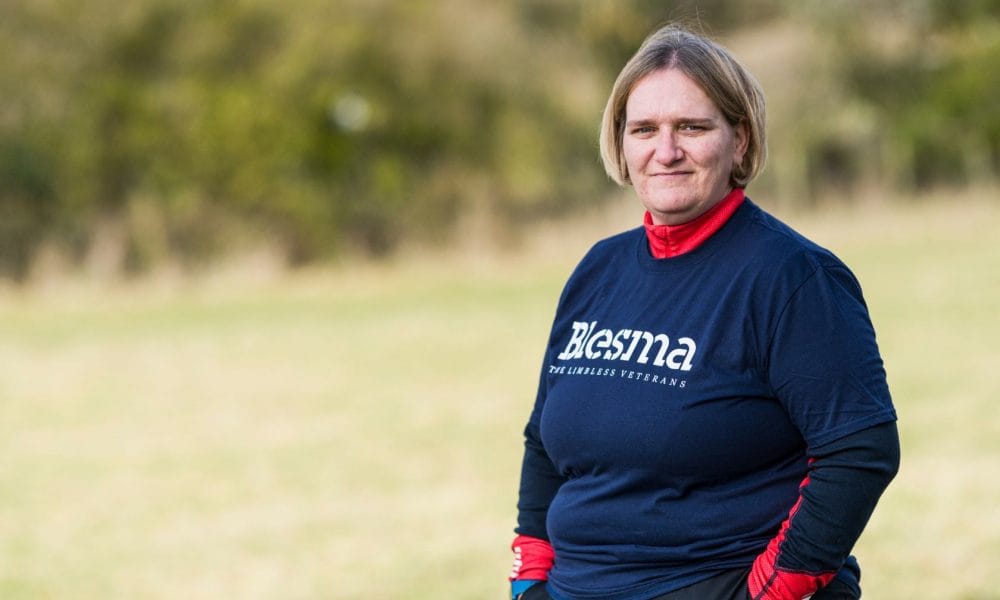
Former military police officer and Blesma member Lesley Stewart spent many years in agonising pain, and eventually lost her leg, due to undiagnosed dystonia. Read her incredible story of coming back from years of struggle to compete in the Paralympics
Lesley, a former Royal Military Police officer, competed in Tokyo this year in a range of shooting disciplines. Though she missed out on a medal, her sights remain set on Paris 2024.
“I had to retrain my brain to shoot competitively,” she explains. “There’s an aggression to military shooting, but it’s the opposite in a competition. To succeed, it’s all about staying calm. You’ve got to relax, lower your heartbeat, keep your movements to a minimum.”
Lesley, from Blairgowrie in Perthshire, Scotland, puts her excellence in the event down to her determination. Joining the Army in 2000, her life changed forever on an annual combat fitness test.
“I pulled a muscle in my back during the eight-mile run. It ached straight away, but within a week I was getting severe pain in my left ankle. My foot began twisting and pointing to the right. None of the medics could understand it because I hadn’t hurt my leg at all,” she recalls.
Years of mystery followed as Lesley underwent numerous scans and operations in an attempt to straighten her foot, but not a single medical expert could explain why her ankle kept twisting sideways and upwards.
“I got moved to Headley Court and had further operations, but everything failed. I was in a huge amount of pain and was heavily medicated – so much so that I didn’t know where I was,” says Lesley.

“I’d phone my dad up to ask him to visit even though he’d just left me! Eventually, in 2007, I had a below-knee amputation because the leg was starting to die.”
But even this didn’t put an end to Lesley’s ordeal.
“After a couple of months of rehab, I started getting horrendous pain behind my knee. It was buckling backwards. I had more operations, but the doctors realised that they had to explore further. I was eventually diagnosed with something called dystonia.
“Basically, when I pulled that muscle in my back, my brain malfunctioned and started sending signals to my ankle, telling it to go into spasm. After the amputation, the signal just moved to my next joint, which was my knee.
“My life was horrendous. I was in constant pain. Eventually, I was told about a process called deep brain stimulation, during which a box is implanted into your chest and wires are fused into your brain. The box would emit electric currents with the aim of blocking the pain signals to my knee.
“The operation is dangerous – I was told I might not wake up and that there was a high possibility that if the signal went to my spine or neck they could snap – but I was in so much pain that I decided to go for it.”
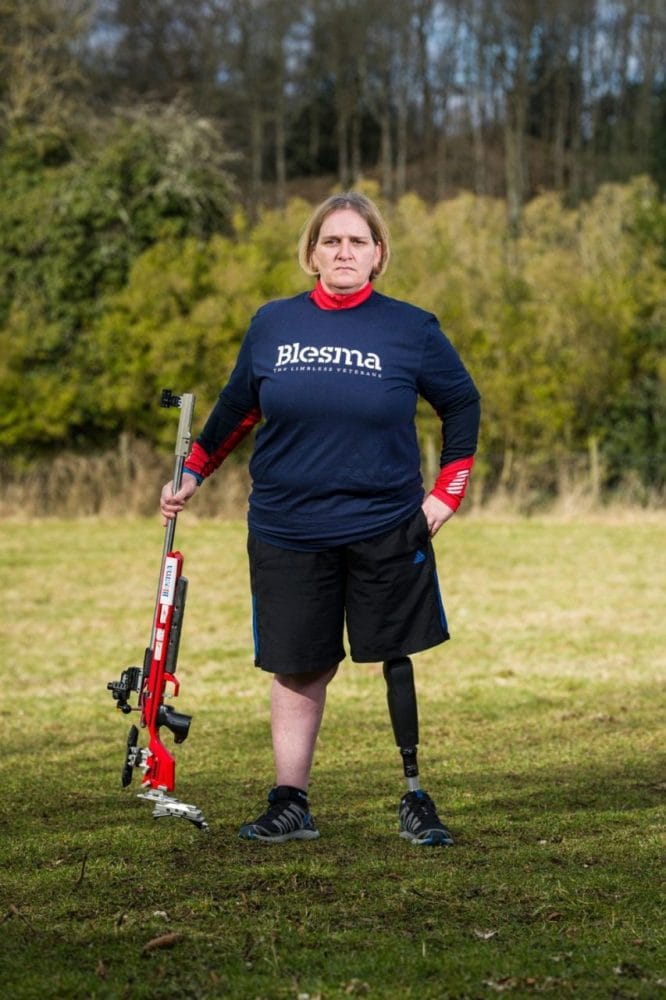 Lesley underwent the procedure in September 2009. “Thankfully, the operation was a success because after a couple of weeks, the knee released itself,” says Lesley. “I’d been in bed for years, so I had to retrain my whole body to walk. There was a lot of crying, but the hard work paid off.”
During her rehab Lesley was introduced to shooting. “The Shooting Association visited Headley to host a ‘have a go’ day. I did well and was invited to another weekend, where I was spotted by the performance director of the GB Paralympic team.”
Though an infection then led to her leg having to be amputated further above the knee, shooting helped Lesley to stay focused.
“I’m now walking well, and shooting better than I ever have,” she says. Lesley is full of praise for two communities that, she says, have supported her over the years; athletes and Blesma.
“Shooting is a small world and the athletes have been like another family to me. Blesma has also been great. My Blesma Support Officer is often in touch, and the Association assists me with funding and other support. The charity has been great during lockdown; I’ve enjoyed all the Zoom conversations, activities and presentations,” she adds.


