



A robotically-enhanced means of mental practice for stroke survivors is being developed to help maximise post-stroke rehabilitation.
For many stroke survivors with upper limb motor function impairment, previously simple tasks like reaching for and picking up items can now feel impossible.
But a team at the Georgia Institute of Technology is now investigating how they can harness the power of intention and determination to translate this into action using robotic prostheses.
Developing what is hailed as “a new paradigm of motor imagery”, it will integrate proven methods of neuromotor facilitation with robotics, to capitalise on the thoughts and intentions of survivors and turn them into supported physical movement.
“The idea here is that people who have had a stroke often have a kind of contracted posture,” said principal investigator Minoru ‘Shino’ Shinohara.
“And when they try to reach for something, or to extend the reach of their arm, they use their trunk, because they don’t have good, fluid arm motion.”
This kind of intentional synergistic movement is common in people with motor impairment caused by stroke or other neurological impairments, he said.
Lacking the fine motor skills to activate their arms or hands, this broad movement often is the best that they can do, particularly in the early stages of recovery.

The movement is a sign that the brain can’t correctly send signals to affected muscles. But it is also a sign that the brain is trying to relearn how, which is what Shinohara and his team want to build upon.
“It’s possible that this motion can increase neural excitability of the hand muscles for opening – that it is related to a more coordinated motion, like grabbing a glass,” Shinohara said.
“We want to utilise this trunk motion for actually opening and closing a robotic prosthesis.”
Working alongside Frank Hammond, assistant professor of mechanical engineering and biomedical engineering, and Woo-Hong Yeo, associate professor of mechanical engineering, the project has been supported with a $275,000, 18-month R21 grant from the National Institutes of Health (NIH).
The researchers hypothesise that control and observation of robotic grasp and release actions via this shoulder and trunk motion – synergistic proximal muscle activation – will increase hand excitability, due to the cognitive engagement with an externally present and visible robotic prosthesis.
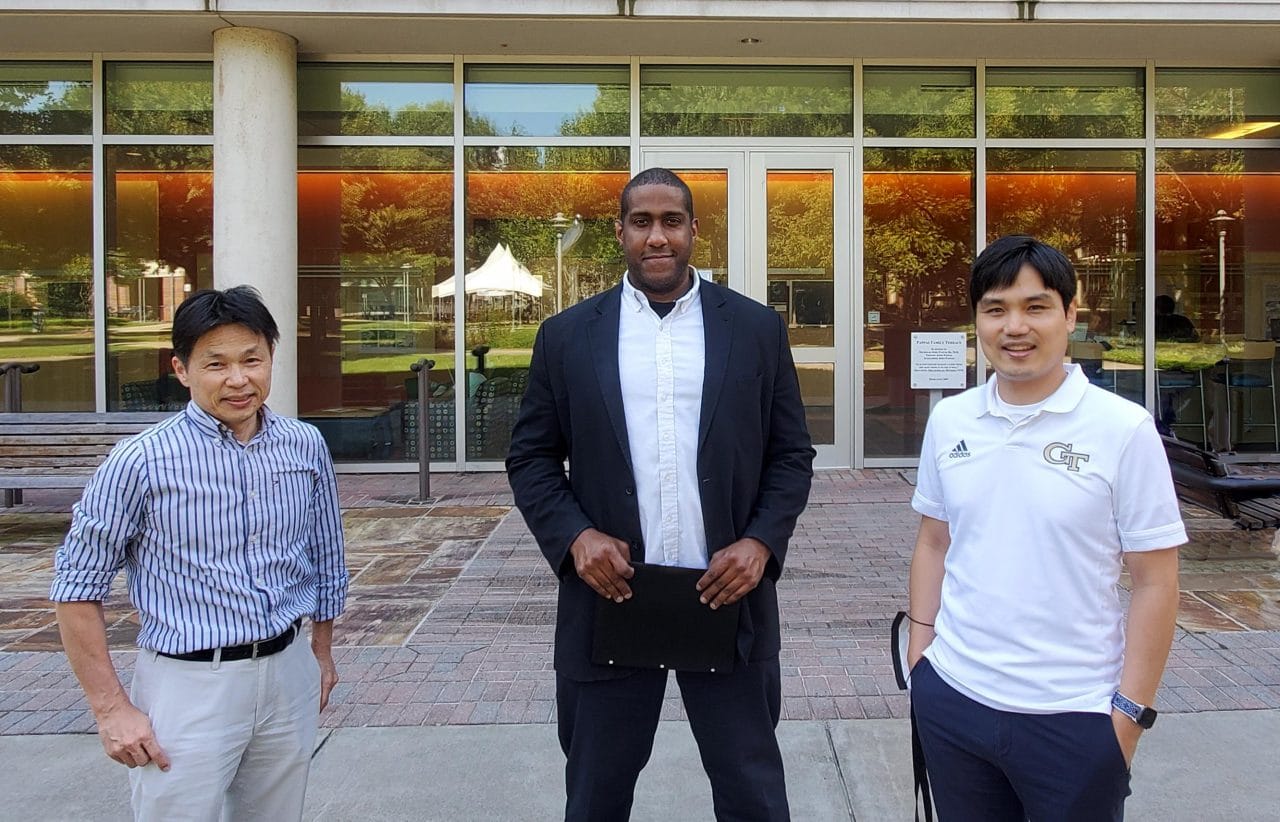
The research team
This could enable the individual, when thinking about grabbing an object and making the corresponding shoulder and trunk motion, to activate a robotic hand.
Shinohara believes this robotically-augmented mental practice can help the brain efficiently relearn how to produce and send the right signals at the right time to the affected hand muscles.
“You may not be able to use your own hands, but you’ll see the corresponding action of the prosthetic reacting, as if it’s your grip and you are opening and closing,” he said.
“That’s action observation. So, if you see the robot and you’re engaged in controlling the action, we expect to see an increase in the ability of the brain to control the hand. That’s the basic idea.”
To test the idea, Shinohara, director of the Human Neuromuscular Physiology Lab and a member of both the Petit Institute for Bioengineering and Bioscience and the Institute for Robotics and Intelligent Machines, all at Georgia Tech, is partnering with the labs of Yeo and Hammond.
Yeo has developed cutting-edge motor imagery-based brain machine interface (BMI) systems – rehabilitation technology that analyses a person’s brain signals, then translates that neural activity into commands enabled by flexible scalp electronics and deep-learning algorithms.
Yeo is principal investigator of the Bio-Interfaced Translational Nanoengineering Group and director of the Center for Human-Centric Interfaces and Engineering.
As principal investigator of the Adaptive Robotic Manipulation (ARM) Laboratory, Hammond’s research is focused on a variety of topics in robotics, including sensory feedback enabled human augmentation devices.
For this project, Hammond’s lab is developing a robotic arm that could potentially restore some neuromotor functionality to patients in the future, he said, “and provide greater degrees of motor imagery. The data we generate will be helpful in creating a robotic device that will be a lot more effective in treatment and maybe more versatile, allowing us to accommodate a broader population of patients undergoing rehabilitation.”
The NIH’s R21 grants are intended to encourage developmental or exploratory research at the early stages of project development, with the hope that the work can lead to further advances in the research. Shinohara believes he and his collaborators are moving in that direction.
“Development of this new paradigm and its integration with able-bodied and post-stroke disabled individuals will open new scientific and clinical concepts and studies on augmented motor imagery,” Shinohara said.
“And that can lead to effective treatment strategies for people with neuromotor impairment.”


