Standing after spinal cord injury can be hugely important in terms of both health and wellbeing. Here, the team at Anatomical Concepts discuss the benefits of standing and why the Tek RMD is widening traditional options to support people with SCI
You may not think of ‘just standing’ as a form of exercise, but it is both an effective and practical method for most people following a spinal cord injury.
People who cannot walk or stand unaided due to a spinal cord injury often must sit for more than eight hours a day, and as a result are at risk of secondary complications including the development of pressure ulcers, limb contractures, compromised circulation, and aggravated bowel and bladder function.
In addition, an improved sense of wellbeing and improved quality of life are associated with standing.
For this reason, passive standing is encouraged by clinicians as soon as rehabilitation starts with the aid of a product or structure that can typically stabilise at least the hips, knees and ankles.
Commonly used methods include so called standing frames, standing wheelchairs and orthoses. The ease with which these can be used varies with the nature of the injury.
Suggested dosage
Evidence-based guidelines defining how long or how often adults with spinal cord injury need to stand to have been published (MASCIP, 2013) Paleg and Livingstone (2015) reviewed the literature and noted that stronger evidence underpins the impact of regular standing programs on range of motion and activity for both stroke and spinal cord injury populations with some mixed evidence supporting impact on bone mineral density.
Dosage data suggests that the use of a standing device should occur for 30 minutes, five times a week for positive impact on most outcomes such as self-care and standing balance, joint ranges of motion, spasticity, pain, skin and bladder and bowel function.
Sixty minutes for four to six times a week may be required for positive impact on bone mineral density and mental function.
Product choices
The most commonly-seen product in the UK is perhaps the standing frame which comes in various guises, such as the wooden ‘Oswestry’ frame or the more modern ‘EasyStand’ designs.
These achieve the basic objectives of allowing a person with lower limb paralysis to stand and may also allow other passive activities to take place at the same time. They need to be set up for the stature of the individual and steps taken to make it as easy and safe as possible to transfer on and off.
The biggest objection we hear is that they can take up too much space in modern houses and are a bit ‘boring’ to use. The problem with being boring is that this is not exactly an incentive for regular use!
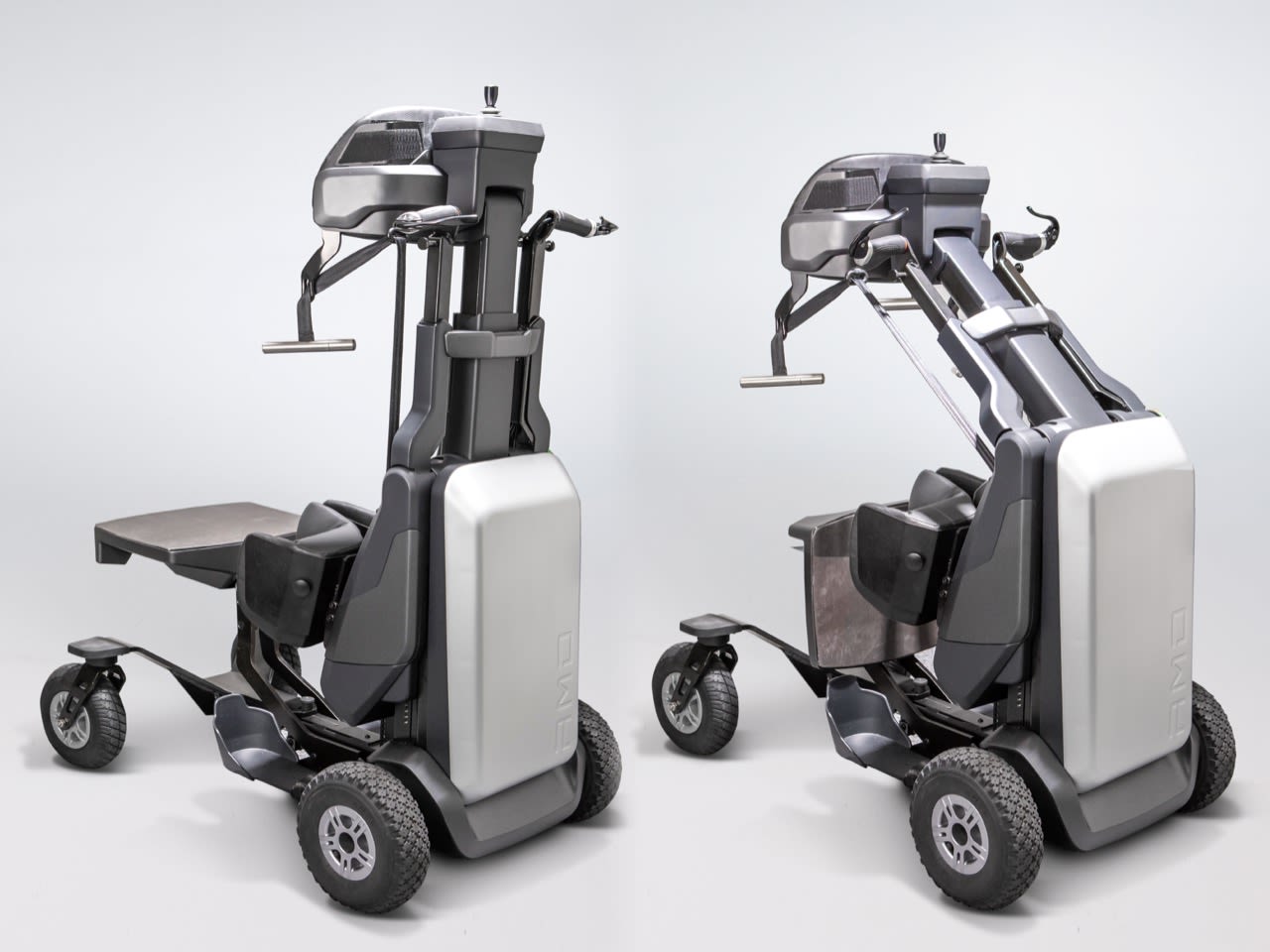
Less well known is the unique Tek RMD from Matia Mobility. It is neither a standing wheelchair nor a passive standing device, but a unique product that can allow users with a spinal cord injury or other neurological injury to readily stand and move in an indoor or outdoor environment. The user of the Tek RMD can now largely have hands free to engage with their environment.
Unlike the typical standing wheelchair, the user is not tilted back when standing upright, so that for most users a perfect therapeutic posture can be achieved and held for longer periods.
Thick pads are positioned just below the knee and at the chest and a seat cushion spans the hip area so that the user is safely held whether fully upright, seated or at any point in between. This balanced posture allows much easier interaction with the environment.
Many users find that they can at last use a standard kitchen layout and they can at will move from picking something from a high shelf or a low cupboard.
Each Tek RMD is set up to suit the stature of the individual user; some people need more trunk support initially and the product can be reconfigured as the user’s requirements change over time.
What surprises many users is that the product is both narrower and shorter than their typical wheelchair so it is very easy to manoeuvre. Using the control panel the user may sit or stand at will, and use the joystick to steer around their environment.
Domestic users should find that they can achieve a good balance between social and therapeutic benefits by using the Tek RMD.
It is always a good idea for people in the market for these products to understand that each device will have different strengths and weaknesses and no product can be perfect for everyone. There are good clinical reasons to make standing part of life and weigh up the most suitable way of achieving this in each individual case.
- For more information, contact the team at Anatomical Concepts here