During MS Awareness Week, in line with its theme of #MSMakesMe, Gavin Crocker shares the reality of living with MS and how rehab is supporting him in living his life
This week it’s MS Awareness Week and, for the first time, the MS Society is joining forces with six other charities to help amplify their voices and raise awareness. The focus for this year’s campaign is how MS makes people feel. Whether, like me, you have MS yourself or whether you live, work or socialise with someone who has the disease.
So how does MS make me feel? Frustrated at times for sure. Worried for my future, too. But, essentially, MS makes me feel very aware of the importance of taking care of my body, recognising my symptoms but not being limited or defined by them. It makes me focus on what I CAN do, rather than what I can’t. And how to make the most of my abilities.
Finding the right rehab
Key to living as well as you can with MS is to having the right rehab and I’ve found that activity based rehabilitation, as provided by Neurokinex, is the most effective.
Neurokinex is highly regarded for its work helping people with neurological and spinal injuries but it’s less well-known for the work it does to help those with MS. It seems appropriate, given it is MS Awareness Week, to highlight this!
My MS has caused neurological damage which affects my walking and I turned to Neurokinex to help improve my gait.
Power of partners
Alongside the work I do at the Gatwick centre, the Neurokinex team have aligned their efforts with the trainers at the Samson Centre for MS in Guildford where I have been training for about three years. It really is a combined effort that is gradually producing results. The Samson Centre looks after my fitness while Neurokinex focuses on my stepping.
I had a full assessment in my first session at Neurokinex and this identified various muscle weaknesses. Many of these came from years of poor posture and bad walking habits. If I was going to walk properly again, I had to strengthen these muscles. As I had already been working with the gym trainers and physios at the Samson Centre, this part was very much a work in progress. The weaknesses Neurokinex picked up were largely already on the Samson list but their fresh approach, alongside a few tweaks, are bringing new gains.
‘Can do’ approach
Each Tuesday and Friday I train with the Samson Centre and each Thursday I’m at Neurokinex, spending much of my therapy time there on the Locomotor Trainer weight assisted treadmill. The Samson Centre and Neurokinex share the same ‘can do’ approach and their respective trainers are excellent. Their approaches complement and enhance each other and I could not have made progress at Neurokinex without the Samson Centre work and vice versa.
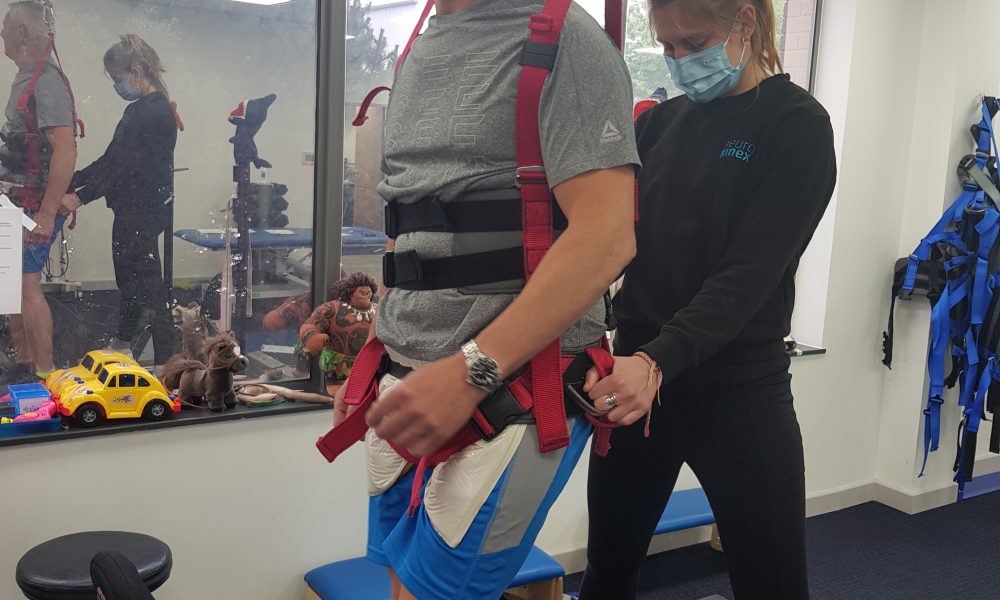
Laurence, my ever-patient trainer at Neurokinex, has extensive experience of gait analysis and watches every step I make on the treadmill. It is his knowledge and the specialist weight assisted treadmill that make the difference. I’m about 80kg (on a good day) and the harness partially suspends me and makes me about 20kg lighter. Reducing the weight on my legs means I can make proper steps reinforcing good movement patterns. None of the exercises at the Samson Centre can reproduce this as I cannot walk properly without some support.
Picking up the pattern
When I started on the Locomotor Trainer I had one person holding my hips to stop them swaying and another person physically lifting each leg into the correct movement pattern for five or ten minutes at a time. This pattern was (eventually) picked up by my neurological system which tells the brain/spinal cord what movement is necessary and I was soon moving my legs without them being lifted for me. Laurence is always there helping to correct my movements.
The support from the hoist is gradually being reduced and the speed of the treadmill increased but ingrained habits take a long time to erase. Most weeks, having spent an hour analysing my gait, Laurence picks up areas for me to focus on in the gym and Mike at the Samson Centre helps me tackle these.
I recently questioned whether all of this was doing any good until I found a video of me walking three years ago. I was a professional shuffler and it was no wonder I was always catching my feet. There is a huge difference in how I am stepping now, I am lifting my feet and I have had significantly fewer falls.
I am impatient but I know that trying to overcome any neurological injury always takes far longer than you expect. I’m hoping that I will be able to walk properly again, whatever that means. I’m a slow learner but enjoying the journey thanks to Laurence and Mike who make it fun. We often share a laugh although I learnt very quickly that I can’t laugh and walk on a treadmill…. I suspect deep down it’s challenging my core to stay upright but, while I master that skill, I’m thankful for the automatic safety stop on the treadmill because I won’t stop trying and I don’t want to stop laughing either!!
So how does my MS make me feel? It makes me feel grateful that I have found like-minded people who lift the barriers and put no limits on how far I can progress. And that makes me feel hopeful, too.