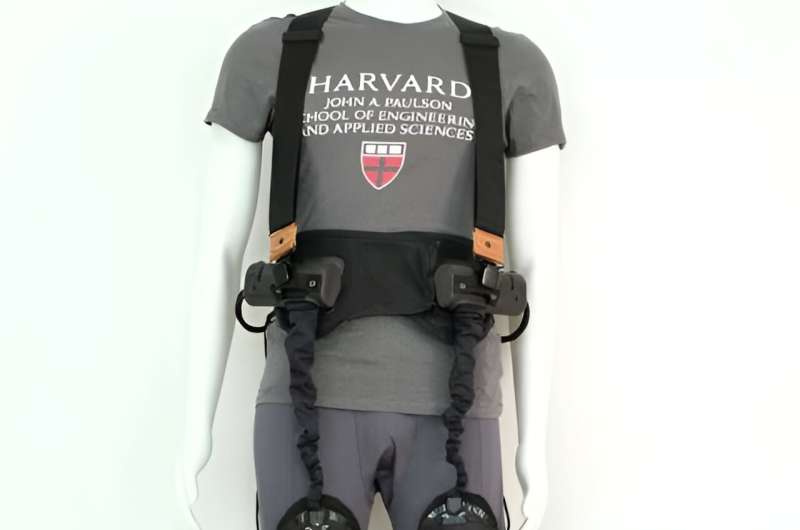
Researchers have developed a soft, wearable robot to help people with Parkinson’s walk without the threat of freezing.
When individuals with Parkinson’s disease freeze, they suddenly lose the ability to move their feet, often mid-stride, resulting in a series of staccato stutter steps that get shorter until the person stops altogether.
These episodes are one of the biggest contributors to falls among people living with Parkinson’s disease.
Today, freezing is treated with a range of pharmacological, surgical or behavioural therapies, none of which are particularly effective.
Researchers from the Harvard John A. Paulson School of Engineering and Applied Sciences (SEAS) and the Boston University Sargent College of Health & Rehabilitation Sciences have used a soft, wearable robot to help a person living with Parkinson’s walk without freezing.
The robotic garment, worn around the hips and thighs, gives a gentle push to the hips as the leg swings, helping the patient achieve a longer stride.
The device completely eliminated the participant’s freezing while walking indoors, allowing them to walk faster and further than they could without the garment’s help.
Conor Walsh, co-corresponding author of the study, said: “We found that just a small amount of mechanical assistance from our soft robotic apparel delivered instantaneous effects and consistently improved walking across a range of conditions for the individual in our study.”
The research demonstrates the potential of soft robotics to treat this frustrating and potentially dangerous symptom of Parkinson’s disease and could allow people living with the disease to regain not only their mobility but their independence.
For over a decade, Walsh’s Biodesign Lab at SEAS has been developing assistive and rehabilitative robotic technologies to improve mobility for individuals’ post-stroke and those living with ALS or other diseases that impact mobility.
Some of that technology, specifically an exosuit for post-stroke gait retraining, received support from the Wyss Institute for Biologically Inspired Engineering, and was licensed and commercialised by ReWalk Robotics.
In 2022, SEAS and Sargent College received a grant from the Massachusetts Technology Collaborative to support the development and translation of next-generation robotics and wearable technologies.
The research is centered at the Move Lab, which aims to support advances in human performance enhancement with the collaborative space, funding, R&D infrastructure, and experience necessary to turn promising research into mature technologies that can be translated through collaboration with industry partners.
This research emerged from that partnership.
“Leveraging soft wearable robots to prevent freezing of gait in patients with Parkinson’s required a collaboration between engineers, rehabilitation scientists, physical therapists, biomechanists and apparel designers,” said Walsh, whose team collaborated closely with that of Terry Ellis, director of the Center for Neurorehabilitation at Boston University.