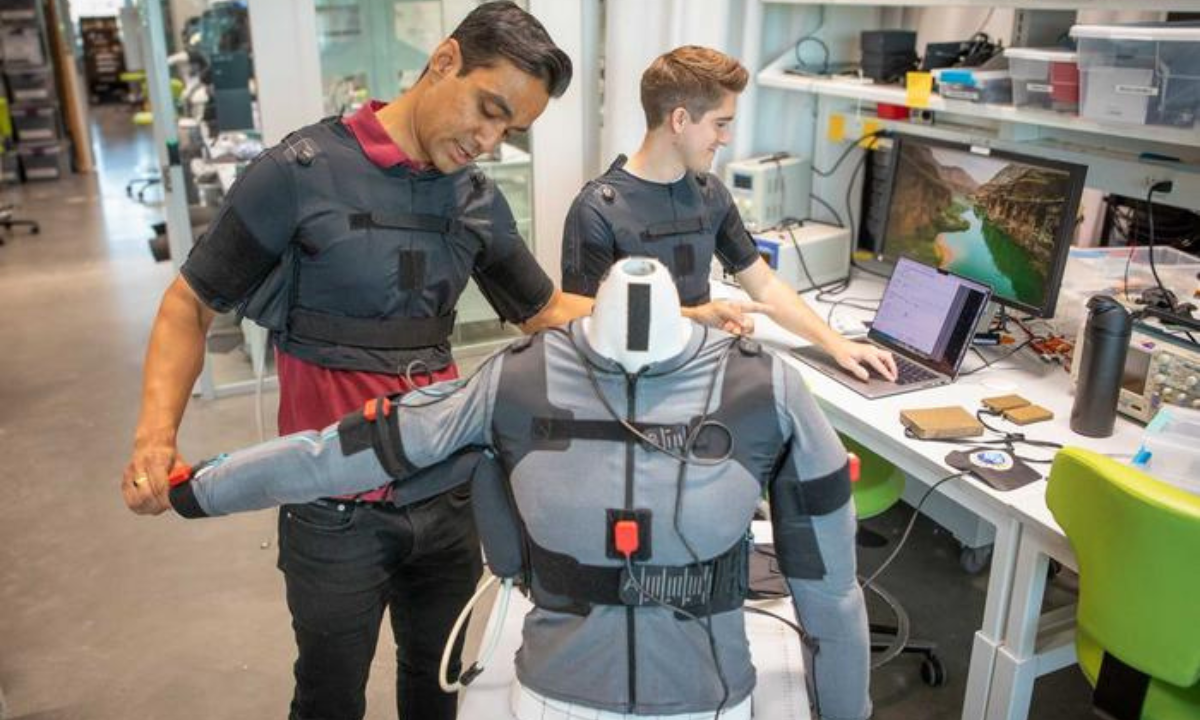
Harvard researchers have created a soft, wearable robotic device that provides personalised movement assistance for individuals with upper-limb impairment, such as stroke and ALS patients.
The latest version of the robot combines machine learning and a physics-based model to learn each user’s unique movements and provide support for daily activities like eating and drinking.
The device was tested with stroke and ALS patients and could someday offer both assistive and rehabilitative benefits.

Kate Nycz has lived with an ALS diagnosis since 2018.
Nycz explained what it’s like to slowly lose motor function for basic tasks.
She said: “My arm can get to maybe 90 degrees, but then it fatigues and falls,.
“To eat or do a repetitive motion with my right hand, which was my dominant hand, is difficult. I’ve mainly become left-handed.”
People like Nycz who live with a neurodegenerative disease like ALS or who have had a stroke often suffer from impaired movement of the shoulder, arm or hands, preventing them from daily tasks like tooth-brushing, hair-combing or eating.
For the last several years, Harvard bioengineers have been developing a soft, wearable robot that not only provides movement assistance for such individuals but could even augment therapies to help them regain mobility.
But no two people move exactly the same way.
Physical motions are highly individualised, especially for the mobility-impaired, making it difficult to design a device that works for many different people.
It turns out advances in machine learning can create a more personal touch.
Researchers have upgraded their wearable robot to be responsive to an individual user’s exact movements, endowing the device with more personalised assistance that could give users better, more controlled support for daily tasks.
Nycz was referred to the SEAS study team by Paganoni in 2018, not long after she was diagnosed with ALS a week shy of her 33rd birthday.
She has provided data and user testing for several iterations of the device, including the latest that includes a personalised motor feedback component.
She said: “I’m big on technology and devices to help improve quality of life for people living with ALS.
“I feel like this robot could help with that goal.”
In the new version, in addition to the machine learning model, the researchers incorporated a physics-based model they had previously developed that estimates the minimum pressure needed to support the arm during movement.
This makes the robot’s assistance feel more natural to the user, offering more nuanced help on basic tasks like eating and drinking.
Combining the models allowed the robot to quickly dial up or down how much assistance it is giving at any time, based on what it has learned about how that user normally moves.
In collaboration with the clinical researchers at MGH, the engineers tested their device with nine volunteers, including Nycz – five who had experienced a stroke and four living with ALS.
ALS specialist Dr Sabrina Paganoni is co-director of the Massachusetts General Hospital Neurological Clinical Research Institute
The researcher said: “For people living with ALS, the most important considerations include comfort, ease of use, and the ability of the device to adapt to their specific needs and movement patterns.
“Personalisation is crucial to enhance their functional independence and quality of life.
“This device holds the potential to significantly improve upper limb function, enhance daily living activities, and reduce compensatory movements.”
Nycz said seeing the different versions of the device over the years has been gratifying, and she’s noticed some of her feedback has been reflected in newer versions.
She said: “They’ve done a great job incorporating and including the person.
“They’re not sitting in the lab just playing with the robot. I felt like they were really engaged with me. I didn’t feel like a lab rat or a cog in a wheel.”
Image: Eliza Grinnell / Harvard SEAS Communications