Brain-computer interface training could improve cognitive function in TBI patients, study suggests
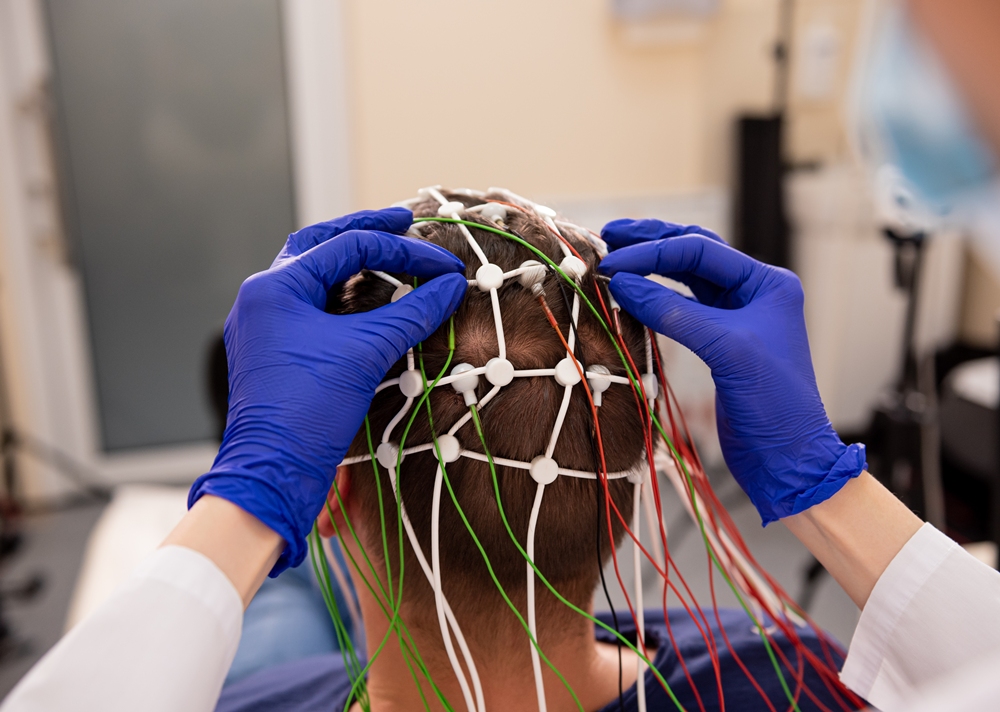
Brain-computer interface (BCI) training may help improve cognition in people with Parkinson’s disease, MS, dementia and traumatic brain injury, a study suggests.
The approach uses feedback from electrical activity in the brain and was linked to improved perception of small visuomotor errors.
The study indicated that participants were able to adjust their brain electrical activity and become better at noticing minor movement-related mistakes.

Researchers used electroencephalogram tests, known as EEG, to monitor electrical activity in the brain.
EEG is a non-invasive test that uses sensors placed on the scalp to detect brain signals.
The team tracked error-related potential, or ErrP, an electrical signal produced when the brain recognises a mistake made by the person or someone else.
One part of ErrP is error positivity, or Pe. It occurs when a person becomes consciously aware of an error.
Researchers suggested Pe could be changed through learning to improve perception of visuomotor errors.
Visuomotor errors happen when what a person sees and how they move do not match as expected, such as when a cursor moves slightly off target.
“By decoding the Pe component in real time and feeding it back to participants, we help the brain amplify its own marker of conscious error detection, something conventional training can’t do once errors get too subtle to notice,” José del R. Millán, of the University of Texas at Austin and senior author of the study, said.
“That lets us drive learning gains for exactly the small errors that behavioural training alone couldn’t touch.”
Over five days of training, participants used a joystick to move a cursor in a straight line towards a target.
The cursor path was altered by different rotation sizes to introduce a visuomotor error.
Researchers found that Pe amplitude increased overall as participants’ error perception improved.
Amplitude refers to the strength of the brain signal being measured.
Participants improved their perception of visuomotor errors for larger rotations, but not for smaller rotations.
Brain-computer interface training increased learning and improved perception of smaller visuomotor errors.
EEG readings showed contributions from parts of the brain involved in decision-making and visuospatial processing.
Visuospatial processing is the brain’s ability to understand where objects are in space and how they relate to movement.
Researchers said the findings suggest brain-computer interface training may be more effective than conventional behavioural training at improving perception of small visuomotor errors.
They also said it may be safer than a drug-based option.
Possible future applications could include improving cognitive function in neuropsychiatric patients and boosting responses in motorsport drivers.