Until the age of 15, if someone asked me if I was a cat or dog person, the answer was always cats – we had two Burmese cats who were incredibly clingy.
But one night my dad brought home a dachshund whose owners were emigrating, followed by a second dachshund looking for a loving family and then a third who needed a new home.
 I was truly a dog lover by this point, so when the inevitable happened and we welcomed a dachshund puppy to our family, I named him Hans and he became ‘my’ dog.
One morning my parents woke up to Mollie (Hans’ mother) seemingly paralysed in her back legs. After a consultation with the vet, it was deemed that she had injured her spine and required spinal surgery.
The surgery would require a lengthy recovery period where she would have to be kept relatively still and movements of her back to a minimum. Mollie of course had other ideas! In fact, it was so lovely when she came home and realised that her feet were working again, she leapt jovially like a grass dolphin over our lawn. Other than a few staples in her back and overly cautious parents, her recovery went smoothly.
Less than two years later, Hans woke up in pain and paralysis halfway down his spine. Another trip to the vet confirmed that he too had broken his back and had a spinal cord injury requiring surgical intervention.
Given our previous experience, we did not hesitate to go ahead with the surgery. Sadly, it did not take us long to realise that his recovery was going to be very different.
After surgery he had not regained the wag of his tail or the movement of his hind legs, his back half of his body remained flaccid and he had  severely atrophied muscles where a once plush bottom was. He was incontinent of both his bladder and bowel but could empty both sufficiently for the vet to discharge him from the hospital.
At home he would drag himself around with the strength of his front half of the body, fatiguing easily as he did not have the strength or endurance to cope with these new extra demands for mobility.
It was sad to see how his personality was changing, from being the first in line to inspect the kitchen for snacks to just laying in his bed and hope that his humans would bring him a takeaway snack.
My colleague working in neuro rehabilitation at the time mentioned to me that her dog also had spinal surgery a few years prior and how she undertook rehabilitation with him in the swimming pool and even made it functional for him by providing him with a tennis ball to chase.
The inner drive of the occupational therapist to even make doggy rehab functional made me giggle, but equally made me think and wonder about how transferable human adult rehabilitation techniques would be for my Hans. As I was working away from home, I asked my parents to send me videos of his current mobility and I could then provide them with tips and suggestions of what exercises to do with him.
 The first video showed a doggy with a flaccid posterior half of his body, unable to move his hind legs or tail. Now, for the tail, I have no knowledge base to draw from, but for the flaccid lower half I instructed my parents to use some sort of suspension therapy (lifting the back half of the body with their strength and allowing him the opportunity to ‘run’ around as before) and the use of proprioceptive feedback techniques in the hind legs.
The second video showed Hans using bunny hopping movements of the hind legs, due to no dissociation of his legs established yet. My recommendations were to continue with the use of proprioceptive techniques but to include doing cycling movements with his legs to help him dissociate them.
At this point I had moved back home as I had changed jobs. Because Hans could only mobilise by dragging himself around in the home and outside on the grass and tarmac (and at this point he did not believe he was disabled anymore) he would often have big bleeding scraped wounds on his tail, paws and penis. His decreased sensation meant that he did not realise how painful it was on the tarmac and grass.
This was where my knowledge of hand therapy and different taping techniques came in handy. I dressed his little wounds and then covered it up with Coban (which in turn provided sensory feedback) and added Hyperfix to ensure he could not bite it off.
To my surprise, the Coban provided enough sensory feedback to Hans that he started to try and stand up on his hind legs independently, it also 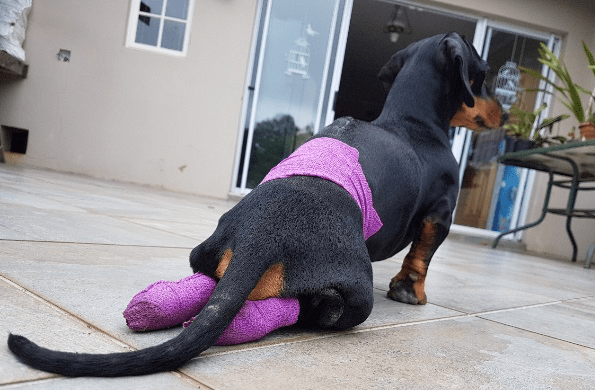 provided him with a non-slip grip to aid him with his many attempts.
At this point I investigated assistive devices for dogs and came across rubber paw socks and a ‘drag bag,’ but Hans did not know what we were doing to him when we placed him in the drag bag and unfortunately the rubber socks were so tight it cut off circulation – so neither were an option for him.
His physiotherapist started coming regularly to give him therapy. He started to use even more therapeutic modalities such as hydrotherapy (which he hated), using the TENS machine and using kinesio tape.
Over time he became stronger and stronger and started to bear weight over both his legs, mobilising independently without the use of the suspension harness.
As he gained more control his back became more hunched. My parents were concerned that this was indicating that he was in pain, but the therapist in me knew that he was hunched at the level of his spinal injury and was using compensatory muscles to help him mobilise.
The natural reaction my human spinal injury patients have is ‘’please give me a back brace’’ and so my parents were requesting the same from Hans’ physiotherapist. It brought a smile to my face when she responded the same way I do to my patients ‘’the brace will decondition his body and would be a barrier in making the muscles he requires to mobilise independently weaker.’’
 Just an important side note here, for some spinal surgeries the use of a back brace is vital, always follow the guidance from your specific therapy and recovery team. Similarly, a pooch wheelchair would take away the opportunity from him to weight bear and weight shift over his affected limbs and therefore inhibit his recovery.
Many months later, Hans is now able to walk independently again, he is mostly continent, and he is living his best life.
From both his and Mollie’s recovery, I learnt that many parallels exist between the recovery of animals and humans.
Many modalities are just as useful in both species and the neuro plasticity principles I apply in my services to human patients could also be applied to my dog’s recovery.
The importance of adjusting our practise to individuals, their personalities and circumstances and knowing that people recover, progress and adjust at different paces was bourne out in the stories of Mollie and Hans.
In my work at Renovo Care, I often think back to these experiences to help remind me that my patients all have goals which are important to them, and that perseverance is a key component of this.
- Simone Budding is an occupational therapist based at Hollanden Park Hospital