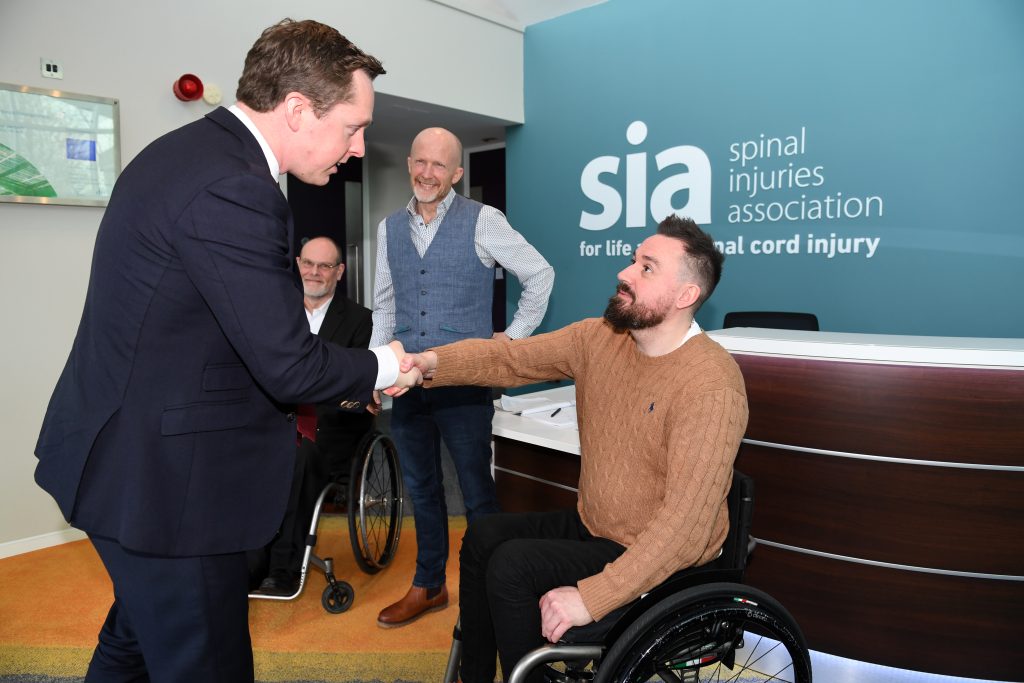
A campaign has been launched to stop spinal cord injured patients experiencing harmful neglect through being denied essential bowel care in some medical settings.
The #SeriousSh1t campaign seeks to raise awareness of the impact of bladder and bowel function in spinal cord injury, which research from the Spinal Injuries Association (SIA) says has been routinely ignored by policymakers for years, which combined with a lack of training, is having serious consequences for patients.
And today, the SIA will bring politicians together from all parties at a meeting in the Houses of Parliament to raise this issue and call for action to ensure NHS healthcare providers have a fully implemented bowel care policy in place.

“The injustice of lying in bed with all sense of dignity and control lost must stop,” says Carol Adcock, a specialist nurse for SIA.
“Imagine you’ve been told you cannot go to the toilet. You’ve been put in a nappy and told to poo in that, and then wait for someone to come and clean you up. Your family and associates are willing to come in and help you go the toilet but they are not allowed.
“Your bowel is becoming so full that there is a serious risk of bowel perforation but before this occurs you are terrified because you know if this doesn’t kill you then the risk of your blood pressure reaching such high levels could kill you anyway but no one is listening.
“SIA hear of similar versions of this scenario every week.”

Mohammed Belal, a consultant urological surgeon at University Hospital Birmingham, who himself sustained a spinal cord injury after being struck by a tree in 2021, believes the hardest part of his journey was the bowel care.
“Poor bowel care can have significant mental and emotional effects, with a decreased quality of life, social isolation, and depression. It is so important to get it right,” he said.
In a survey of spinal injured people undertaken by the Spinal Injuries Association in 2022, 72 per cent of respondents said they faced significant bowel management challenges in their life.
Many patients have told the charity shocking stories of neglect, like Heather Scott from Leicestershire.
“I was instructed to get on with my own bowel care even if that meant messing the bed, so I soiled myself many times. I’ve been spinal cord injured for over 40 years and have never felt as humiliated and frustrated as I did then,” she said.
Terry Turner from Liverpool said of his experience of poor bowel care: “If that was animals in a zoo the bosses would be jailed, and the zoo closed down.”
Stuart Bartels, of Tonbridge in Kent, wrote a letter of complaint about his experiences in general hospital as a spinal cord injured tetraplegic patient after the appropriate bowel care was not carried out.
“It’s criminal because it’s the worst physical thing, I can take all the pain in the world but this…you feel like death warmed up,” he said.
According to the charity, these widespread issues in care stem from a combination of a lack of policy and a lack of training for healthcare professionals.
An article in the Nursing Times on continence care just this month cited a 2022 report from the National Institute for Health and Care Research which said that “a significant barrier to progress is the lack of training for ward staff in continence care.”
The Royal College of Nursing are keen to work with SIA on what they believe is a vital campaign.
Fiona le Ber, chair of the RCN’s Bowel and Bladder forum, said: “No healthcare professional should be expected to carry out specialist procedures without the correct training or support.
“We acknowledge standards of care need to change and The Royal College of Nursing support the training of more healthcare professionals in specialist bowel care technique so that no patient suffers both the physical and mental consequences of poor bowel care.”
Dave Bracher, SIA’s campaigns manager, said: “We understand that change won’t happen overnight, but we will continue to actively campaign on this issue until we see an end to this needless suffering.
“It’s time we were all more open about bowel care but unfortunately, it’s still a subject that patients feel embarrassed to discuss.
“Many will be shocked and appalled to hear some of the stories we are going to be sharing as part of our campaign, but this is the reality of life for far too many spinal cord injured people. This is Serious Sh1t.”