



Care provider to develop sector-leading VR training
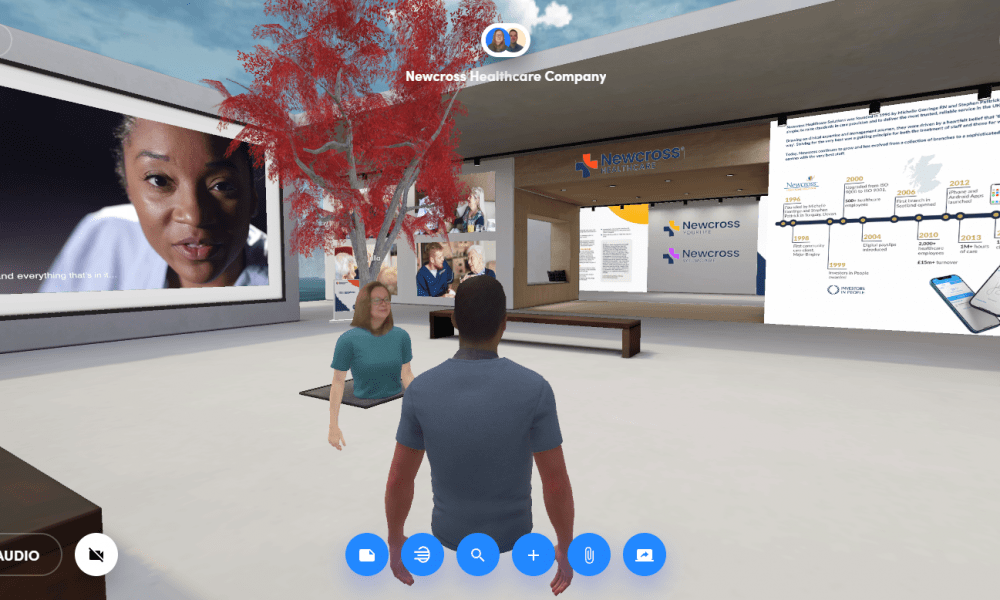
A care provider is building on its experience of using virtual reality (VR) for in-house training to create the first programme of its kind for healthcare, which is set to be rolled out across the sector.
Newcross Healthcare first began to adopt VR around three years ago, but over the past year has upskilled its in-house learning and development team to create its own bespoke content to deliver new and engaging staff training.
The team has created a number of programmes and ‘virtual shifts’ to enable staff to learn more about the Newcross business and its continuing staff development to deliver the best possible client care.
Now, Newcross plans to take its expertise in VR to a new level, by expanding into learning and training through the creation of an ‘extended reality’ programme.
The pioneering new training – which will be a first for the healthcare sector – will enable the recreation of emergency situations, including life-saving first aid, to help staff develop their skills, confidence and ability to remain calm for when confronted with such an event in real life.

The system – which Newcross hope to deliver within the next six to nine months – will be used in-house initially, but can also be used by clients and other care groups to use VR training to help raise standards and innovation throughout the health and social care sector.
“Our experiences of creating these environments has now enabled us to to define what how we want to use this in a learning environment,” says Mark Story, head of learning and development at Newcross.
“We want to use technology – it might be VR, immersive, 360 videos, augmented reality – to allow people to experience stress environments so they can get over the initial shock factor and be able to think clearly for when it happens in real life.
“Our focus initially will be on those topics for learning that people might feel shocked by when they first when they first come in or, by their nature, they’re stressful things.
“If you’re training someone in basic life support or in seizures, for example, you can only really go so far. But by being able to recreate that environment, for if and when it happens to them, they will be more prepared.
“It also has a role to play in keeping people’s skills fresh and up to date. With something like CPR, you hope that you never have to use it, but this could provide the opportunity to keep the skills at a simmer, as opposed to letting them go cold.
“That will be for internal staff for healthcare staff, nurses and carers, and shortly after that it will be made available for external healthcare professionals. Our ambition is to offer this learning to anybody that wants to access it.
Having invested in the development of its own in-house capability, Newcross is now able to deliver something new for the sector, building on the training currently available and creating a cost-effective new option for the marketplace.
“There is other training out there, but what we found is that it’s either immersive, so gives a bit of an immersion into the situation, or it’s something that has a simulation and assessment of a physical activity, or it’s something that is kind of broadly virtual reality.
“There doesn’t seem to be anything in there that brings these three pieces together, which immerses you, assesses you and and keeps you in that virtual reality environment.
“So we think we can we think we can bring those things together in a new way for for healthcare.
“What we’re creating isn’t entirely new, and certainly exists in high-end learning activities, like training pilots, for example, or training surgeons. We know these sorts of learning interventions do work but we’re looking to create them for the mass market, to get thousands of people engaged as opposed to a small number.
“We want it to be democratised, to be cheap enough for us to develop and offer out to anybody who needs it. That’s what we’re working towards.”


