



Spinal injury

New research has identified novel cell types and RNA signals that may assist with brain and spinal cord repair.

US medtech firm Boston Scientific has announced the European launch of a pioneering therapy for spinal cord stimulation (SCS).
Medication is not as effective as physical therapeutic interventions after spinal cord injury, researchers have found, with promising approaches to alleviate symptoms of spasticity also being identified.
A team of researchers representing six Spinal Cord Injury Model System Centers across the United States found that the lived experiences of people with spasticity after spinal cord injury were complex and multidimensional, but certain commonalities - such as stiffness, rather than spasms, as the most problematic characteristic - can inform further studies to identify effective treatments. The research “Characterizing the Experience of Spasticity after Spinal Cord Injury: A National Survey Project of the Spinal Cord Injury Model Systems Centers” brings together leading experts in the field from across the United States and the world. Chronic spasticity - characterised by uncontrolled tightening or contracting of muscles - affects most people with spinal cord injury. Its effects range from restricting ability to perform daily activities and pain to negative self-image, and anti-spasmodic medications are often prescribed to mitigate symptoms. However, data was lacking regarding the lived experience of people with spasticity and the value of medication as a management strategy. To better address this common secondary condition, researchers and clinicians needed more information.
A mother and son team who have devised a pioneering standing wheelchair are looking to partner with a manufacturer to bring their prototype to fruition.
The Walking Wheelchair enables people with limited use of their legs to assume a standing position, using a saddle therapy seat and Segway-style wheelbase. Its design, which is aimed at people living with conditions including Muscular Sclerosis, Cerebral Palsy, Motor Neurone Disease and spinal injury (L1-5), is protected by patent and has already won awards for its innovative design. It differs from what is already available through its saddle seat lifting the user’s weight vertically to standing, rather than a conventional seat which tips, and has a gyroscope to balance the standing weight instead of a counterweight. It also has a two wheel wheelbase with a tight turning circle rather than the standard six-wheel base.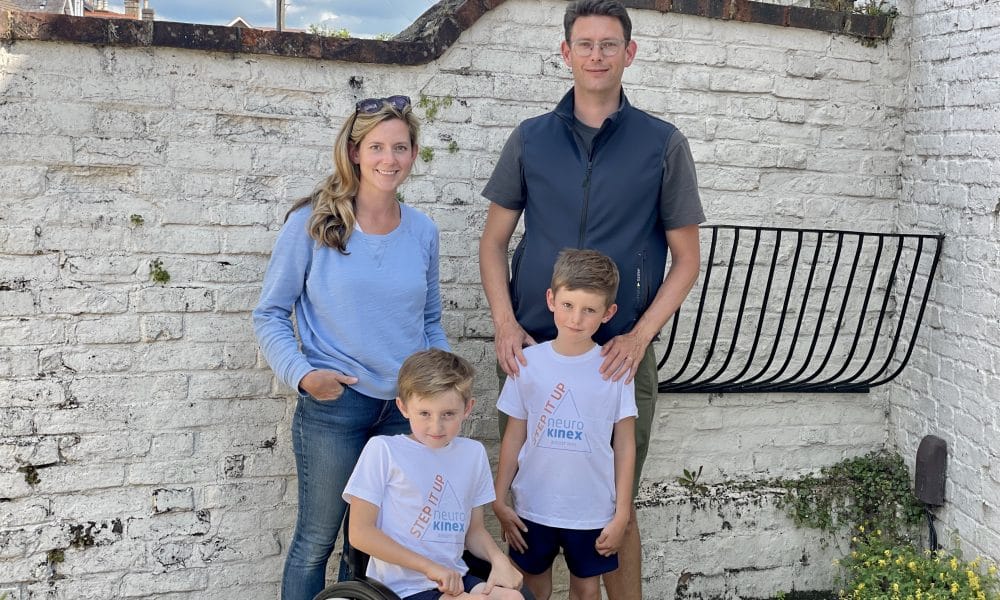
An eight-year-old boy has rallied his family to join him on a 330-mile charity challenge to safeguard a life-changing spinal cord injury rehabilitation programme which has supported him.
Jasper Thornton-Jones was paralysed aged two after a spinal stroke. Key to his rehabilitation therapy since then has been the Neurokinex Charitable Trust, based near Gatwick. Jasper was the first paediatric client at Neurokinex when he started there in September 2016 on its Step Up Scheme. The initiative has proved life-changing for many patients, and offers a set of six free rehab sessions for adults and children with a new spinal cord injury. The scheme costs the Neurokinex Charitable Trust £420 per person to fulfil and relies on funding for its survival.
What began as a small Facebook group has now become the UK’s leading voice on Cauda Equina Syndrome.
The Cauda Equina Champions Charity is an active campaigner to achieve greater recognition of the condition, among medical professionals and the public alike, with a lack of knowledge leading to many people being undiagnosed and suffering in silence. The syndrome is a rare and severe type of spinal stenosis where the nerves in the lower back suddenly become severely compressed, and failure to diagnose and receive appropriate treatment can lead to greater risk of long-term consequences including incontinence or paralysis.
Brain and spinal cord scars in people with multiple sclerosis (MS) may reveal why they develop progressive disabilities, research suggests.
Suicidal risk and understanding how best to respond was the subject of a recent webinar for professionals working with brain and spinal injured clients. Assessments including how to assess the different levels of risk, including looking out for red flags, primary drivers and secondary drivers, were all addressed to empower people to deal with what [...]

If injury or illness means living life your way isn’t easy, live-in care can provide support. Agincare is experienced in supporting people with acquired brain injuries, acquired spinal cord injuries and more diverse neurological needs.
As a family owned and run business and one of England’s largest care groups, we’re proud to have been delivering skilled and professional care with a smile for 35 years. If you’re looking for round-the-clock support without compromising on your choice, lifestyle, or independence, live-in care is designed for you. To discover the difference that live-in care can make, we’d like you to meet Callum. Callum’s story Callum is no less an adrenaline junkie today than he was as a teenager. Unfortunately, at age 16, while having fun with friends, Callum fell 30 feet. He sustained trauma to his head, memory loss and an acquired spinal cord injury. Callum spent the next two years in hospital. With his mobility declining and behavior becoming challenging, Callum’s social worker decided to research live-in care.
Erin Pollitt suffered a serious spinal injury in her second year of professional dance training.
While practicing a difficult move during rehearsals at the Northern School for Contemporary Dance in Leeds, she fell to the floor and suddenly felt a sharp pain at the base of her spine. She was booked in to see the school’s physio the next day, feeling the full impact of the fall after being unable to walk properly or move as she normally could.


