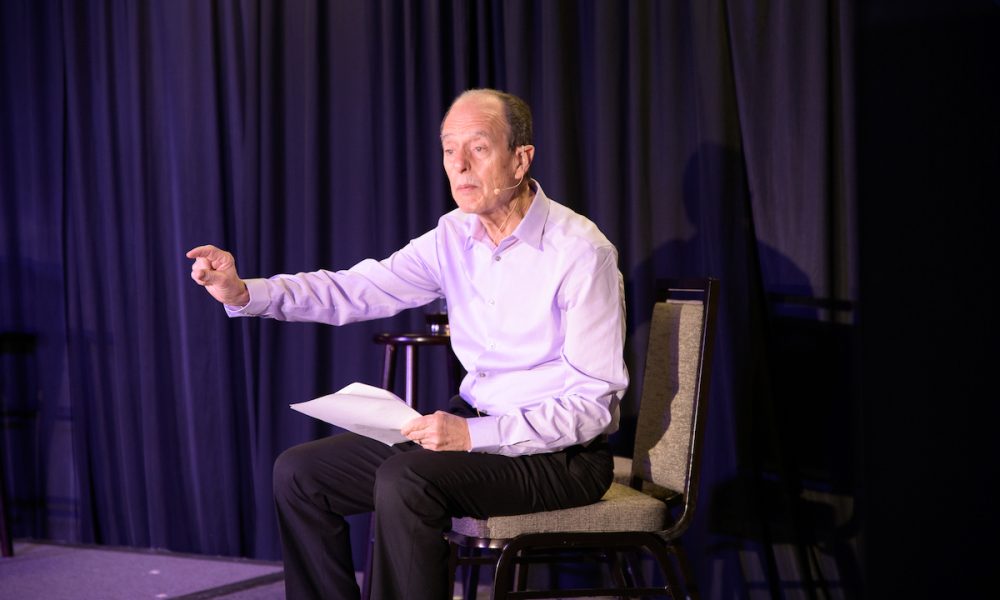
Samuel Simon is a prominent consumer rights campaigner in the US who turned to theatre to help process his wife’s cancer diagnosis, and later, his own experience with early-stage Alzheimer’s. Here he shares his story with NR Times.
Samuel Simon, 77, is a founding member of Nader’s Raiders, a renowned public interest and advocacy group spearheaded by political activist, Ralph Nader. In the 1970s, Samuel played a pivotal role in pushing for consumer protection and anti-trust enforcement reforms within the Federal Trade Commission.
Samuel’s involvement with Nader’s consumer movement catapulted him into the national spotlight, earning recognition in major media outlets, including the New York Times.
His life took a turn for the worse when his wife was diagnosed with advanced breast cancer in 2000.
During this time, he grappled with the impending loss of his partner, an experience that later influenced his decision to begin his ‘fourth age of life’ as a playwright and performer.
 Thankfully, his wife survived but the pain of confronting her death lingered on in what he describes as a case of ‘post-traumatic spiritual disorder’.
In 2012, he premiered his first play, The Actual Dance, a one-man theatre piece that chronicles his wife’s journey with cancer. The play has received acclaim and continues to be performed a decade later.
He would later put pen to paper again as he came to terms with his own diagnosis of Alzheimer’s.
A moment of realisation
Samuel’s struggle with cognitive impairment began in 2015, but in retrospect, he recognises indicators that appeared much earlier. These early signs were often dismissed as normal ageing or mild depression.
Driving incidents became a pivotal moment of realisation for Samuel. On one occasion, he found himself driving on the wrong side of the road, oblivious to his mistake until honking cars alerted him. These incidents, coupled with episodes of a sudden “black wall” in his mind, prompted Samuel to seek answers from his internist and eventually a neurologist.
“It’s like looking backwards once you’re diagnosed,” Samuel said. “You start connecting the dots and realising the signs were there all along, but you just didn’t recognise them at the time.
“I developed what I experienced as a black wall. I’m trying to remember something and I just experience infinity, black, nothing forever. I’m in an isolated place where nothing around me makes sense. I can’t relate to it.”
Diagnosed with mild cognitive impairment in 2018, it wasn’t until 2021 that the root cause was identified as early-stage Alzheimer’s.
The path to diagnosis, however, was a convoluted one, with numerous doctor visits and tests along the way.
Samuel criticised the ‘broken’ state of neurological care and emphasised the need for improved support and resources for people navigating the path towards understanding and managing their condition.
“I’ve come to learn that the neurology world in America is badly broken,” Samuel said. “My first neurologist gets the report to say I’m cognitively impaired. He just walks in and says ‘So, you’re mild cognitively impaired, but good news, you don’t have tangles’ [abnormal accumulations of tau proteins in the brain known to cause Alzheimer’s].
“He’s walking out the door and I ask ‘What do I do? What road am I on? what’s my prognosis? What’s going to happen?’ He’s now frustrated and he says, ‘Well, there’s only one road for you; it’s just going to get worse.”
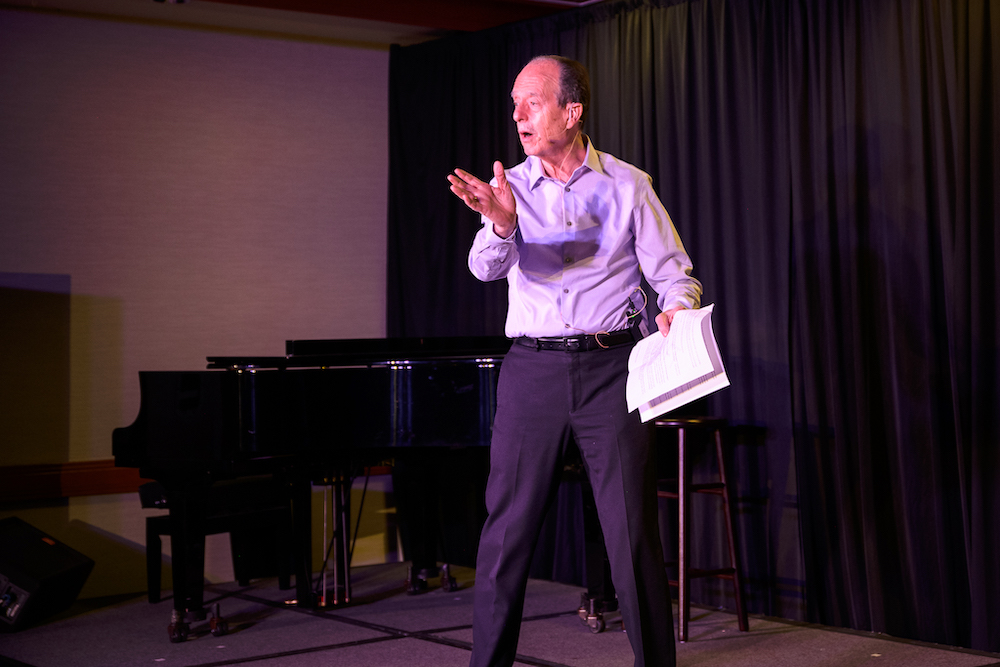
The Dementia Man: An Existential Journey
This experience would later be brought to the stage in Samuel’s latest work, Dementia Man: An Existential Journey, which chronicles his life with Alzheimer’s.
Writing and performing The Dementia Man has been a deeply therapeutic process, he said, allowing him to confront and accept his Alzheimer’s diagnosis. Once again, his writing served as a catalyst for self-discovery.
One particular moment stands out in Samuel’s recollection. Not long after his diagnosis, he remembers the fear that gripped him when his wife expressed her concerns about him potentially causing her harm. Aggression and frustration is a common symptom of Alzheimer’s.
Seeking support, they met with a social worker who provided them with guidance and reassurance. Although this specific incident did not directly find its way into the play, it became a central theme, offering Samuel a deeper understanding of the complexities and nuances of neurological conditions.
Through the play, he aims to drive awareness within the medical and neurological communities, urging practitioners to provide comprehensive support and guidance to patients upon diagnosis. Samuel believes that no one should be left to navigate the uncertain path of cognitive disease alone.
An alternative to the ‘tragedy narrative’
With Dementia Man, Samuel wants to challenge the tragedy narrative often associated with dementia. He hopes to inspire a paradigm shift in how society perceives and supports people living with neurocognitive diseases.
He stressed that you don’t need to write a play to experience the therapeutic benefits of expressing the complex feelings that come with a neurocognitive diagnosis. He encourages others on similar journeys to find spaces to express their emotions and share their experiences openly.
“I’ve had a woman contact me whose husband has impairment, but he won’t tell anybody. He’s worried he’ll be fired from this job,” Samuel said.
Long before being diagnosed with Alzheimer’s, Samuel was an active campaigner for the American disability rights movement. His journey has brought him full circle as he advocates for the need to accommodate neurocognitive disabilities, just as society has made strides in accommodating other forms of disabilities.
He argues that the existing narrative surrounding cognitive impairments limits our ability to imagine new solutions that could enable people with Alzheimer’s to live a life with more dignity.
Envisioning a better future for people living with neurocognitive conditions
In Dementia Man, Samuel provokes audiences to contemplate their own fears and biases surrounding cognitive disabilities while sharing a vision of a future that redefines what it means to live with a neurocognitive disease.
In the play, Samuel introduces the concept of a ‘cognitive navigator’, a digital companion of sorts that can assist with day-to-day activities. The idea forms part of his vision for a future where people with cognitive disabilities are given the opportunity to live fuller and more independent lives.
“I argue that the world needs to accommodate neuro-cognitively disabled people in the same way that they have accommodated other disabilities,” Samuel said. “The tragedy narrative around cognitive disabilities is preventing imagination.”
Since premiering earlier this month, Dementia Man has garnered attention from a diverse audience, including medical professionals, dementia advocates and theatre enthusiasts.
Notably, prominent figures such as Steven Post, author of Dignity for Deeply Forgetful People and Reverend Lynn Casteel Harbor, minister for older people at Riverside Church in New York, have praised Samuel’s work.
Looking ahead, Samuel hopes to continue performing the work for as long as he is able to, with the ultimate goal of filming and publishing the play so that other actors to bring his story to life.