


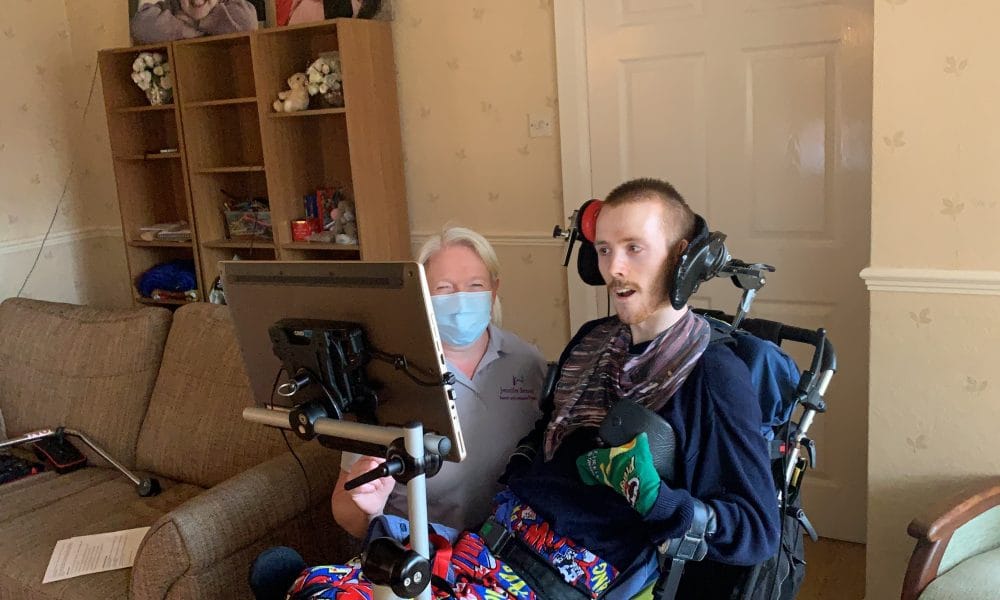
With the #avoiceforrichie campaign to enable Richie Cottingham to have his own voice capturing the hearts of the nation, NR Times meets the woman who made it possible – speech and language therapist Jennifer Benson
Having had the same vocabulary package for his communication aid since school, Richie Cottingham was well overdue a change.
Being reliant on assistance with speaking from the earliest age, Richie – a 26-year-old with Cerebral Palsy – had become used to the generic ‘American’ accent he spoke with, not believing there could be an alternative.
But as part of the change in his communication package – which came through an overhaul of his wider multi-disciplinary team – Richie met Jennifer Benson, his new speech and language therapist.
Experienced in voice banking and preserving the voices of people with neurodegenerative conditions by recording them, Jennifer’s thoughts for her new client turned to whether – in contrast to the more common technique of voice preservation – there could be the potential for voice creation.
“Richie is a proud Yorkshireman and such a character with it, he’s a fantastic bloke, and I wondered whether we could give him a voice to call his own,” says Jennifer.

“He has never had his own voice, and a voice is critical to a person’s sense of identity and heritage. In many regards, it’s as unique as a person’s fingerprints – but when Richie was around his peers who also used communication aids, they all sounded the same. Richie did not have the unique voice to match his uniqueness as a person.
“So I suggested that we look for a voice which is more representative of him as a young man from East Yorkshire, and he loved the idea.”
One email to their local BBC news later, and the sensation of #avoiceforrichie was born. Within days, Richie and Jennifer were appearing on local and national television and radio, capturing the hearts of the nation with their search for a voice donor to give Richie his own voice for the first time.
“It has been amazing, Richie has stolen people’s hearts and has had so much media attention. He is such a fantastic character and always laughs at me for getting nervous before our interviews,” says Jennifer.
“In many ways, being on the radio has been even more meaningful than being on TV – there is no reason someone with a communication aid can’t speak on radio, but it so rarely happens. Richie is breaking down barriers and showing what’s possible.”
From their appeal, 35 men came forward volunteering to donate their voice, which Richie has now finalised to three. SpeakUnique, the voice banking partner Jennifer has worked with for several years, is now creating three blended voices from which Richie can make his final selection.
“When we started getting the videos through, it quite restored my faith in human nature, people were saying such lovely things and really recognised the importance of this to Richie,” says Jennifer.
“The importance of having a voice is perhaps something people haven’t thought about before, because if you’ve never been in the position where you don’t have the ability to speak and are locked inside your head, then you could never know. But from listening to Richie, people have been inspired to act and that is so lovely.
“Richie listened to the voices at first and rated them out of ten, and then watched the videos of the people talking and he rated them again. He went with his gut feeling on his choices, but I was really interested to see that with the videos, he went for the people who came across as the jolly, cheeky chappies – people I think he saw as representing his sense of humour.
“SpeakUnique usually create a voice from two voices blended together, but Richie just couldn’t narrow it down beyond three, so they’re doing three varieties for him. It won’t be long now until Richie has his voice – that will be an amazing moment.”
While this project will have a life-changing impact for Richie, Jennifer hopes that other speech and language therapists will follow her lead and embrace voice banking – both for this type of work and for people with neurodegenerative conditions in ways they previously may not have done.
“This technology is there and we should be using it, but there is quite a bit of fear that still exists,” says Jennifer.
“While there seems to be a preconception that it’s high-tech so therefore you need to be an IT expert to use it, it really isn’t like that – I’m certainly no technology expert and it’s a really simple process.
“The search for a voice for Richie has taken on a life of its own but has turned into a really amazing shared project for us both, and has given me a real depth of relationship with Richie with so many more opportunities for communication.
“Using this technology is nothing to be frightened of and my biggest hope from what we’ve done over the past few weeks is that it can break down barriers around its use.”
For more information on voice banking, visit www.rcslt.org


