Arts therapies provider Chroma has completed a pilot project using the innovative MiMu gloves.
Led and initiated by Daniel Padhila, neurologic music therapist at Chroma, the gloves formed part of upper limb rehabilitation for post-stroke clients at the Wellington Hospital, London.
MiMu gloves were developed by a team led by singer-songwriter Imogen Heap, and have established their place in the music world for 10 years, offering a new, innovative way to make music more naturally, through movement.
Paolo Tomaselli, neurologic music therapist at Chroma, said: “These gloves are impressive.
“The feedback from clients has been very positive with many stating that having a sound reference provides them with a lot of cues, both spatial and time, and they enjoyed making music with movement.
“Producing the scale with the gloves poses a great challenge that they feel helps them better initiate movement and perform the whole movement.
“That’s the thing about these gloves, they encourage movement to enable patients to re-learn a movement and encourage the use of the hand/upper limb as best as possible.
“The music they play triggers the brain to react at the same speed, power and direction as the music, because the auditory part and motor parts are entrained. That guides the user to respond and perform appropriately.
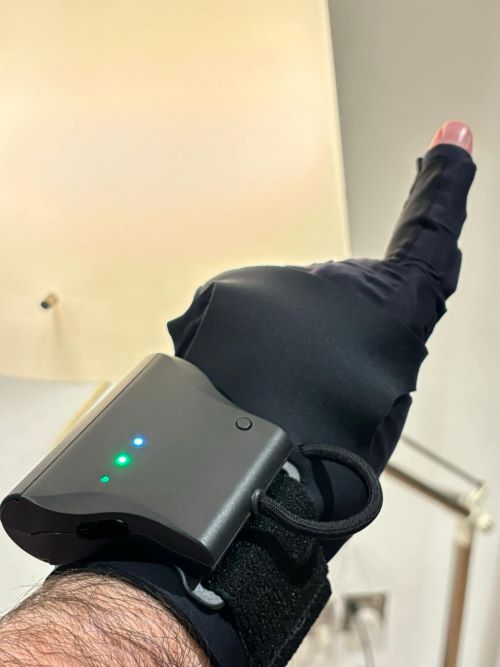
The gloves use a range of sensors to translate gestures into sounds, meaning simple movements can lead to complex musical compositions.
They use finger, hand and arm movements to create sounds and effects, allowing users to create music.
Chroma has been using the gloves in Neurologic Music Therapy (NMT) sessions to support sensorimotor rehab, encouraging post-stroke survivors to create music through movement.
The successful pilot could see the gloves integrated into more of Chroma’s music therapy work.
The client wears the gloves that connect to an online portal and every movement is recorded in note form.
Chroma therapists programme the software to play an Arpeggio – a chord played melodically rather than harmonically, at the same time.
The arpeggio will only play once the client successfully moved.
Tomaselli added: “From what we have seen, these gloves make music therapy more effective, motivating the client and creating a more enjoyable experience for them as they can see the effects immediately.
“There is something special about auditory feedback rather than visual – these gloves really allow the user to focus on just the music rather than paying too much attention to other aspects of rehabilitation.
“Clients feel a great sense of achievement that encourages them, and hope, that the function of their upper limb could, over time, improve. That motivation alone, I think, is enough to spur them on in other aspects of their rehabilitation journey.”