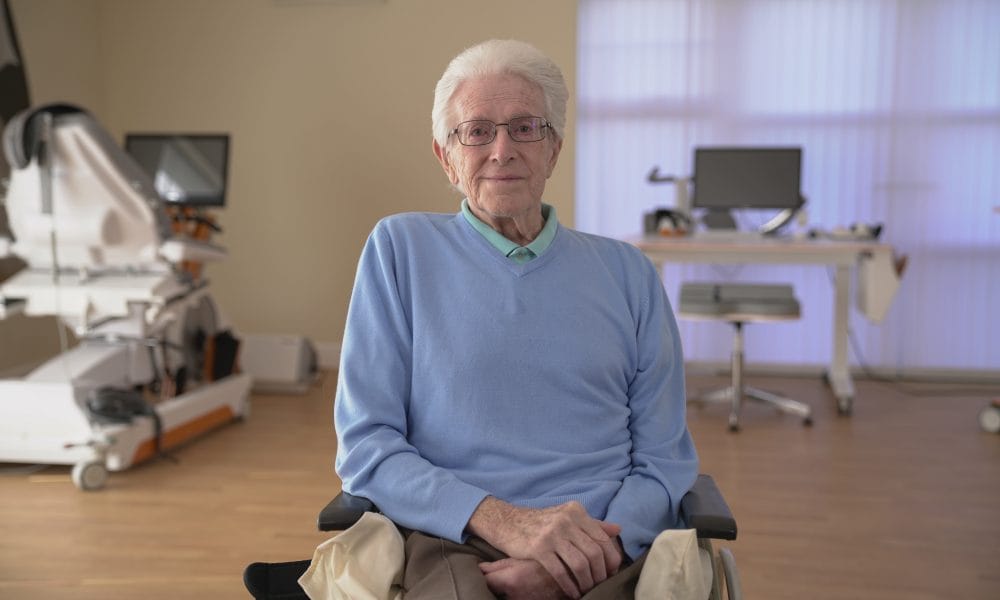
After 88-year-old Philip Haines had a stroke and lost mobility in his left side, his bespoke rehabilitation enabled him to regain his independence. Here, to mark Stroke Awareness Month, he shares his story of recovery
“I’ll be forever grateful.”
For 88-year-old Philip Haines, who lost mobility in his left side following a stroke, his thanks to those who helped him regain it are limitless.
Philip, former secretary to the Anglican Diocese of Peterborough, admits being “hit for six” after his stroke, which was caused by a blood clot in his brain.
His cerebral infarct left him with dense left hemiplegia, meaning he was unable to move his left arm and leg. While the blood clot was successfully removed, the stroke left Philip with cognitive challenges and difficulty in swallowing.
Philip was admitted to Askham Rehab from Peterborough City Hospital in November, where he was assessed by the multidisciplinary team and set clear goals, before being put on a specialist four-month programme specific to his needs.
And now, to mark Stroke Awareness Month, Philip is sharing his gratitude for the team at the specialist neurorehab community near Doddington, as well as to help show the life-changing effects such rehab can offer.
“The stroke knocked me for six and changed my life dramatically, but every day I was met with a group of very enthusiastic physiotherapists who were trying to bring some life back into my left side,” says Philip, who returned home last month.
“This whole journey has been a completely new experience, it’s almost like a rebirth. You always try to be positive, but it’s inevitable that you go through periods of feeling low.
“The team’s enthusiasm helped pick me up during those low points. We got on fine, they were very helpful, and it was a real group effort in trying to bring life back into my muscles.”
When asked if he had any final words for the team that looked after him throughout his rehabilitation, Philip says simply: “Keep up the good work. I’ll be forever grateful.”
During his time at Askham Rehab, Philip was able to make use of the family-run community’s robotics and sensor assisted technology, with it being one of a small number of providers in the UK to offer a specialist robotic-led rehabilitation service.
He used the MYRO table, a sensor-based surface with interactive applications, to aid upper limb movement and focus on balance, coordination, and cognitive training.
With strokes being a specialist area at Askham Rehab, Philip also performed mirror therapy, hands-on therapy and functional tasks as part of his tailored programme, which soon led to a significant improvement in his mobility.
“Philip had access to all four of our disciplines; clinical psychology, physiotherapy, occupational therapy, and speech and language therapy,” says Sara Neaves, clinical lead and outpatients service manager at Askham Rehab.
“It was clear from day one that Philip knew exactly what he wanted to achieve. This enabled us to set patient-centred goals with him, ensuring he was part of the process throughout his journey with us.
“Philip was fully independent before his stroke and enjoyed walking into Peterborough city centre every day for his lunch, so he was determined to get back on his feet.
“He swiftly improved the mobility of his left upper limb through the use of our robotics and mirror therapy, and was soon able to transfer using a Molift with the assistance of two.
“He also improved his swallowing through oral motor techniques and no longer needed thickening in his fluids.
“It has been extremely rewarding to see Philip come this far. He had a positive outlook on his rehabilitation journey with us from the offset.
“His sister has also been an excellent support to him and due to our patient-centred care, his individualised programme has worked to his goals.
“We’re delighted he’s now able to get back out and head into town again for his lunch outings with friends.”
Aliyyah-Begum Nasser, director at Askham, adds: “Philip’s journey at Askham encompasses what Stroke Awareness Month is all about; highlighting the strategies to improve the quality of life for persons recovering from the condition.
“Our family-run community, which has more than 30 years’ experience, including 10 years of neurological rehabilitation expertise, prides itself on having comprehensive and specialist programmes in place to ensure those undergoing rehabilitation with us receive structured, high-quality care with a holistic approach.”
For more information on Askham Rehab, visit https://askhamrehab.com/.