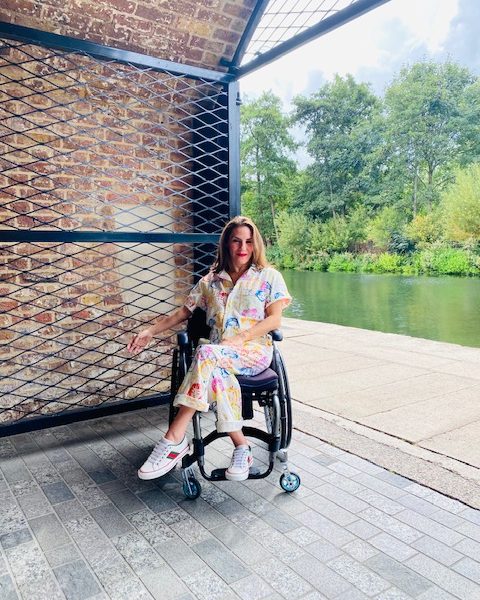
After a rare spinal cord stroke which left her paralysed, Sophie Shane now relies on a wheelchair to retain her fiercely-guarded independence. But in a society which still has much to do to be disability friendly, Sophie continues to experience many challenges along the way
Here, Sophie shares some insights with her trademark searing honesty, as well as her hopes for greater awareness around disability and to remove the taboos around being in a wheelchair
Five years ago, I had a spinal cord stroke. It’s a very rare form of stroke where a blood clot essentially passes through your spine, and has left me paralysed and in a wheelchair.
This is my reality and this is my life.
Without doubt, it is the most traumatic thing to happen to me – but I won’t let it define me. I am me, the Sophie I have always been, but now I use a wheelchair.
In adapting to my new life, I have found that paralysis is not something we as a society are used to talking about.
Being around people in a wheelchair is unfamiliar for so many people, and they just aren’t quite sure how to approach you.
I’ve had to adapt to a lot of change in the last five years and learning how to navigate the world in a wheelchair has been challenging.
I don’t think I realised how frequently I’d be asked clumsily about what happened to me. In a black cab, the cabbie will say ‘Do you mind me asking, love, what happened to you?’ and I find myself repeating my story, opening up the scar and reliving the horror over again.
It’s tempting to say ‘Only if you tell me about the worst day of your life first?!’
So now, I’ll often tell new people as soon as I meet them, then we’ve got it out of the way and we can get on with the conversation and they can hopefully start to see me and not my wheelchair.
It’s my way of feeling a bit more in control of the situation. Then the question isn’t lingering and they aren’t wondering what happened and if it’s OK to ask me or not.
It’s been a huge learning curve from the moment I became paralysed.
You think you know about disability but you have no real understanding until it happened to you or someone you love. You have to learn a whole new vocabulary, how to advocate for yourself and how to ask for help.
Often people think they’re helping by pushing your wheelchair. I’ll ask someone if they can open the door for me, and I’ll look around and they’re suddenly pushing me through it. I’ll put my hand on theirs and say, ‘Thank you so much, but I push my own chair’.
It’s so personal to touch someone’s wheelchair, it’s a part of you. But you can’t expect someone who’s never experienced being in a wheelchair to know that.
Those interactions can feel so awkward and difficult to navigate.
On one hand you’re asking for help and on the other there’s the boundary where I can do it myself. There’s so many grey areas that my friends and family know the rule, I’ll ask for help if I need it, it’s so important for me to still be as independent as possible.
I’ve definitely had to become much more patient and remember my sense of humour.
When I was on holiday about a year after my stroke, the lady on the next sun lounger realised I was paralysed and said ‘I’m a spiritual healer, please can I pray over you’.
Twenty minutes later, she was still silently touching my legs, and I’m thinking ‘Please God, listen to her prayers so I can get out of here!’
I quickly learn how to create boundaries and how to politely say no.
I’ve learnt to be very organised and to plan ahead. So if I’m going to a restaurant, or a building I’ve never been to before, I’ll email ahead to let them know that I’m in a wheelchair and we can work out any access arrangements in advance or ask them to remove a chair from the table to make way for my wheelchair.
I find by letting them know beforehand, it allows them to be more prepared. I find things always run a lot smoother and it makes me feel a lot less anxious too.
You have to find your way of advocating for yourself, to be confident and not self conscious.
Last year I got some crocheted wheels covers for my chair. I’d seen lots of girls with them on Instagram, there’s this incredible woman in the Netherlands who knits them all herself.
They instantly become a great ice-breaker and talking point, it was such a positive way for people to engage with me and so refreshing to chat with strangers about something other than my disability.
I try to encourage people to ask questions, because disability is an unknown for so many people.
When you have a spinal cord injury you don’t wake up the next day with all the correct language, I’m still learning as I go. I try to remember that most people are coming from a good place and want to do the right thing.
I hope by sharing my experience as openly and honestly as I can, I can help others like me, but also show how to relate to disabled people.
Attitudes towards disability are slowly changing and it gives me hope for the future.
As society becomes more exposed to people living with disabilities, and people become more open about what it’s like, seeing someone going about their daily life in a wheelchair will become less of a novelty.
Of course it’s frustrating when you don’t feel ‘seen’ if someone won’t speak directly to you.
Even the word ‘disability’ is so dismissive, when I’ve overcome so much, and still feel so able.
All I hope is for some kindness and empathy while I navigate this world that’s not yet fully adapted for me.
My life changed forever on that day five years ago. This is now my new life, and I’m living it.
- Sophie is a Stoke Mandeville Spinal Research Ambassador. For more information, visit here