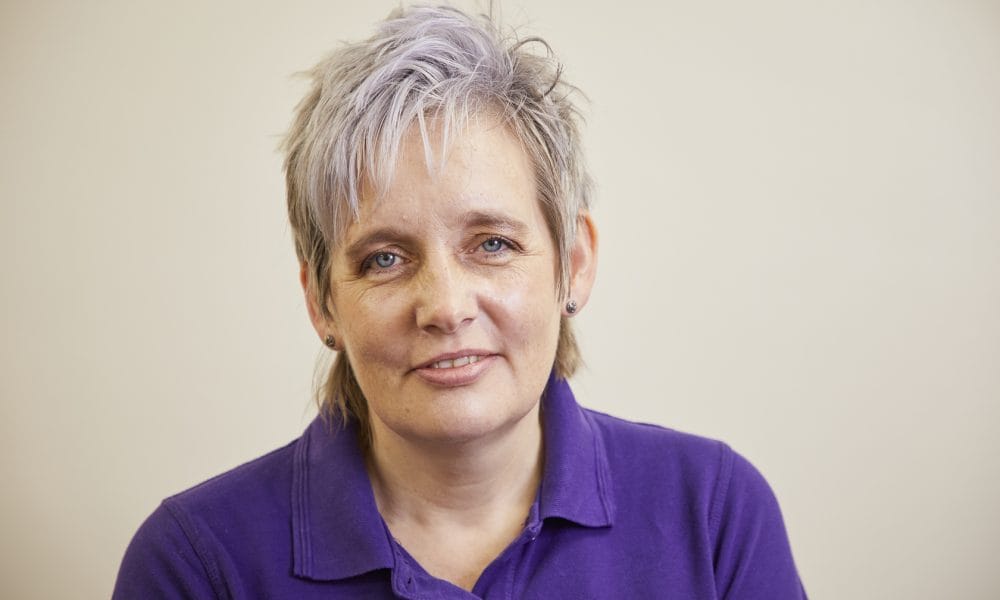
Sarah Hayes, a lead occupational therapist within the neuropsychiatry service at St Andrew’s Healthcare, works across brain injury, dementia and Huntington’s disease. Here, she shares her experience of working with older people living with dementia and the privilege she feels in being able to support them
What are the challenges and complexities of working with older people?
There’s a wonderful poem out there called the ‘Crabbit Old Woman’ which is written by an older lady who is in hospital, and it enables us as health professionals to remember what is important about an individual; the fact that she has this whole life before we met her, that she was once a child, she has a family, she had a husband and she’s had grandchildren, and there she is at the end of her days requiring full care for her complete self.
And I think the challenge that we have is to remember this person beneath the physical and mental health and the cognitive impairment, to get to know who this person is underneath. It’s the sense of ‘personhood’ that is often referred to by Kitwood and his person-centred care model for dementia patients, and recognising that we need to get into the individual’s world.
The difficulty we have is when you have the cognitive and the communication impairment, getting in and understanding that person’s world is the challenge. The complexities start with understanding the individual, but as we get older we know that our bodies become less robust from a physical perspective, and there are lots of barriers that our bodies give us to stop us from doing what it is that we want to do.
So as an occupational therapist, we are the ones that prescribe equipment for everyday living, ensuring, for example, that the beds that our patients have are correct and can suit their needs. If they need a wheelchair, that the wheelchair supports their posture; if their posture is correct they will be more able to sit and enjoy a meal. They will then be more able to sit and interact with the world around them.

The specialist Lowther dementia hub at St Andrew’s
The other element relates to understanding the sensory world in which our patients are living. So some people, as we know, like to be stimulated by what’s going on around them, but some require a quieter environment.
It’s up to us to be able to understand that; whereas younger people can grow and adapt, those who are older are less able to adapt. So we need to understand the core of that particular individual’s sensory information and how they process it, and then provide the environment that most suits their ability.
What do you routinely face among this client group and how do you need to support them?
I think the best way for me to describe it is to take a morning routine as an example. For most of us, we are able to get ourselves up out of bed, into the shower and have our breakfast without any particular thought.
Many of us probably also have children and pets to look after which also forms part of the routine and what we consider to be very simple occupations, but for a person with dementia that morning routine can be complete chaos for them right from the word go.
The ability to be able to get up, to be able to make that transfer from lying to sitting and then from sitting to standing to get out of bed is something that requires a lot of planning, as well as the physical ability to be able to do that.
One of the key interventions we do as occupational therapists is at first we take a little bit of a step back, because we want to understand what that base of the individual’s performance is. We don’t want to go and fix whatever is being done independently and we want to be able to promote the autonomy that they have already got.
We need to make a decision; what is the most important thing for this individual? Where do they maybe want to focus their energy? We will work with the individual, and family commitment is very important here.
As an occupational therapist how do you overcome the complexities presented by working with older people with dementia?
We always try to build strong relationships with families, which is important. As an occupational therapist I would use activity and occupation as a means to enable us to get to know the person.
One of the key elements that is so powerful for us to use is community leave; being able to take somebody even to our own café here and to sit down and to pass the time of day, by doing something like that we often find that conversation flows a lot more than if you are on the ward with them.
By going out into the world, they can feel they have a voice, they can experience what it’s like to be an individual, to be a citizen within our community once again. As occupational therapists we will ensure we make that a success by carefully organising and planning all aspects of that trip.
I think at St Andrew’s what’s key to the way that we care for older adults is the ability that we have to work together in multidisciplinary teams. Each team member has their own unique set of skills to support the care of that particular individual.
So for example, we know that physiotherapy can play a really key part in maintaining function by doing stretches, promoting mobility, reducing the falls risk. If we are able to promote physical wellbeing, then we are more able to then work with the cognitive deficits that somebody has.
The whole team works together to play their individual role, and once we have grown that understanding of an individual through our occupational analysis, we would then spend a lot of time working with our nursing staff to say; ‘This is this is the right way to work with this particular individual’. If we can do it that way, then we know that their wellbeing is going to be enhanced.
What is the most rewarding part of your role?
You could have somebody who, for example, may be unable to maintain their sitting posture, that means that they slump down and slowly, bit by bit, their ability to interact with the world around them is greatly disabled. When you have swallowing difficulties as well you need to have that strong and upright posture to be able to eat safely and with enjoyment.
There is nothing more satisfying than using our knowledge as occupational therapists to plan what the individual needs to be able to interact with the world; to be measured up and to be fitted for a wheelchair that completely supports their posture, whether it be through their lower body, whether it be through their upper body and their arms. You get them sitting in that wheelchair, you get them sitting at a table, and their faces and their whole demeanour change because they can sit at a table and they can enjoy a meal or they can enjoy watching television.
I think that’s where the greatest joy comes, in how we can use equipment to be able to promote how somebody interacts with the world around them.
How is working with older adults as an OT different to working with other patient groups?
There is a uniqueness about working with older adults. As we grow, as we as we get older, our bodies don’t work as well as they used to, our minds sometimes don’t work as well as they used to, so occupational therapy in many ways relates to looking at a person’s ability to learn how to adapt.
So what we need to do, particularly when we’re working with those with degenerative conditions such as dementia, is to look at promoting or sustaining their level of ability for as long as possible, and we do that by compensating; we look at how we can compensate for the way that the body and the mind are maybe going in a different direction, and that is why prescribing equipment for everyday living is so important.
We look at the environment around them and see how we can change that, rather than by looking to change the individual.
What makes St Andrew’s a great place to work?
We are so privileged to work with our patients, who come from all over the country, they come from all different backgrounds.
The vast majority of the patients we work with have had some really, really tough lives. They’ve had some really very, very difficult things happen to them, and there’s me as an occupational therapist being given the privilege to be able to work with them.
To be able to understand what is most important to them and to be able to make it happen for them is really special. So that’s why St Andrew’s is very special to me.
And in addition to your working life, can you tell us something else about yourself that your colleagues may not know?
Many a year ago, I was challenged by my cousin to do the Great North Run.
I do not run. I never have and never did. And I have not done since. But because it was a challenge and I went through the whole process, somehow or another, I was able to run 13 and a half miles to complete the Great North Run.
And that is it for me. Never again. But we did it. We were raising money for a children’s charity for wheelchairs, and I’m very proud we could support that.
To meet more of the St Andrew’s team visit www.stah.org/older-adult