A husband-and-wife research team have discovered the means to make a thousand ‘mini brains’ at a time, inspiring hope of new discoveries about dementia.
While juggling home schooling and remote working during the COVID-19 pandemic, Professor Lars Ittner and Associate Professor Yazi Ke – Director and Deputy Director of the Macquarie University Dementia Research Centre – found that stem cell technology had progressed to a point where they could potentially use it to create miniature brains.
The ‘brains’ are pink clusters of neurons about a centimetre wide, and the team is already using them in a range of studies ranging from investigating neurodegenerative disorders like Alzheimer’s, as well as motor neurone disease (MND) and looking at the effects of COVID-19 on the brain.
“Until now, the technology to produce such mini brains was not reliable – one was not the same as the next,” Prof Ittner said.
“Seeing those neurons firing for the first time when we perfected the process, it was a combination of disbelief and a little bit of awe.
“I always wanted this technology to work to enable new Alzheimer’s research, but it was Yazi who had the vision behind it.
“We had been scanning the latest advances in systems and technologies for some time now, and last year it became clear that the advance we’d been waiting for had been made.
“We were able to build on that, taking skin biopsies, culturing the cells, reprogramming them to become stem cells, then driving them to become neurons.

“Now we can take a single sample and produce thousands or hundreds of thousands of cells that are all exactly the same.
“We create a hundred or a thousand mini brains at a time, then scoop out as many as we need for analysis.”
Associate Prof Ke – who has a background in molecular neurobiology, which combines with her husband’s clinical expertise – said it took just three months from the time they started work until they had their first dish of mini brains.
“It could be a downside for some people, but we never stop talking about work,” she said.
“During lockdown, we had unlimited time to bounce ideas off each other, from breakfast to when we were brushing our teeth at night.
“Seeing those neurons firing for the first time when we perfected the process, it was a combination of disbelief and a little bit of awe that we had managed it so quickly, because nothing is quick in dementia research.”
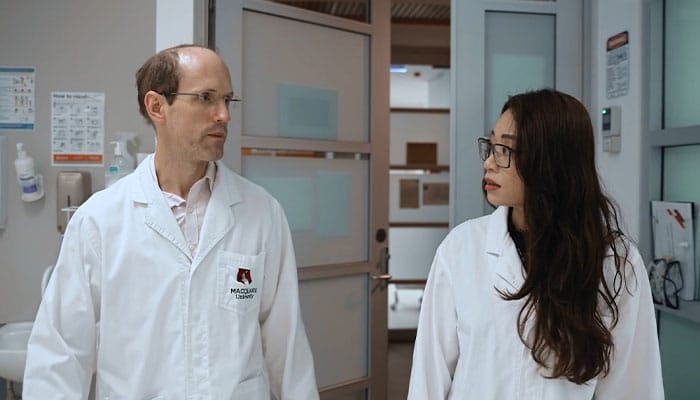 The lab now has incubators full of the cell clusters reflecting different donors, cell types, diseases, and underlying genetics, and with CRISPR gene technology, the scientists can introduce a single mutation at a time to test the effect.
They have already put their advances to use. One of the early experiments they carried out in collaboration with researchers from the Queensland Brain Institute using the mini brains was looking at how they reacted to SARS-CoV-2, the virus that causes COVID-19.
“The COVID findings are quite frightening,” Associate Prof Ke said.
“The neurons were fusing to each other. The virus is obviously affecting them and their interactions, but we don’t yet understand the full impact of COVID in neurology, or what effects it could have in the long term.”
One of the reasons the couple were so keen to find a way to advance stem-cell technology was to reduce the reliance of their research on animals.
Mice have long been used in dementia studies, a practice that comes with problems of its own: as well as the ethical concerns associated with animal research, a treatment that works for mice does not necessarily produce the same results in human subjects.
“Having access to complex human neuronal networks brings us a step closer the patient,” Prof Ittner said.
“The mice might answer a certain area, but with stem cells, we can do anything.
“Also, we’ve been working with mice for the past 15 years, and we’re known internationally for that, but I’m always looking for the next new, exciting thing.
“As soon as I saw the possibilities emerging here, my brain went wild. We’re in this new, uncharted territory, and all these ideas were popping into my head, ways to solve problems we’ve failed to address before.
“We hope this will enable new discoveries in dementia and other neurodegenerative diseases, like how they occur and how they can be treated.”
Reflecting on their breakthrough, Associate Prof Ke added:“We just would like to be able to make a difference.
“We would like to see that, together, we can achieve something in our lifetime.”