Justin Yerbury’s life irrevocably changed six years ago when he was diagnosed with motor neurone disease. He tells NR Times how he started researching the complex disease unfolding right before his eyes.
Australian Museum’s Eureka Prizes are the country’s most comprehensive national science awards.
This year’s 14 prizes – awarded across four categories including research, innovation, leadership, science engagement and school science – have recognised the work of the motor neurone disease (MND) researcher, Professor Justin Yerbury of the University of Wollongong.
Considering his remarkable contribution to broadening the understanding of MND worldwide, Yerbury’s award comes as no surprise.
He did not know anything about MND until his uncle was diagnosed with the disease. A few years later, in 2016, he was given the same diagnosis.
“At the time my uncle was diagnosed we had no idea what MND was, and we had no clue of what was to come,” he says.
“In the next few years we would lose cousins, aunts, my grandmother and my mother. I wanted to know why we didn’t know about this before, how did I manage to grow up with this lurking in background hidden.
“Digging back through the family tree I found out that it had always been there and this discovery had my mind wanting to know more.”
It was this unrivalled curiosity that propelled Yerbury to start his career researching MND – a rapidly progressing, neurological condition that causes the degeneration of the motor system and results in weakness and wasting of the muscles.
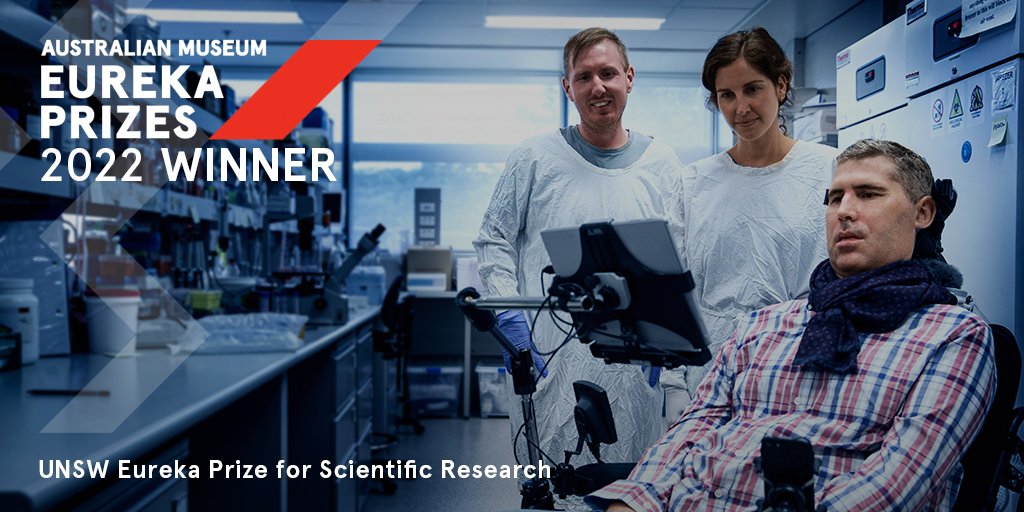
Professor Justin Yerbury awarded the UNSW Eureka Prize for Scientific Research
“I started reading journal articles about the latest MND research and I wanted to know why there was no drugs that could slow down the disease,” the scientist explains.
“But not having studied biology before, I struggled to understand. It was like reading another language. So, I found myself learning the basics of molecular biology to help with my reading and I decided to enrol in some biology classes at the local university to advance my knowledge.
“I found that I picked it up quickly, so I kept going and I started to think that I might even be able to do my own laboratory research.
“Many things in my life have taught me the courage and resilience that I needed to cope with my MND diagnosis,” he continues.
“But despite its hugely devastating consequences, it gave me the drive and motivation to continue researching. If anything now, it made me feel even more determined to contribute what I can to find a cure.”
The University of New South Wales (UNSW) Eureka prize for scientific research is a recognition of the hard work and sacrifice he and his team have made in their quest to improve the lives of Australians living with MND, says Yerbury.
“It is a reflection of the amazing efforts of those that make it all possible, including my wife Rachel, my family, my research team and all those that have donated to our research.
“Research is the key to better outcomes for people living with MND and increase their quality of life. In particular, the diversity of the research is vital to broadening this collective effort and thus increasing the chance of finding an efficacious therapy.”
While funding research is vital, more investment is needed.
In the UK, a petition handed in to Downing Street by motor neurone disease campaigners called for £50m of funding to increase targeted research for MND and address “insufficient investment for a disease of this nature”.
“MND-based research funding is difficult to procure from the normal federal sources,” says Professor Yerbury.
“Without fundraising we would have to go without certain experiments and tools, which in turn lowers the impact and breadth of our research.
“In the Yerbury laboratory we utilise methodologies from many areas of science to best examine MND and possible cures. A loss of funding would limit our scope and, in short, our research would grind to a halt.
“Fundraising, on the other hand, would allow us to further test drugs discovered in our lab in pre-clinical models of MND. Every dollar raised is always spent on developing desperately needed therapeutics for MND.”
But Yerbury remains optimistic. His laboratory’s work has broadened the understanding of MND across the globe and has made him even more determined to discover meaningful treatments.
“MND research is picking up speed and our work is a part of that global network,” he says.
“Together with international collaborators, we are beginning to understand what goes wrong at the molecular level in MND. We have identified drugs that work in our laboratory in preclinical testing, and we hope in the future they will prove useful in some forms of MND.”