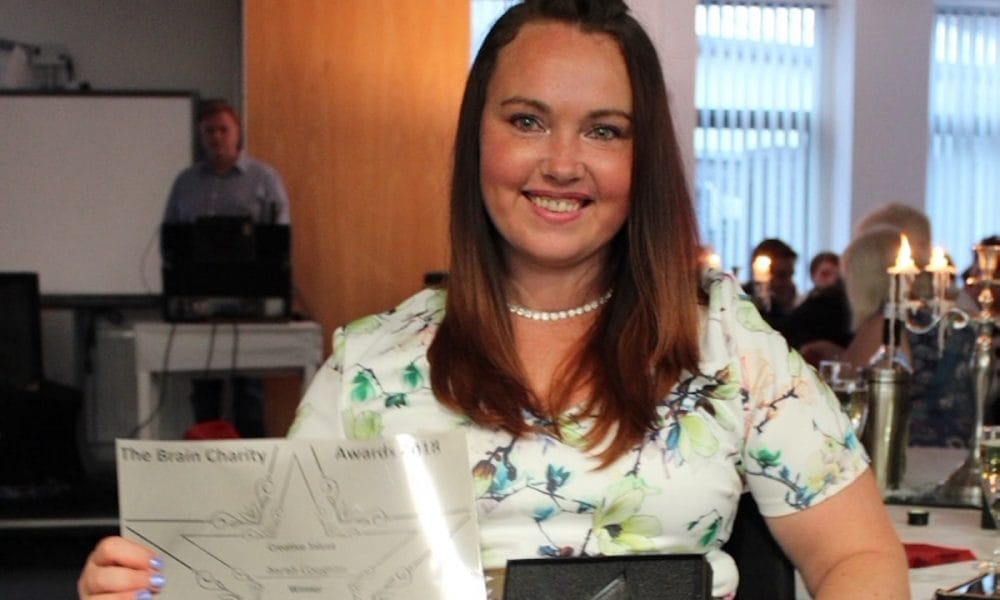
Sarah Coughlin experienced the horror of her head facing backwards after sustaining a brain injury. Here she shares her recovery journey with NR Times.
“I was wondering why my windscreen had black lines across it – until I realised I was looking out of my back window.”
Sarah Coughlin recalls the horrific moment she realised her head had turned 180 degrees to face backwards, due to brain trauma she had suffered after sustaining a head injury.
In the immediate aftermath of the injury, Sarah recalls little seemed wrong aside from a persistent headache.
But five days later, when she woke up late and rushed out to her car, the extent of what had happened became all too clear.
“I could feel this searing pain through my shoulders and my back,” says Sarah, as she realised her head had turned around to look out of her rear windscreen.

“It was quite difficult to turn my head back around and keep there but after a while I managed it, though the pain did not go away.
“I thought I had just slept funny and once I had properly woken up the sore neck would probably calm down. But when I got to work I still felt awful.”
This began the long process of diagnosis, which took years to achieve.
“I went to A&E every week for three months because the pain wouldn’t go away and I was still getting neck spasms,” she remembers.
“I was told it could have been a slipped disc, a muscle injury or having slept awkwardly. It changed each time.
“I was in agony constantly, but I still wasn’t diagnosed for at least another two years.”
At first only Sarah’s neck and walking were affected, but over the course of a year she developed spasms, optical neuralgia, pressure on the occipital nerve which runs through the neck up into the scalp, causing tremors, fits, paralysis and fatigue.
Eventually, she was diagnosed with dystonia – a condition which causes involuntary muscle spasms and was the cause of her head rotating.
Doctors also told her she had a Functional Neurological Disorder (FND), a variety of medically unexplained neurological symptoms which appear to be caused by problems in the nervous system.
After her injury in 2014 and its consequences, Sarah could no longer drive, do her job as a teaching assistant – a role she loved – or take part in the same social activities as before.
She also lost touch with many of her friends and hardly left the house as she was scared of people staring at her and judging her for the way she walked and moved.
The 37-year-old, from Fazakerley, Liverpool, says: “I used to be quite fiercely independent – so to go from doing so much to not being able to do anything was the hardest transition.
“I felt a real sense of loss for the life I had when I was first diagnosed.”
 In 2017, Sarah discovered The Brain Charity, a national charity based in Liverpool which provides practical help, counselling and social activities for people with all forms of neurological condition.
She made new friends by joining the charity’s craft club and received help getting carers allowance for her partner John and with finding a new home as she could not use stairs safely anymore.
One night in Autumn 2019, John woke up to find she had turned blue and stopped breathing as a spasm had caused Sarah’s neck to contort, closing her throat and airways.
The only solution was a specialist bed which cost £10,000, which was achieved through fundraising and grant funding. She managed to raise the money last year, and now has a bed which uses deep massage cyclo-therapy to improve circulation and reduce her symptoms.
Sarah is now a passionate supporter of The Brain Injury Charity for the assistance it has given, and is keen to encourage people to donate. The charity’s resources are currently under unprecedented pressure as a result of the COVID-19 pandemic, with a 70 per cent increase in referrals met with a huge decrease in fundraising.
“There’s lots of things I can’t do anymore but The Brain Charity has freed me from staring at four walls,” says Sarah.
“They helped me achieve goals that without them I wouldn’t have been able to do.
“It seems obvious, but the more money people donate, the more people the charity can give the vital support I found so important.
“I want other people to have that place that is safe and secure, in an environment with people who have had similar experiences.
“The Brain Charity has given me such incredible support and I’m so grateful for it.”