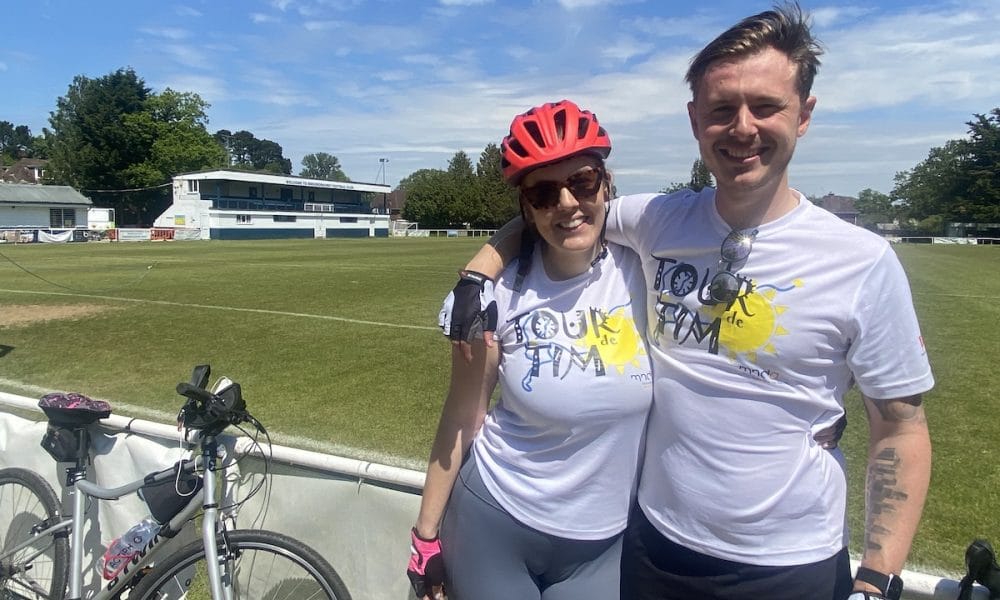
A radio presenter has raised over £5,000 for the MND Association and paid tribute to her late father by cycling over 100 miles to visit all of his former football clubs.
Fern Balch, who works for both the BBC and talkSPORT, took on the mammoth cycle last month to mark ten years since her dad, Tim, lost his battle with motor neurone disease (MND).
The ‘Tour de Tim’ featured twelve different teams across Dorset and Hampshire which he either managed or played for, all of which he had an impact on.
Despite being fit and busy all his life Tim was diagnosed with MND in March 2010, with its fast progression taking its toll on both him and his family.
 Speaking to NR Times, Fern spoke about the impact the disease had.
“It was really strange when he actually started to get symptoms of MND,” she said. “He began to get unsteadiness on his feet, dizziness, he kept losing balance and then struggled to hold a pen and write.
“After his diagnosis he was just getting progressively worse every day, he couldn’t drive or walk anymore and he had to be put in a wheelchair.
“Eventually he couldn’t breathe by himself and he couldn’t eat by himself or go to the toilet.
“He was six foot two and very fit, so to see someone so strong degenerate every day was very difficult.”
Tim was then under constant care, with his wife quitting her job to help run his business and share the responsibilities with a 15-year-old Fern.
Their home was effectively changed into a hospital with hoists, chair lifts and toilet commodes all installed which completely changed the family’s lives.
Despite this Fern still has some amazing memories of her father and spoke about what a vibrant person he was.
“What’s been so lovely about the fundraiser is that I’ve heard so many stories about my dad which I wouldn’t have known,” she said. “Every single story just points to this character that he was.
“He was bubbly and he would light up a room. He was always asked if he was a celebrity of some kind because he carried himself in a certain way.
“He could talk for hours and hours and oozed confidence. He was just my best friend and we were really close, so to lose him at such a young age was really hard.”
Tim was immensely popular in the local footballing community and this is partly the reason why the fundraiser has been such a success.
When he first received his diagnosis 11 years ago knowledge and treatments around MND were a world away from where they are now.
The condition was a relatively unknown one then with Tim’s doctor at the time being baffled by his symptoms, initially diagnosing him with repetitive strain injury from his goalkeeping days.
He was the first case of MND his doctor had ever come across, but Fern says a lot of this has now changed thanks to the work of organisations like the MND Association.
This is one of the reasons why Fern undertook the challenge, to allow people to understand more about the condition.
“People have got in contact with me during the cycle saying they didn’t know MND was a problem and they didn’t understand how bad it could get.”
 “Something that stands out to me is that when my dad was poorly, but he could still get out and about, we went shopping once and he stumbled onto his knees.
“After that someone walked by and said ‘oh I bet he’s drunk’ and we all heard it. He wasn’t at all, he was disabled.
“I hope that by people knowing the symptoms and what it can cause there might be a little bit more understanding if they see someone not being able to drink their drink properly at a coffee shop or lift their arm.
“Hopefully they might be a bit more compassionate and open to the fact that these people are poorly.”
The cycle was tough for Fern but she knew it was all worth it, with the event part of a number of efforts she has given to the organisation since her father’s passing.
“I really wanted to do something to honour the help that they gave to him. I know what they can provide and it’s gotten better year on year in the decade that my dad’s not been here.
“They’ve come up with the Voice Banking project in Dorset which has enabled people with motor neurone disease to record their own voice so that when they lose the ability to talk, they can still communicate with their family members.
“I’ve worked quite closely with them on the project over the last couple of years and it’s something I hold really dear to my heart.
“I want to see it improve and be rolled out across the whole country because everyone with MND deserves the right to talk and be able to communicate with their family members
“Anything I could do to contribute to research and contribute to another family like mine who have come through something so devastating.”
To find out more and donate, click here.