
Data is leading Parkinson’s care into a new era of personalised care and accelerating the race towards better treatments.
Devices like smartphones and smartwatches are capturing an ever-expanding array of health data with increasing accuracy. Thanks to a growing body of validation studies being published by Apple, its devices – especially the Apple Watch – are being utilised by health tech companies to support neurologists in treating their patients.
Precision neurology company, Rune Labs, is one such company, using data to help patients, clinicians and researchers gain a deeper understanding of clinical outcomes.
There are two sides to its technology, a platform that enables clinicians and patients to make better shared care decisions, and a clinical operation that is helping Parkinson’s diesease trials run more efficiently.
Boosting clinical outcomes
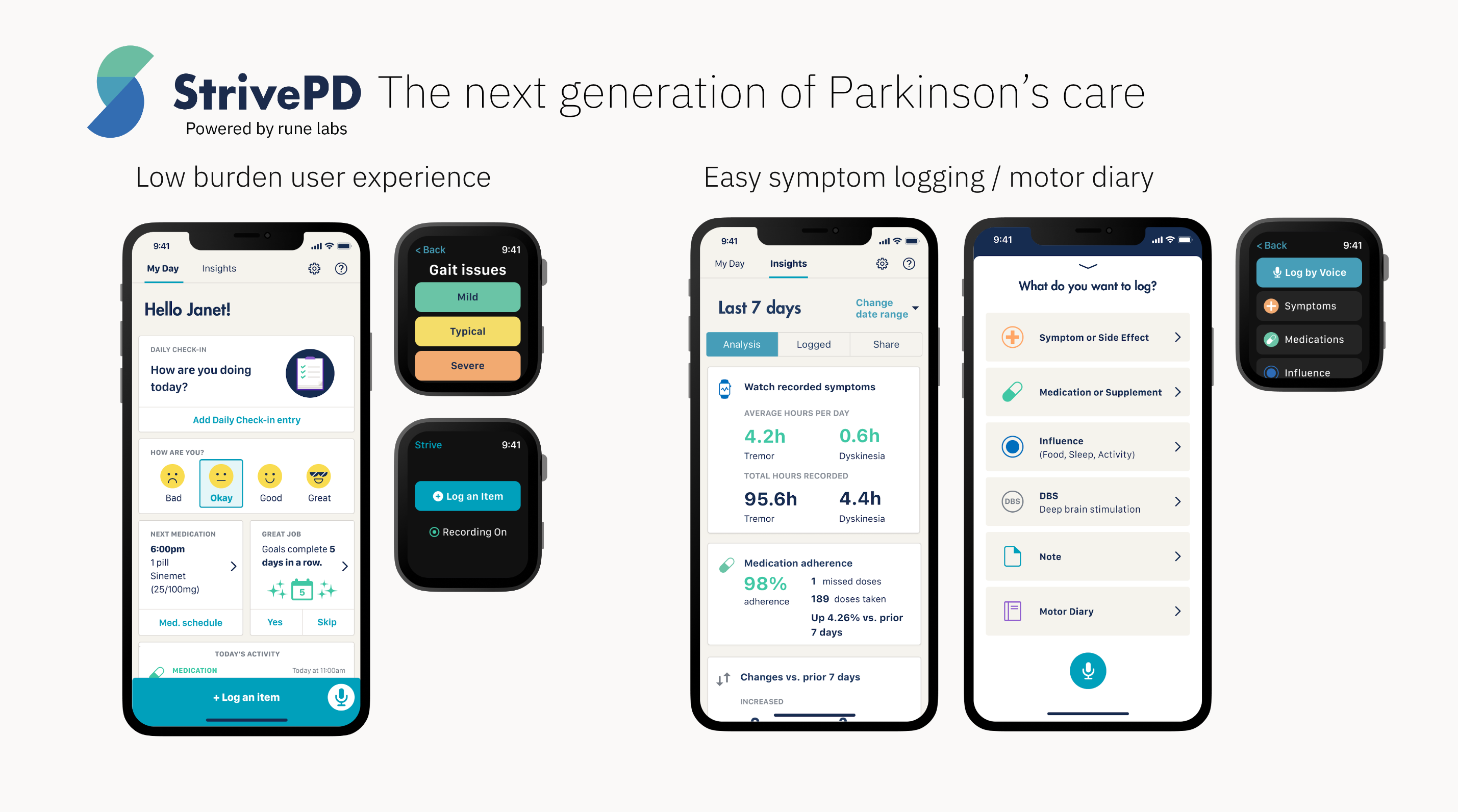
The company’s flagship app StrivePD is designed to aid both patients and clinicians, monitoring important health data and measuring outcomes to inform neurologists about which medications and therapies are working for their patients.
Patients access the app through an Apple Watch, which collects tremor and dyskinesia scores along with a wide range of information about mobility and sleep. The data is packaged into a dashboard for clinicians to see their patient’s symptoms quantified.
Lead neuroscientist at Rune Labs, Ro’ee Gilron told NR Times: “When clinicians are trying to decide which treatment options they should give the patient or how to make a decision about a care decision like changing medication, the medication schedule or the medication strength, they have a lot of data backing to do this.”
“We have an app that patients can use with an Apple Watch that measures patients’ tremor and dyskinesia and the app was really created initially by a Parkinson’s patient who was frustrated with not being able to track around symptoms – how do you manage you know, a condition that is so variable day to day where there’s all these medications you have to take and really understand what’s going on with you better.

For patients, one of the most challenging aspects of Parkinson’s disease is managing a complex course of medication that can involve taking medicines upwards of eight times a day, sometimes in the middle of the night.
“For a lot of patients, what they’re doing right now is they’re doing this with an alarm clock,” Gilron said “We make this a lot easier and more Parkinson’s-focused. We also pair this information about medication with what the outcomes are to help a patient get a much better understanding of the varying effects of living with Parkinson’s.”
StrivePD has been cleared by the FDA for its tremor and dyskinesia metrics.
It is now being used in over 100 clinics across the US and several academic centres in Europe in experimental settings.
By the end of this year, the company is aiming to have onboarded over 5000 patients in total.
Using data to accelerate Parkinson’s research
In the clinical research space, Rune Labs’ StriveStudy platform is using data in conjunction with StrivePD to drive better efficiency in trials, improve screening processes and reduce the time needed to run data so researchers can focus their attention on the patient.
Rune Labs is not alone in developing a technology that uses data to support clinical trials, however, it claims to be bringing something different to the table by providing data from longer timescales than other platforms.
There are companies that are helping support research trials by measuring Parkinsonian symptoms,” Gilron said.
“I think the big difference is that these companies have developed a device that gets sent to a patient for a limited period of time. This is usually two weeks for the remote patient monitoring experience and that’s it.”
Using a whole year’s worth of data, the Strive platform offers higher resolution and greater accuracy when it comes to measuring the effectiveness of a drug. The additional context means more therapies can be tested, potentially accelerating the route to market.
“If you’re running a big trial, we can provide you a much more rich data set for the patients that are using this platform,” Gilron said. “You already know the trajectory of the patient compared to how most trials are run where you just start you start measuring going forward.
“We think being able to look at this over long periods of time is the key thing because what we’re trying to help usher in, in the long and medium term, are therapies that will help alter the progression of the disease.”
StriveStudy was launched in March, with the cell therapy developer BlueRock Therapeutics being the first to deploy the platform in a clinical trial.
It will capture multimodal data from people with Parkinson’s to gain a better understanding of individual disease experiences and build a dataset to characterise baseline symptom activity.
“Up until now, clinical trials have relied on patients with Parkinson’s disease to self-report their symptoms. Now, thanks to new technologies like Rune Labs’ platform, we have new tools to measure and assess disease progression,” said Seth Ettenberg, president and CEO of BlueRock Therapeutics.
Taking cues from cancer research
Rune Labs was formed against the backdrop of a technological shift in how health data is captured and used.
While it did not invent this technology, the company has been gaining significant traction in recent years. Gilron believes this is thanks to the groundwork laid down by the world of cancer research.
Over the last decade, the cancer space has undergone a revolution that has led to a shift towards a more personalised approach to care and research.
Before this, many clinical trials were deemed a failure as only a small subset of patients responded to the given therapy.
However, scientists realised that if they sought to understand why this proportion of patients responded, they could build a more personalised approach to treatment.
“There’s a lot of companies that have grown up in that ecosystem,” Gilron said.
“Taking all that data, aggregating it, making it useful to pharma companies and clinicians and then allowing clinicians to make personalised medicine decisions on each. We’re trying to do the same thing in the space of precision neurology.”
“You need that data first to be able to make those kinds of claims, understand those relationships and then deliver therapies in that manner.”
A patient-focused approach
While there are various other platforms on the market with similar aims to Rune Labs, Gilron says it differs from other players in the field thanks to its patient-centric approach.
StrivePD was initially developed by a patient before the company took over the development of the application.
The patient has remained a key member of the Rune Labs advisory team and this patient-focused approach has continued to be at the core of the firm’s approach.
The company has a team that is dedicated to supporting, onboarding and teaching patients how to use the platform. The company believes this patient-focused approach makes for a richer, more relevant insight into the needs of patients and what therapies are working for them.
“This means that the insights that these patients can give to clinicians are much more relevant to the things that are really impacting them,” Gilron said.
“What are the big challenges that they have in their care? What are the issues that they’re trying to help you to solve? And then hopefully, how they get access to the most innovative care
“A lot of companies in this space have patient advisory boards, but I think the question is, how involved are patients really in bringing the voice of what they’re experiencing to the product and what you’re developing.”
Enhancing deep brain stimulation with data
Deep brain stimulation is one of the most common surgical interventions for Parkinson’s disease, primarily helping improve symptoms related to movement and dyskinesia.
The therapy involves a pulse generator sending high-frequency stimulation to targeted areas of the brain through thin wires inserted into the brain.
As the technology develops, devices on the market are capturing an increasingly deep and unique array of electrophysiological data. Medtronic is one of the biggest players in the market, having developed a device with a unique capability.
Not only does the device stimulate the brain, it also senses activity from these regions.
Rune Labs is currently working with the company to connect this data from the brain to clinical outcomes so that neurologists can make better clinical decisions.
“Looking forward, the hope is that once you pair all the sensor information from the brain and all the outcome data together, that’s really what will bring things together.”
“There’s an explosion in work right now. Specifically looking at the impact of physiology on sensing and the design and delivery of therapies, not only for Parkinson’s but a long list of neurological disorders and psychiatric disorders.
“The number of different conditions being studied and the experiments that are happening right now was just astounding.”