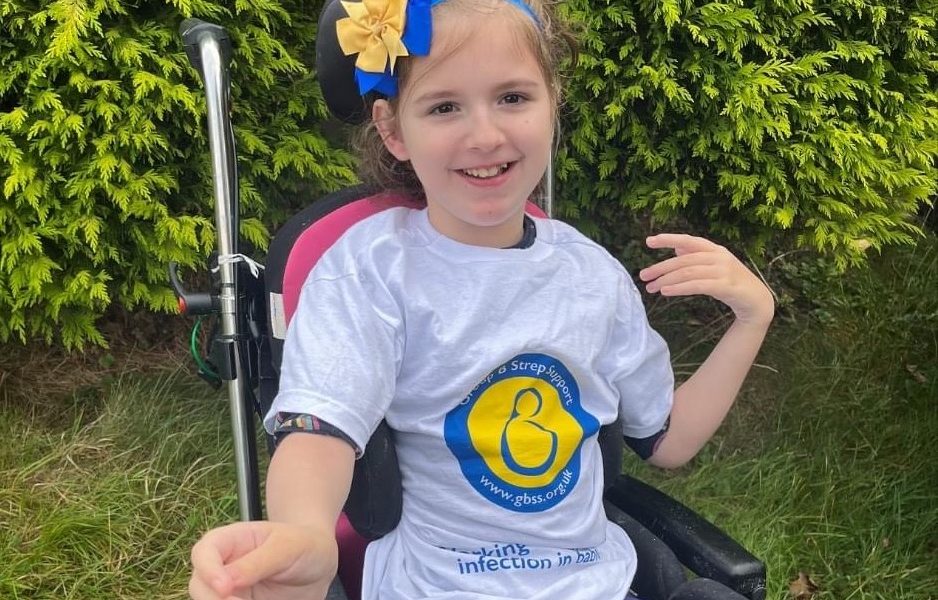
Through Group B Strep, unwittingly passed from Charlotte to her daughter Aimee, the youngster faced a battle for survival and lives with profound disabilities. Here, Charlotte describes the horror of almost losing her baby, the challenges they face together, and the urgent need for routine testing of all expectant mothers for Group B Strep.
“It’s absolutely heartbreaking what can happen just because a simple swab test isn’t taken.”
Charlotte’s words reflect the truly dreadful reality of the situation she and many other parents find themselves in due to the lack of routine testing for Group B Strep infection.
For Charlotte, her daughter Aimee was given a five per cent chance of survival at only five days old, after the presence of Group B Strep was detected.
Happily, Aimee defied the odds and is now a happy 11-year-old – although lives with a multitude of needs, which only become more distressing for devoted Charlotte by the day.
“When she was younger it didn’t affect me as much – but now, she should be getting her inde-pendence, she should be approaching her teenage years and becoming a young woman wanting to get out into the world,” says Charlotte.
“I’m very blessed to have her, and to me, Aimee is just Aimee and I wouldn’t have her any other way. But it does break your heart to think of everything she has been through.”
Group B Strep is a bacteria carried by an estimated one in four pregnant women, and the bacteria is passed from mother to baby. In the majority of cases, babies can be protected if the moth-er is given antibiotics during labour.
But Charlotte did not know she was a carrier – and with no routine testing, there was no way of finding out.
“I just find it bizarre that these tests aren’t done. I can’t understand it, I really can’t. It has to change,” she says.
Fight for survival
It was back in 2011, when Charlotte was a 22-year-old first time mother that she noticed something was wrong with newborn Aimee.
“She didn’t seem very well, something wasn’t right. I was a new mum and didn’t really know what I was looking for, but my gut instinct was telling me this wasn’t how it was meant to be,” says Charlotte.
“She wasn’t feeding properly, although we knew she had jaundice, so I thought it could be be-cause of that. I asked the midwife to take a look at her – but by the time she arrived, Aimee had gone all floppy and was foaming at the mouth.”
After being rushed to hospital and with a series of tests being done – “all I remember was being sat in a separate room and hearing her high-pitched screaming, I was frantic” – Charlotte was told that Aimee had Group B Strep meningitis.
“Everything went fuzzy. I was told she had a five per cent chance of survival and the next 24 hours were critical. Her dad had gone home to get some clothes to prepare for us staying at the hospital, but I was told that he would probably want to come back as soon as possible,” recalls Charlotte.
“There was so much to take in, I think I went into autopilot. It was like something from a soap opera, not from real life. All we could do was stay by her bedside and hope for the best.
“They sent a vicar up to bless her, but I said ‘No thank you, she’s going to fight this’. I couldn’t even think that this was going to be goodbye.”
Happily, Aimee made it through the critical 24 hours, although the difficult times continued, with Charlotte unable to hold her baby due to barrier nursing. The first time she could cradle Aimee was during her brain scan, with Charlotte’s enduring memory being the fragility of her skin and the pain her baby felt with every touch.
“I don’t know about the brain but I’d seen pictures of brain scans before. On Aimee’s scans, there were white patches, which I knew weren’t normal and not what you’d want to see,” says Charlotte.
“We were told that they didn’t know what life would look like, and that all we could do was wait and see.”
Ongoing challenges
 While doctors could not give clarity over how Aimee’s condition would manifest, as she grew older, the impact of the Group B Strep infection became increasingly clear.
“We knew pretty early on there were problems. She wasn’t weaning as she should, she wasn’t hitting the milestones you’d expect to see. We could see things were quite serious,” says Char-lotte.
Aimee went on to be diagnosed with cerebral palsy. She cannot walk or talk, cannot sit unaided, is tube fed and is incontinent.
Happily, she does attend school and has a strong personality – “she didn’t want to go to school this morning, she was very unhappy about that,” smiles Charlotte – but life is difficult in having to manage such profound needs.
“Being brutally honest, it is quite difficult. Aimee is severely disabled and she has a very basic understanding of the world – she doesn’t really understand Christmas or birthdays, but we’ll make them extra special with balloons and bubbles, just so she can see these are special days for her,” says Charlotte.
“I never imagined my life to be like this when I thought of being a parent – I’m a nurse and physio and so many other things in there too. Life becomes a blur in many ways.
“When I’m watching Children in Need, I’ll sit and cry and watch what the families are going through – but then I’ll take a step back and realise that’s our life on that screen. It doesn’t hit me until I see it happening to someone else.”
Despite the daily challenges, Charlotte is hugely proud of her daughter and the way she copes with everything that is thrown in her way.
“She has taught me so much and I wouldn’t change her for the world,” says Charlotte.
“I’m so fortunate she is here with us, no matter what difficulties we face, we face them together.
“Aimee has been through several surgeries and has ongoing medical appointments and Botox to release her muscles, but she’s happy and loved so much.
“Group B Strep Support have been absolutely amazing to us, and we try to give back where we can. We got Aimee a special bike for her birthday last year and we did a little fundraising bike ride around the local community. We raised £260 for the charity, who have been so important in our lives.”
The urgent need for testing
 Charlotte continues to live with the heartbreak that, if she had been tested for Group B Strep, the situation she and her daughter find themselves in now need never have happened.
“For something as serious as this, I just don’t understand why it isn’t done,” she says.
“Testing should be routine, absolutely. And it’s just a simple swab test – so many other tests you can face as an expectant mum are much more intrusive.
“Group B Strep is so preventable, and we need to stop it happening.”
Group B Strep Support have long called for change, with routine testing of all pregnant women to help prevent avoidable profound disabilities like Aimee’s.
“The team work so hard, but when are the people who can make this change going to do some-thing about it?” says Charlotte.
“My daughter will never lead a ‘normal’ life, and that is really heartbreaking. All for the sake of a simple test.
“It’s devastating to think of how many more families have been affected in the nearly 12 years since I had Aimee. This has got to change, and fast.”