A digital rehabilitation tool is being developed with the goal of enhancing quality of life for stroke survivors.
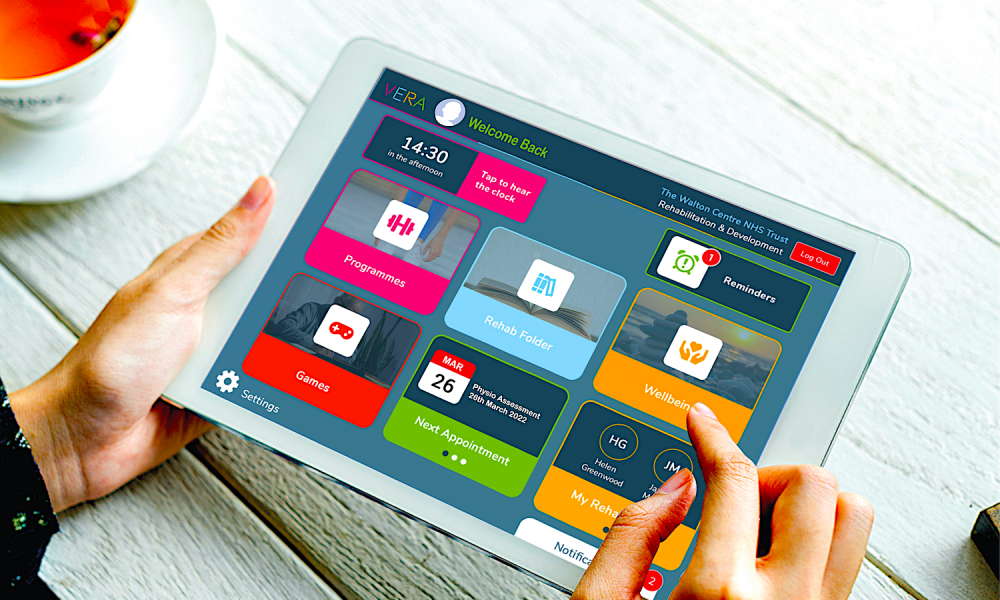
The Virtual Engagement Rehabilitation Assistant (VERA) allows mobile devices to access a range of applications to support rehabilitation and provides patient information, images and videos to guide bespoke personalised exercises, treatment information, a daily schedule and support.
Offering a bespoke programme to every user, VERA – currently subject to a pilot study – aims to significantly improve patient recovery and how survivors adapt to life after a stroke.
It is hoped the tool will empower stroke survivors by improving their understanding of rehabilitation and increasing their personal motivation and opportunity to participate in therapy.
By streamlining the process, it is hoped VERA will increase the availability of rehabilitation therapy to stroke survivors, help healthcare professionals use their time more effectively and ultimately, save the NHS money.
VERA is being developed by The Walton Centre NHS Foundation Trust and Citrus Suite software company, with research, funded by The Stroke Association and MedCity, led by the University of Central Lancashire (UCLan).

Dr Ganesh Bavikatte, consultant and clinical lead in rehabilitation medicine at The Walton Centre NHS Foundation Trust, said: “Every patient who goes through the rehabilitation journey with The Walton Centre and our partners in the Cheshire and Merseyside Rehab Network, has a different experience. It is really personal to them.
“This digital tool will help us provide a bespoke process for each patient which will support our teams to provide the very best rehabilitation and therapy programme.”
The pilot study aims to investigate VERA to identify who might benefit from, and to better understand, this digital technology.
Dr Kathryn Jarvis, senior lecturer in occupational therapy at UCLan, is the research lead on the project.
She said: “We have worked closely with stroke survivors and healthcare professionals to develop VERA and the supporting training materials.
“In the study, we will gauge how VERA could be used to increase activity and functional recovery in neurological rehabilitation.
“In addition, we will explore how VERA can be implemented, taking into account any potential barriers, and who would facilitate its use in a complex neurological in-patient setting.”
The initial idea for VERA came from a hackathon held in 2018 at The Walton Centre and was then developed in a partnership between The Walton Centre NHS Foundation Trust, UCLan and, at a later stage, Citrus Suite.
The Walton Centre Charity provided £37,000 to develop a prototype, and funding of almost £60,000 to test the research came from The Stroke Association and MedCity.
Richard Francis, head of research at the Stroke Association, said: “As a charity, we know the vitally important part research plays to ensure stroke survivors can access the latest and best rehabilitation after stroke.
“Every stroke is different and so is every recovery, so personalising therapy is key to helping stroke make the best possible recovery.
“We know that stroke survivors are still not accessing all the rehabilitation they need, which has only been made worse by the pandemic. That’s why funding these new technologies could help improve and increase access to personalised rehabilitation.”
The results of the study will be published in summer 2022.