VR could boost recovery for brain and spinal patients, research shows
VR could help brain and spinal patients practise rehabilitation earlier and more often after serious injury or surgery, research suggests.
An early-stage study looked at whether virtual reality technology could support patients recovering on busy hospital wards, where therapy time is often limited.

Researchers wanted to see whether the approach could give patients more chances to practise rehabilitation exercises while still in hospital, with the aim of also improving home rehabilitation in future.
The study was led by researchers from the NIHR Biomedical Research Centre: Leeds in partnership with Leeds Teaching Hospitals NHS Trust.
Will Bolton, NIHR clinical lecturer in neurosurgery and a neurosurgery specialist registrar at the University of Leeds and Leeds Teaching Hospitals NHS Trust, said: “It is incredibly exciting to help build a future in which digital technologies safely and effectively augment the healthcare workforce, allowing better care to reach more patients.
“Spatial computing, including virtual reality, is especially well placed to harness advances in areas such as AI, and because brain and spinal cord disorders affect systems that are inherently three-dimensional, they may be especially responsive to immersive technologies.”
People recovering from brain injury, spinal cord injury, or major brain or spine surgery often need rehabilitation as soon as possible.
Early rehabilitation can help retrain the brain and body, improving the chances of recovery and helping people regain independence.
However, delivering enough therapy in hospital and at home can be difficult because of staff pressures, limited therapy time and patients who may be tired, in pain or too unwell for longer sessions.
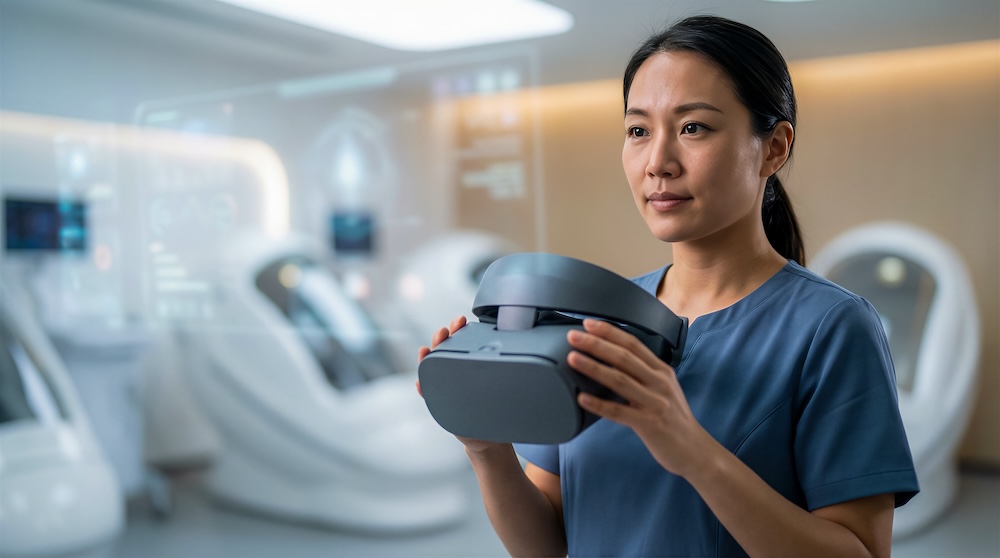
Using a VR headset, patients took part in simple guided activities in a calming 3D environment.
The activities supported movement, concentration and relaxation, and were designed to complement, not replace, therapy delivered by rehabilitation specialists.
The study involved patients aged 16 and over who were recovering from brain tumour surgery, brain injury or spinal cord injury.
Participants were offered one VR session a day for up to 14 days, or until they left hospital.
The sessions were delivered alongside usual care and supervised by the hospital rehabilitation team.
A total of 39 eligible patients receiving treatment at Leeds Teaching Hospitals NHS Trust were invited to take part.
Of these, 36 agreed to participate, and 32 used the VR intervention at least once.
Patients typically started using VR three days after injury or surgery, suggesting the technology could be introduced early during recovery.
The study found VR rehabilitation could be delivered safely on a hospital ward.
There were no seizures, wound infections or rehabilitation-related injuries within 30 days of VR use.
The equipment also worked reliably throughout the study, with no technical failures reported.
Most patients tolerated the technology well.
A small number experienced mild symptoms such as slightly blurred vision, but no severe side effects such as significant dizziness or sickness were reported.
The oldest participant was 89, suggesting the approach could also be used by some older patients.
Bolton said: “In this study, we have answered some of the key early questions about whether this technology can be used safely and practically in the acute neurosurgery hospital setting, which has significantly reduced uncertainty.
“We are now seeking further NIHR support to carry out more definitive studies and, ultimately, bring the benefits of this approach to more patients in Leeds and across the UK.”
Brain and spinal cord injuries are among the leading causes of disability worldwide.
Recovery can take months or years, and many people require long-term care.
In the UK, the wider economic impact of these conditions, including healthcare costs, lost work and social care needs, is estimated to be around £17bn each year.
The researchers said the study helps answer practical questions that can slow the use of new technologies in the NHS.
They found VR headsets could be used safely after brain surgery, cleaned and reused in hospital settings, and delivered by busy clinical teams on a ward.
The next step is a larger study across several hospitals to test whether VR-supported rehabilitation improves recovery compared with standard care alone.
Researchers will examine outcomes including how quickly people regain independence, how soon they can leave hospital, quality of life and whether the approach offers value for money.
The team said VR rehabilitation could also support recovery at home or in community settings, potentially reducing pressure on hospitals while improving access to rehabilitation.
VR hardware and software were provided in kind by SyncVR Medical as part of a clinical service evaluation.