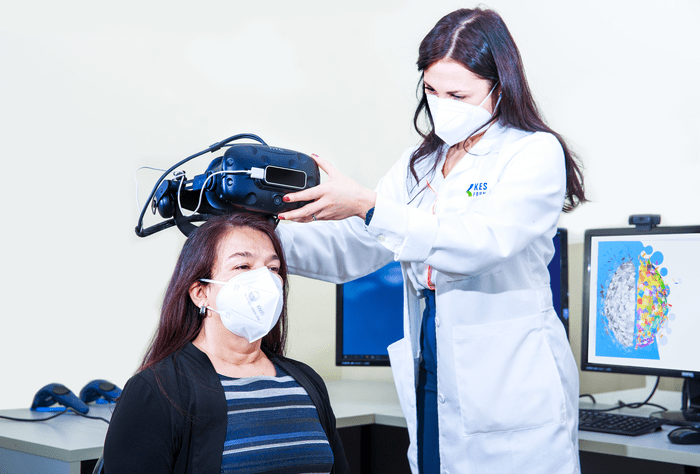
A new immersive virtual reality (VR) system is being pioneered among stroke survivors to help treat spatial neglect.
A new user-centred programme which uses a head-mounted display and hand-tracking technology is engaging survivors using intensive repetitive therapy, which is showing great promise in trials.
Spatial neglect is experienced by at least 30 per cent of stroke survivors and impairs the neural networks supporting spatial attention and related cognitive and motor functions.
People experience altered spatial orientation, which can cause problems with balance and navigation, as well as with memory, reading, and other cognitive processes.
While progress has been made in detecting post-stroke spatial neglect, treatment strategies have lagged.
To address the need for effective neurorehabilitation in this area, researchers at Kessler Foundation have developed a treatment approach based on immersive VR, which allows standardised delivery of intensive, repetitive therapy in a flexible, engaging environment.

The new system – the Kessler Foundation Spatial Re-Training Therapy (KF-SRT) – has been developed working alongside Virtualware, an award-winning VR technology company based in Spain, and builds further on the pioneering work between the two, following the development of a VR system to help with sight loss after brain injury.
“During user testing, we were able to communicate the need for revisions to Virtualware and adapt the software according to feedback from therapists and patients,” said Dr Peii Chen, senior research scientist in the Center for Stroke Rehabilitation Research.
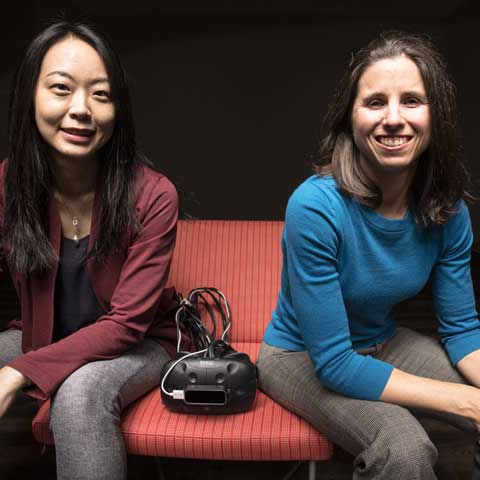
Dr Peii Chen and Dr Denise Krch
“The resultant system has a user interface that accommodates creation of a patient profile, a calibration module, a choice of four game-like treatment modules, and a spreadsheet for data collection and export, enabling therapists to review progress across sessions.”
In the virtual treatment environments, patients wear a head-mounted display and hand-tracking technology to engage in a variety of challenging motor tasks.
“The scoring algorithm rewards correct responses, with higher scores awarded for tasks completed successfully in the neglected space,” explained Dr Denise Krch, senior research scientist in the Center for Traumatic Brain Injury Research.
The team reported that therapists were unanimously satisfied with the KF-SRT user interface, and patients preferred the VR experience to conventional therapy.
“The next step is to conduct pilot studies of feasibility, limitations, and preliminary efficacy, while continuing to update the system’s software and technology,” the study’s authors concluded.
“This will position VR technology in the forefront of options for rehabilitating individuals with spatial neglect.”