World-first app delivering life-changing outcomes

A world-first app developed by a neurophysiotherapist is delivering life-changing outcomes for people with paralysis caused by stroke and traumatic brain injury, with many regaining the ability to move parts of their body using brain stimulation technology.
Benjamín Chitambira has seized on the potential of regaining balance, muscle tone and muscle strength directly through stimulating the brain through his app, enabling people with paralysed limbs and clawed hands to improve their recovery.
The app capitalises on the basic principle of a set of lines on a screen, which induce sensory conflict in the brain between the visual motor system and balance system in the ears, stimulating the brain in what Ben describes as a “physics-based, rather than biology-based, approach”.
The development of the app has been a process of more than ten years, with Ben – an NHS physiotherapist for 16 years, before leaving in 2019 to start his business, Neurorestorative and Neurorehabilitation Solutions (NRNRS) – turning to research during his previous career to better help his patients, discovering his breakthrough therapy in the process.
The app is currently in use by NRNRS, with a three-year plan in place for global expansion once it has completed a randomised controlled trial.
Preliminary peer-reviewed papers have already confirmed the app’s effectiveness within the first three months of recovery, with further papers and verification currently being prepared to show its longer-term credentials in supporting recovery even in chronic cases in the community.
“This is unprecedented and very exciting,” says Ben, who is based in Ashford, Kent.

“Using this way, I have had people who are paralysed on one side with no sitting balance, recover within eight weeks to be able to use their affected side and prevent clawing of affected paralysed hands. They can go on to stand and walk normally in the community, as if they never had paralysis.
“People who have had rigidity and clawing of their hand recover its use, which is especially pleasing when it is on their dominant side, as it helps to regain a lot of independence. Those who feel they are swinging their leg when they walk can recover the walking style they hope for.
“Word is spreading across the country, and we are expanding the app, but very slowly.
“Currently, it is in use at my practice and very recently one other. But the fact it is an app means it can be used anywhere and empowers family members to be part of the rehabilitation process daily at home, instead of just watching helplessly.
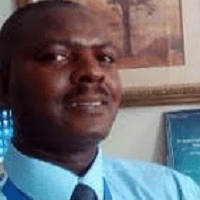
Ben Chitambira
“There is huge potential, and once we have completed the randomised controlled trials, we can look at going into other countries across the world.”
The inspiration for the app came from Ben’s career with East Kent Hospitals Trust, where he wanted to find new ways to advance his patients’ recovery.
“When I worked in the NHS, I always wanted to do research,” he says.
“In neurorehabilitation, we often put neuroscience aside so we can work on standing and walking, but I wanted to find out what we were missing. I wanted to know how else we could help people recover use of their affected side, how we could help the rigidity in their hands.
“There had to be another way, so I kept my mind open.
“In 2004, I did a course in managing dizziness and I realised how important that is in stroke and traumatic brain injury. In physio sessions, we were getting people with stroke and TBI up and telling them the dizziness would go away, but not actually doing anything about it.”
From there, Ben began to research the issue, and adopted his findings into his neurophysio sessions while still working in East Kent Hospitals Trust.
“I had enough numbers of patients to compare with similar patients treated by my colleagues to show the effect of my way of working. A lot of my colleagues strictly stuck to the traditional approach, which made comparisons of similarly impaired cases’ recovery trajectories easy to do,” he recalls.
“As I went down the research route, the impact it was having on my patients was there for all to see. Things evolve, nothing stands still and especially not science, so I knew I would have to set up on my own to make my app become what I wanted it to be.”
Since leaving to establish NRNRS in 2019, plans for the app are now fully developed with it set to become a commercial reality in the years ahead, pending controlled scientific experiments, peer review and licensing.
Ben also plans to carry out ongoing research to continually maximise its potential in other neurological conditions such as Guillain Barre Syndrome and spinal cord injuries, where he has noted unprecedented recovery in impairments rather than just in function.
“There are so many offshoots to the research which can bring in new conditions, and we can look at new outcome measures. There is so much more we can do, and a lot of work to be done, but we will continue to build on what we can currently do so we can help as many people as possible,” he says.