Community-based rehabilitation centres are powerful tools which can support you in your recovery journey.
As well as offering you access to expert advice and guidance, specialist equipment, novel and intensive training modalities, you will have the opportunity to receive client-centred sessions as part of structured rehabilitation programmes supported by neurorehabilitation experts. Together, they create the optimal environment for you to work towards goals and maximise your recovery potential.
In-centre rehabilitation sessions are a must have for any rehabilitation plan: those who can, should attend as much as possible to maximise their progress. However, for many people, barriers – such as travel and funding – stand in the way of them attending for the advised and required frequency. It is likely, therefore, that this time constitutes just a fractional part of the overall time most individuals should be committing to their rehabilitation.
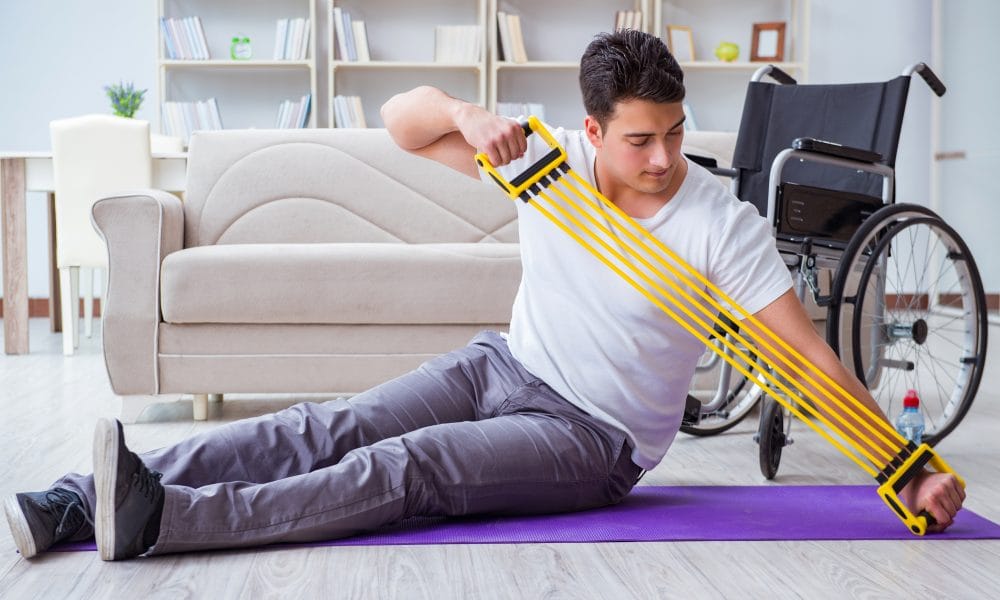
Research has consistently shown that both exercise intensity and high repetition are essential to maximising recovery following neurological injury. Therefore, individuals should look to establish a strong home exercise routine as part of their rehabilitation plan to maximise on these principles. An established routine will also maximise the benefit of your other therapy sessions, keep you focused, active and committed to your rehabilitation journey.
However, building and dedicating to a home exercise programme can be challenging. Here is some advice from our team at Neurokinex for upgrading your home exercise programme based on our experiences with clients.
“What should I be doing at home?”
Firstly, make sure that your home exercise programme contains everything it needs.
Many of you will already be following a rigid and intensive stretching programme and this should continue to formulate the core of your home exercise routine to help manage spasticity and contractures. Dedicate time to moving your body into different positions, prone is great, which can be effective in allowing muscles to be stretched for prolonged periods of time and in alleviating pressure.
Standing should comprise a proportion of your daily routine. Standing for 30 to 60 minutes a day can help with bladder and bowel function, joint range of motion and bone demineralisation, along with promoting improved quality of life.
Decreased activity also increases the risk of developing cardiovascular disease and diabetes, therefore it’s important to find a way to incorporate some regular aerobic exercise to benefit cardiometabolic health. One guideline suggests 30 minutes of moderate to vigorous exercise three times per week.
Last but not least, dedicate additional time to completing any rehabilitation exercises prescribed by your trainer.
“The requirement seems like a lot, how do I fit it all in?”
Fitting all the above into your daily routine might feel impossible alongside incorporating the additional exercises prescribed by your trainer. The best way to start is by identifying if any of your rehab exercises can be integrated into time spent doing other things.
A couple of examples of this would be completing your shoulder or hand exercises whilst in your standing frame. Or completing your upper or lower limb exercises whilst spending time prone or as part of your morning stretching routine in bed. This would help maximise your efficiency, achieve those all-important repetitions without the feeling of having to go out of your way to put aside too much extra time.
Just like your sessions with your trainer, home exercise should be effectively programmed and this can be another helpful way to save you time. As well as helping you remain engaged and feel like you are progressing.
Typically, you’ll have many areas that you wish to improve on with many associated exercises to do. It is easy to fluctuate between these if you don’t have a plan and though rarely are these goal areas mutually exclusive, it is important to work each area independent of the other.
We often prescribe clients five exercises, taking no more than 30 to 45 minutes a day, that can be progressively tracked over four to eight weeks. This helps to promote overload, adaptation and better tracking of progress towards the goal area. It also means that you set a point of review and importantly introduce variation to keep things fresh and exciting.
Some common short-term goals that we use with clients include increasing the number of repetitions, timed seated or standing balance and physical exertion tests, such as a five-minute time trial.
“I over-did it last week”
Consistency beats intensity. Often, clients feel the need to work themselves to the maximum every session. Though this approach can produce short term results, it usually leaves them exhausted and they rarely maintain consistency long enough to see significant change.
Remember we’re playing the long game here. Our advice is to choose an exercise routine that you can execute even on your worst week.
“I’m worried about doing exercises incorrectly”
An unfortunate side effect of client-centred exercise is that people can become nervous to perform exercise without the keen eye of a trainer by their side.
If this is you, start with a few exercises that you are comfortable with and have completed in your rehabilitation sessions. Follow this up by challenging yourself to try a new exercise, film it and take it to your next therapy session for your trainer to okay.
Nine times out of ten they’ll be delighted you’re trying new things!
“I can’t remember what I did”
Keep a log! The most important piece of advice that we can give you is to start keeping a diary. In it note the rehabilitation you do each day and reflect upon how it went. Don’t forget to include your achievements and any significant milestones. This will form an essential part in your rehab journey and help you to stay committed and invested.
Most importantly, take this with you to your next session and show your trainer all the great rehab that you have been up to. We want to hear that you are continuing your rehabilitation at home.