Therapists know that as people age and require more care, the risk factors for falls increase.
Muscle strength, impaired vision, sleep problems and daytime fatigue, incontinence and dizziness, as well as external factors like poor lighting or medications all influence the risk of falls.
The common consequences of falls can range from bruises to wounds and even serious fractures which can result in the significant loss of independence, need for long term assistance or even death.
Regardless of the resulting pathologies, every fall contributes to the feeling of insecurity and fear of falling. Time and time again we see how this situation conduces to movement avoidance, leading to decreased strength and balance and lower quality of life1.
A vicious cycle of fear and avoidance behaviour sets in.
The best way to prevent and counteract most of these fall risk factors is to maintain and promote mobility and do it early. The ability to stand and work on balance is the starting point to work towards ambulation and therefore of utmost importance for all acute rehabilitation2.
The importance of getting patients back on their feet as early as possible and engaging in meaningful task specific activities is well documented in research. For example, a recent study demonstrated a statistically significant benefit in functional balance for individuals post stroke who engaged in sustained standing of 30 minutes, 5 days a week3.
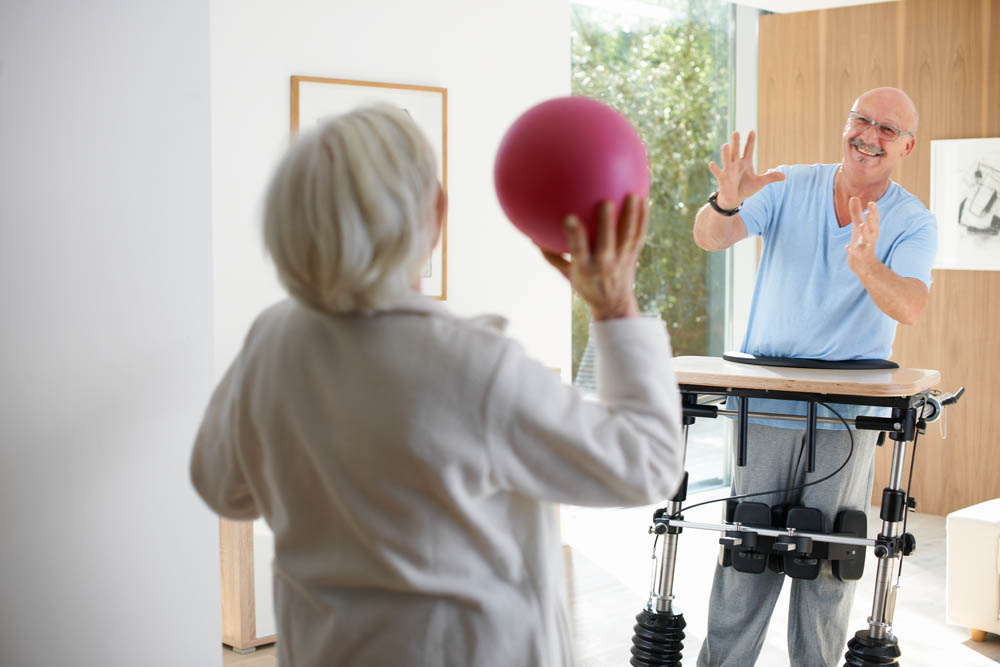
“The balo™ is unique because it is so dynamic. Other standing frames don’t have the features that the balo™ has, which makes it stand out as a device. We can stand patients that we wouldn’t normally be able to stand and get better outcomes at a quicker rate. This is a life-changing device.”
The principles of neuroplasticity must be present to maximize neuroplasticity in standing: As stated by Klein and Jones, use or lose it, repetition, time matters and intensity 4. Other benefits include stretching contracted muscles, decreasing spasticity, strengthening muscles, improving bladder and bowel function and relieving pressure areas5,6,7.
However, providing interventions that encourage these principles can be a challenge.
The THERA-Trainer fall prevention and balance program combines innovative rehabilitation technology with customised clinical exercise protocols specifically for this application.
The patented balo™ and coro™ dynamic balance systems assist therapists in performing static and dynamic standing exercises to train anticipatory and reactive balance, as well as postural control, weight-bearing, weight-shifting, object pick-up, core strengthening and for fall prevention.
Naomi Greenberg, physical therapy team leader at MossRehab, says: “We utilise the balo™ to assist patients with SCI to improve proprioception, strength and motor control of their trunk and core musculature. As a result, we are able to achieve a decreased fall risk when performing both sitting and standing tasks.”
The systems allow up to 11˚ of postural sway in all directions to effectively train patients’ postural control in a fall-safe environment. A fast setup is key for therapists, therefore balo™ and coro™ are designed for extremely quick and easy setups in typically under three minutes.
The THERA-soft® therapy and documentation software allows for a variety of movement tasks and biofeedback activities to enhance repetition, intensity and motivate patients to train. It also adds the benefits of motor planning, visual scanning and dual tasking to the therapy session. An integrated database helps therapists with patient-specific training controls and planning of interventions as well as detailed analysis and evaluation of all training results.
Thanks to the use of technology, therapists can prioritise the use and interpretation of clinical outcomes in a fast and easy to access manner.
“I recently had a patient with profound sensory and coordination deficits who was able to stand and ambulate with an assistive device but had trace ankle motor function and significant weakness in his glutes. The balo™ was the perfect tool to specifically target and activate these muscle groups, work safely to fatigue, and improve carryover to overground walking,” explains Kelsey R. Loose, physical therapist at MossRehab, about her experience with THERA-Trainer balo™.
References
- Schmid, Van Puymbroeck, Altenburger, Miller, Combs, Page (2013)
- Huber, Pott (2018)
- Das, Kumaresan (2018)
- Klein, Jones (2008)
- Baker, Cassidy, Rone-Adams (2013)
- Jacobs, Johnson, Mahoney (2003)
- Netz, Argov, Burstin, Brown, Heyman, Dunsky, Alexander (2007)